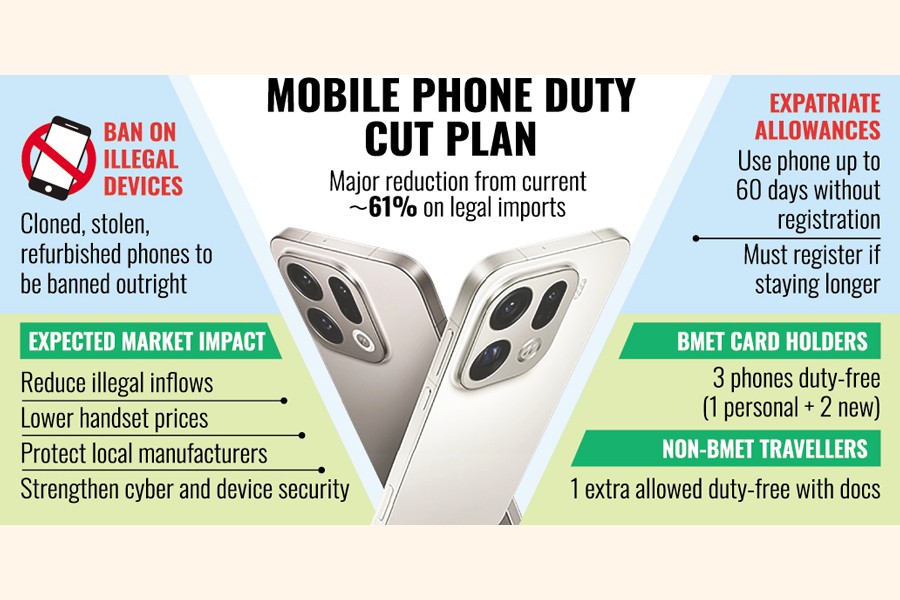
The government has initiated a major move to cut import duty on mobile handsets, aiming to lower consumer prices and curb the influx of illegal, cloned and refurbished devices.
The decision came from a high-level coordination meeting held on Monday at the office of Faiz Ahmad Taiyeb, Special Assistant in charge of the Ministry of Posts, Telecommunications and Information Technology under the Chief Adviser.
Officials from the National Board of Revenue (NBR), the Ministry of Commerce, the Posts and Telecommunications Division and the Bangladesh Telecommunication Regulatory Commission (BTRC) attended the meeting. A number of decisions were taken to ease legal imports, protect local industry and strengthen digital security.
According to the decisions, expatriate Bangladeshis will now be able to use their smartphones in the country for up to 60 days without registration. Registration will be required only if they stay longer. Migrant workers holding a BMET registration card will be allowed to bring in three mobile phones free of duty - one for personal use and two new handsets. A fourth handset will attract duty.
Those without a BMET card may bring one additional handset free of duty alongside their personal phone. Travellers must carry legitimate purchase documents to prevent misuse by international smuggling rings that often coerce migrants into carrying high-value goods.
One of the key outcomes of the meeting was the government's decision to "significantly" reduce the current duty structure on legally imported smartphones, which now stands at roughly 61 per cent. Officials said that lowering the duty would make legal imports cheaper and discourage illegal inflows.
However, the meeting acknowledged that a parallel reduction in duties and VAT on locally manufactured handsets - produced in 13 to 14 factories - would also be necessary to prevent adverse impacts on foreign investment in the domestic device manufacturing industry.
BTRC and NBR have already held multiple rounds of discussions with the Ministry of Commerce to align import and local production tax structures, and the ministries expect a positive outcome for the country's device industry.
Authorities also urged mobile subscribers to remain vigilant about potential abuse of SIM cards registered under their names, which could be misused for cybercrimes, online scams, mobile banking fraud, gambling or other illegal activities. Users were strongly advised to use only SIM cards registered in their own names.
The government also announced steps to ban the import of cloned, stolen and refurbished mobile phones. For illegally imported handsets that are already at the market, traders will be allowed-until 16 December-to submit lists of stock phones carrying legitimate IMEI numbers to BTRC for regularisation at a reduced duty rate. This facility will not apply to cloned or refurbished devices.
The authorities reassured consumers that any mobile phone activated before 16 December will not be blocked under any circumstances and urged the public not to be misled by rumours.
Bangladesh is set to introduce the National Equipment Identity Register (NEIR) on 16 December, and consumers have been advised not to purchase devices without legal IMEI numbers. The move aims to stop the dumping of used foreign phones and the widespread smuggling of devices disguised with new casings.
Customs authorities are preparing targeted operations at airports and land ports, especially on flights arriving from India, Thailand and China, to crack down on illegal consignments.
The proposed Telecommunications Ordinance (Amendment) 2025 will include strong provisions for data protection related to mobile SIM eKYC and IMEI registration. A new clause will bring violations involving registration data under punishable offences.
The government called on the public to remain alert and avoid misinformation and unnecessary panic as the new regulatory measures come into effect.
bdsmile@gmail.com
© 2026 - All Rights with The Financial Express

