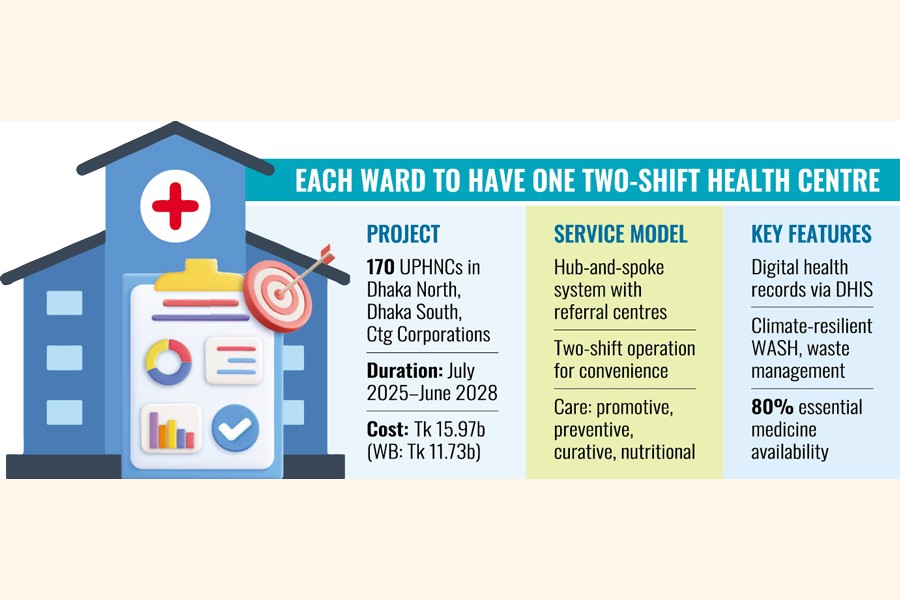
The Directorate General of Health Services (DGHS) will establish 170 Urban Primary Health and Nutrition Centres (UPHNCs) across Dhaka North, Dhaka South, and Chattogram city corporations, aiming to expand access to primary healthcare services.
The Health Services Division under the Ministry of Health and Family Welfare (MoHFW) submitted the project proposal, titled "Expanding Access to Integrated Health Care for the Urban Population," with an estimated cost of Tk 15.97 billion, including a World Bank (WB) contribution of Tk 11.73 billion.
"The proposal has just been submitted to the Planning Commission. We will review it before forwarding it to the Executive Committee of the National Economic Council (ECNEC) for final approval or returning it to the sponsoring ministry," said a senior official at the Socio-Economic Infrastructure Division of the Planning Commission.
Scheduled for implementation from July 2025 to June 2028, the three-year project aims to bridge the long-standing gap in urban primary healthcare and improve access for the growing urban population, particularly the poor and underserved, according to the proposal.
Officials said the project will adopt a hub-and-spoke model, connecting all primary care facilities with referral centres.
"Each ward in the targeted city corporations will have at least one fully functioning health and nutrition centre, provisionally named City Health Centres, operating in two shifts to ensure convenience and inclusivity," a senior health ministry official said.
Services will include promotive, preventive, curative, and nutritional care, alongside capacity development, recruitment of human resources, and provision of essential medicines, equipment, and logistics.
The project also emphasises digital integration with the District Health Information Software (DHIS) to maintain electronic health records and enable real-time data monitoring.
Climate-resilient infrastructure will be strengthened, including water, sanitation, hygiene (WASH), and medical waste management (MWM) facilities. The government targets 100 per cent WASH and MWM compliance and 80 per cent essential medicine availability at each centre.
The proposal highlights the chronic underdevelopment of urban primary healthcare in Bangladesh. Currently, only 35 government dispensaries serve nearly 14 million urban residents.
"Limited operational hours and overcrowded tertiary hospitals have forced many residents, particularly the poor, to rely on private providers, pushing households into poverty," it noted.
Government data shows that 68.5 per cent of total health spending is out-of-pocket, with 64.6 per cent spent on medicines alone, driving nearly five million people into poverty annually.
The project also addresses the dual disease burden in urban areas: persistent communicable diseases and rising non-communicable diseases (NCDs).
"In urban Bangladesh, 49 per cent of women aged 35 and above have hypertension, while maternal and child health coverage remains inadequate. Only 40 per cent of pregnant women in slums receive four or more antenatal visits, and child stunting remains high at 40 per cent," the proposal added.
Officials said the two-shift model ensures accessibility for working individuals and homemakers, reducing congestion, shortening wait times, and improving public trust in primary healthcare. The model does not ask people to adjust their lives to healthcare - it adjusts healthcare to fit people's lives, morning or evening, always, they added.
jahid.rn@gmail.com
© 2026 - All Rights with The Financial Express

