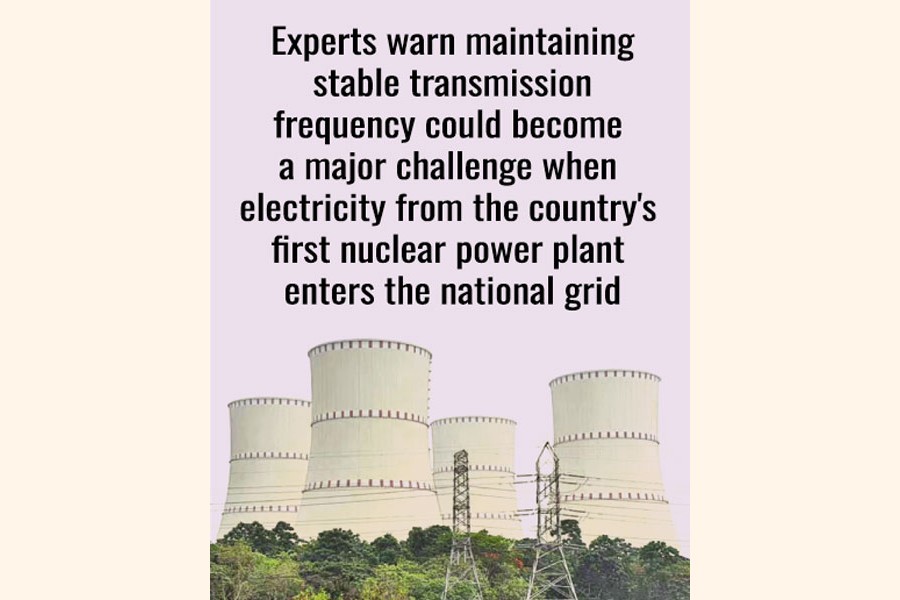
As Bangladesh prepares to connect the Rooppur Nuclear Power Plant (RNPP) to the national grid, regulators, power-sector officials and policymakers have raised concerns over the grid's ability to maintain stable transmission frequency.
They warn that inadequate preparation and coordination could increase the risk of system disruptions once nuclear-generated electricity begins flowing into the network.
"I have doubts about whether the existing transmission system will be able to absorb nuclear power from Rooppur," Chairman of the Bangladesh Atomic Energy Regulatory Authority (BAERA) Mahmudul Hasan told The Financial Express on Wednesday.
"I have already asked all concerned agencies, including the Power Grid Company of Bangladesh (PGCB), to take the necessary steps to ensure the smooth synchronisation of nuclear power with the existing grid, which currently carries electricity generated from gas, coal, solar and hydropower sources," he said.
If transmission frequency falls below the standard level of 49 hertz (Hz), it could become difficult to maintain grid stability, he noted.
A frequency above 50 Hz is manageable, he said, adding that a lower transmission frequency could lead to tripping of the national grid.
PGCB Chairman Abdur Rashid Khan echoed similar concerns about frequency fluctuations following the commencement of power generation at the Rooppur plant.
"It is a major challenge to maintain stable frequency in a transmission system that carries electricity generated from multiple sources," he said.
Frequent fluctuations in electricity demand could further complicate the situation, he cautioned.
A sharp fall in power demand caused by storms or other unforeseen incidents may lead to lower transmission frequency, increasing the risk of grid disruptions, he added.
However, he stressed that maintaining frequency stability is not solely the responsibility of the transmission company. Power generation companies and distribution utilities also have important roles to play.
According to him, close coordination between the Rooppur Nuclear Power Plant authority and power distribution companies could help mitigate the risks associated with unstable transmission frequency.
"We completed the necessary transmission line on 2 June 2025 and have since been ready to transmit electricity from Rooppur," he said.
Mr Khan, however, claimed that PGCB itself does not directly control transmission frequency.
"Currently, we are transmitting electricity at frequencies ranging between 49.5 Hz and 50.5 Hz," he said.
Meanwhile, the Power Division under the Ministry of Power, Energy and Mineral Resources (MPEMR) has decided to scrutinise the existing transmission system before commissioning the country's first nuclear power plant in order to avoid potential disruptions.
Power, Energy and Mineral Resources Minister Iqbal Hasan Mahmood has already directed relevant officials to undertake the review.
"Since nuclear power involves advanced technology, we must be properly prepared before production begins," he told The Financial Express.
"Nuclear power is very important for us. But as it is a highly advanced and complex technological system, comprehensive preparation and caution are essential. Public safety must be given the highest priority. That is our goal," the minister said.
Although the tariff for electricity generated by the Rooppur plant has yet to be determined and the overall cost structure remains undisclosed, authorities have already started test operations after completing fuel loading on 13 May.
The authorities aim to generate around 300 megawatts (MW) of electricity from Unit-1 of the RNPP by August.
The plant has a design lifespan of 60 years, which can be extended by a further 30 years through proper maintenance.
Financially, Rooppur remains Bangladesh's largest single infrastructure project.
The first unit is expected to enter commercial operation in January 2027, while the plant's full generation capacity of 2,400 MW from two units is expected to be achieved after the second unit becomes operational.
The project cost stands at US$12.65 billion, with Russia providing 90 per cent of the financing through a state loan.
Construction of Unit-1 began on 30 November 2017, while work on Unit-2 started on 14 July 2018. Unit-1 was originally scheduled to begin operations in December 2022 and Unit-2 in October 2023.
However, the Covid-19 pandemic and payment complications arising from the Russia-Ukraine war delayed the commissioning of the project.
Azizjst@yahoo.com
© 2026 - All Rights with The Financial Express

