The government and policymakers are placing strong emphasis on research, development and innovation while preparing the budget for the country's education sector, which is expected to surpass last year's allocation.
The primary allocation for primary, secondary and higher education has been set at Tk 920 billion, according to the Ministry of Planning, up from Tk 821 billion in the current fiscal year.
Overall, the education sector budget stood at Tk 950 billion in the outgoing fiscal year, covering primary, secondary and higher education, madrasa and technical education, the Bureau of Statistics, the Ministry of Religious Affairs and other related institutions.
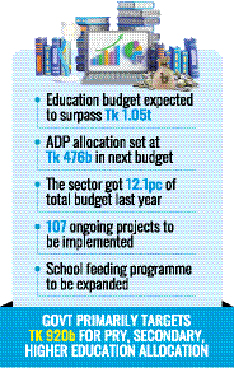
The total budget for the sector is expected to exceed Tk 1.05 trillion in the upcoming FY27 proposed budget, which is likely to be unveiled within two and a half weeks, officials from the planning and finance ministries said.
With a view to strengthening state-led research and development, the government has allocated Tk 476 billion for the development budget (ADP) of the sector, according to officials.
Of this, Tk 207 billion will be spent on 107 projects, while the rest will be allocated as block grants.
Among the allocations, Tk 192 billion under the ADP has been earmarked for primary and mass education, while higher secondary and higher education will receive Tk 210 billion.
Among ministries and divisions, the Ministry of Primary and Mass Education has received one of the highest allocations.
The ministry has been allotted Tk 32 billion for five projects under the project allocation category. It will also receive a block allocation of Tk 162.63 billion, reflecting the government's strong focus on strengthening primary education infrastructure and services.
The Secondary and Higher Education Division has secured the largest number of projects in the education sector, with 65 projects approved involving allocations of Tk 112 billion.
The division also received Tk 96.52 billion in block allocation, reflecting continued investment in schools, colleges and higher educational institutions.
Meanwhile, the Technical and Madrasa Education Division will receive Tk 52.54 billion for 21 projects, along with Tk 8.86 billion in block allocation.
These allocations reflect the government's priority to improve human resource development through the expansion of quality education, technical skills and vocational training, alongside strengthening mainstream and madrasa education systems, said Bobby Hajjaj, state minister for Primary and Mass Education.
He said the most important foundation of a child's cognitive development is laid at the primary education level. Considering this, short-, medium- and long-term reform activities have been initiated based on expert recommendations.
He said targets have been set to modernise classrooms, provide teachers with electronic devices, and expand the school feeding programme for children, which will be extended to over 150 upazilas to help reduce dropout rates.
He added that students will be given opportunities to enhance their skills through the use of computers and artificial intelligence.
Hajjaj also said allocation for research and development (R&D) is going to get top priority from this year.
Educationist and political analyst Dr Maruf Mallick said rising allocation for R&D in Bangladesh could play a crucial role in reducing brain drain and generating quality employment opportunities.
He said many talented students, researchers and skilled professionals have left the country due to limited research facilities, inadequate funding, weak laboratory infrastructure and a lack of career opportunities.
According to government data, Bangladesh's total expenditure on R&D is only Tk 900-950 million.
He added that nearly half of this allocation goes to agriculture, while industry and ICT sectors receive little to no dedicated research funding. Applied R&D accounts for around Tk 400-450 million.
Dr Mallick said increased investment in R&D could help reverse the ongoing brain drain by creating a stronger ecosystem for innovation, scientific research and technology development within the country.
He added that higher R&D spending in schools, colleges, universities and research institutions would enable the establishment of modern laboratories, innovation hubs and technology centres.
This, in turn, would encourage talented graduates to pursue research and higher studies in Bangladesh instead of moving abroad.
He also suggested that competitive research grants, scholarships and industry-linked projects could help attract expatriate Bangladeshi researchers to return home.
In the long run, he said, a stronger R&D ecosystem would help develop a more vibrant private sector capable of generating new employment opportunities through innovation, research and technological advancement.
tonmoy.wardad@gmail.com
© 2026 - All Rights with The Financial Express

