The government has planned to review controversial capacity charge and power- purchase agreements on power plants under a major sectoral reform to minimize electricity-generation costs.
Shutting down or modernising inefficient power plants, strict action against corruption and ensuring and transparency and accountability are among the other measures the government has planned, Finance Minister Amir Khosru Mahmud Chowdhury said while placing national budget Thursday for the upcoming fiscal year.
 The new government has adopted short- medium-and long-term reform plans for power generation, transmission and distribution.
Work is also underway to modernise transmission and distribution networks and reduce system loss -- a perennial problem in the sector.
A long-term goal set in the budget is to raise generation capacity to 35,000 megawatts 2030, with at least 20 per cent of total demand met from renewable energy.
Transmission lines will be expanded to 25,000 circuit kilometres (km).
Some 1,200mw is expected to be added to the national grid from the first unit of the 2,400-megawatt Rooppur Nuclear Power Plant by January 2027.
Within just 10 days after the current government assumed office through the February polls, held against the backdrop of domestic political upheavals a, a new crisis erupted in the Middle East, posing a sudden and major risk to Bangladesh's economy, says the finance minister in his budget speech.
As a direct result, international prices of fuel oils, LNG, and fertilizers more than doubled.
"This sharply raised production costs in electricity, agriculture, transport, and industry, fueling inflation and putting heavy pressure on government subsidies," he told the House.
The surge in import costs has also hurt foreign-currency reserves.
Since the Middle East is the largest destination for Bangladeshi migrant workers, prolonged instability there could disrupt future employment opportunities and remittance flows, he alerts.
The finance minister strongly criticizes the policies and management of the previous government, blaming corruption, mismanagement and reckless energy policies for skyrocketing power-generation costs.
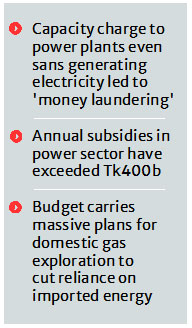
He points to massive waste through "capacity charge" payments made to power plants even without generating electricity and alleges money laundering in the process.
He says controversial terms in certain megaprojects have burdened the country with excessive costs for power imports and purchases, which citizens are still paying for.
As a result, annual subsidies in the power sector have now exceeded Tk 400 billion.
Although installed generation capacity has reached 28,919mw (including imports and on-grid renewables), flawed policies have prevented uninterrupted, quality electricity supply to the public.
In the budget proposal, the finance minister emphasizes the need to move away from excessive reliance on imported energy.
The new economic pointsman says past mismanagement and import dependency left the sector fragile, with little progress in domestic gas exploration or refining capacity.
Despite global price hikes in diesel and liquefied natural gas (LNG) due to the Mideast crisis, the government continues to provide large subsidies to protect citizens.
Gas supply has been kept stable without price increases.
To ensure long-term energy security, the government is prioritizing domestic gas exploration and production.
Over the next three years, state-run Bangladesh Petroleum Exploration and Production Company Ltd (BAPEX) will conduct 270-km geological surveys, 700 line-km of 2D seismic surveys, and 700 sq km of 3D seismic surveys.
Plans include drilling 69 new wells and working over 31 ones, alongside purchasing new rigs. Offshore exploration has been launched through a revised production-sharing contract (PSC).
Azizjst@yahoo.com
© 2026 - All Rights with The Financial Express

