Institutional fragmentation, weak financing, and rising climate pressures continue to limit broader water-security outcomes in Bangladesh, according to the Asian Water Development Outlook (AWDO) 2025.
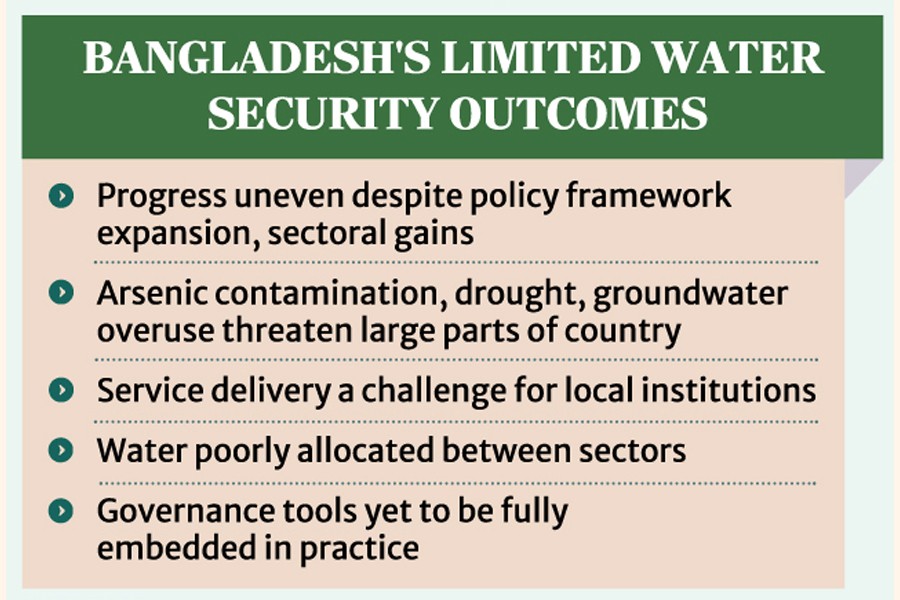
The Asian Development Bank (ADB) released the outlook on Monday, showing that while policy frameworks have expanded and some sectoral gains have been achieved, progress remains uneven.
It says rural household water security remains a concern.
National programmes have improved service access and sanitation, but arsenic contamination, drought, and groundwater overuse still threaten large parts of the country.
Local institutions face challenges in service delivery, and the coordination between agencies remains limited while rural water governance lacks the capacity to fully address these overlapping risks.
Economic water security has benefited from new planning frameworks and institutional investments, particularly in agriculture. However, water remains poorly allocated between sectors.
The absence of permits, pricing mechanisms, and cross-sectoral water accounting limits both productivity and sustainability, according to the outlook.
Institutional reforms have begun, but governance tools are not yet fully embedded in practice, it says.
Based on the findings, the AWDO says urban areas continue to experience fragmented water and sanitation services.
While infrastructure has expanded in some cities, informal and peri-urban settlements are often left behind.
High non-revenue water, poor wastewater management, and exposure to floods and salinity are persistent challenges in Bangladesh.
Urban planning has yet to fully integrate water resilience or equitable service delivery.
Environmental water security remains weak, while pollution, declining flows, and wetland degradation are ongoing problems, the outlook says.
It mentions that institutional mechanisms exist to support ecosystem protection, but they lack funding, real-time data, and enforcement power.
Ecosystem needs are not well-integrated into the basin planning processes.
Across all areas, weak coordination, limited local capacity, and fragmented financing hinder progress.
Strengthening cross-sectoral planning, protecting ecosystems, investing in inclusive services, and integrating climate risks into national frameworks are essential steps toward climate-resilient water governance, adds the outlook.
jubairfe1980@gmail.com
© 2026 - All Rights with The Financial Express

