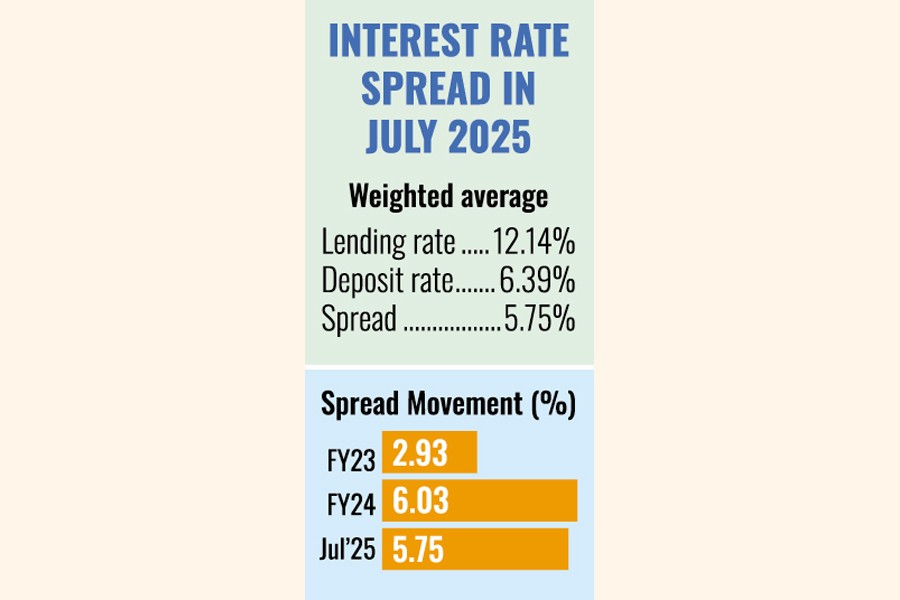
The interest-rate spread between banks' weighted average lending and deposit rates narrowed to a 25-month low of 5.75 per cent in July, raising concerns over profitability in the country's financial sector.
The decline, driven by higher deposit costs and sluggish lending growth, reflects mounting stress in the banking industry, according to Bangladesh Bank data. The spread narrowed by 7.0 basis points compared with the previous month.
The spread is widely used as an indicator of the business efficiency of financial institutions, and the regulator often takes corrective measures based on its movements.
Bankers attributed the July decline to a build-up of stressed assets across the industry, noting that funding costs remained elevated while lending growth lagged during the period under review.
Until the end of fiscal year 2023, banks operated under a capped formula that fixed the maximum lending rate at 9.0 per cent and the maximum deposit rate at 6.0 per cent, resulting in a spread of 3.0 per cent.
Sector-wise data revealed sharper declines in July: the spread for SMEs narrowed by 5.0 basis points to 6.13 per cent, agriculture by 16 basis points to 5.30 per cent, large industries by 10 basis points to 6.10 per cent, and services by 8.0 basis points to 6.50 per cent.
"The rate of interest on deposits was higher in July, which helped compress the spread," said Syed Mahbubur Rahman, managing director and chief executive of Mutual Trust Bank (MTB), a leading private commercial bank. "But the narrowing of spreads has squeezed banks' profitability," he added.
Mr Rahman also noted that trends in August and September suggest deposit rates are easing, reflecting a fall in treasury yields.
The weighted average yield on treasury bills, Bangladesh Government Treasury Bonds (BGTB), and Floating Rate Treasury Bonds (FRTB) declined in August 2025 compared with July.
Treasury bills and bonds, which act as benchmarks for market rates, are currently trading at around 10 per cent.
Meanwhile, the weighted average interest rate on deposits across all banks increased by 13 basis points to 6.39 per cent in July 2025 compared with the previous month.
The weighted average interest rate on advances rose by 6.0 basis points to 12.14 per cent over the same period.
Bangladesh Bank has also revised its calculation method for spreads to prevent banks and non-bank financial institutions (NBFIs) from artificially lowering their reported figures.
The central bank now measures the weighted average lending rate by including the interest charged before loans become classified as defaulted.
According to Bangladesh Bank data, the industry-wide spread stood at 6.03 per cent in FY2024, compared with just 2.93 per cent in FY2023.
jasimharoon@yahoo.com
© 2026 - All Rights with The Financial Express

