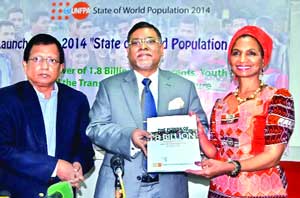
 State Minister for Health and Family Welfare Zahid Malik and UNFPA Country Representative Argentina Matavel holding a copy of The State of World Population 2014. UNFPA launched it at the National Press Club on Tuesday. — Focus Bangla
Bangladesh needs to make heavy investment to transform its nearly 48 million youths aged between 10 and 24 into a dynamic workforce for economic growth, said a report of the United Nations Population Fund (UNFPA).
It also suggested paying serious attention to their proper education, technical skills, health including sexual and reproductive health education and necessary job opportunities to reap demographic dividend by raising income levels.
According to the report, released Tuesday at the National Press Club in the capital, today's generation of young people numbers slightly less than 1.8 billion in a world population of 7.3 billion. That's up from 721 million people aged between 10 and 24 in 1950 when the world's population was 2.5 billion.
The report titled "The Power of 1.8 Billion: Adolescents, Youth and the Transformation of the Future" documented prospects of the youth, obstacles that prevent them from realising their potentials and offers options to overcome those.
"Bangladesh is one of the countries of the world where the number of youth, who will lead her economy in coming years, is high. So, the government should think right now how properly they (the youth) can be managed," said Argentina Matavel, UNFPA Representative, Bangladesh at the launching ceremony of its annual flagship report 'State of World Population 2014'.
She said Bangladesh has done well in terms of primary school enrolment, reducing birth rate, maternal and mortality rates, but child marriage is still a threat to human health.
"Less you invest in, can they compete with the world of information technology? We also have a responsibility to remove any obstacles that prevent young people from reaping their full potentials," she said.
The UNFPA Representative said these investments need to be made right now so that young people can be a catalytic force in the transformative agenda.
She said the UNFPA would like to call on the government to continue its commitment and investment in the social sector and especially focus on the young people - who will be the problem solvers, creators, entrepreneurs and leaders of the future.
"Some 2.0 million young people reach working age every year. Will there be enough jobs to accommodate their need for decent work and a good income? Are health services strong enough?," she asked.
According to the report, fully 89 per cent of the world's 10 to 24-year-olds, almost nine out of 10, live in less developed countries (LDCs). In the LDCs (a United Nations category that includes 33 countries in sub-Saharan Africa, eight in Asia, six in Oceania and Haiti in the Caribbean) the age group makes up 32 per cent of the population.
In the more developed countries, the figure is 17 per cent. India has the highest number of youth with 356 million followed by China 269 million, Indonesia 67 million, the United States with 65 million, Pakistan with 59 million, Nigeria with 57 million, Brazil with 51 million, and Bangladesh with 48 million.
While unveiling the report, Country Director of Population Council, Bangladesh Dr Ubaidur Rob said the country needs to covert the youth into an economic force to have more gains.
He said around 10 million Bangladeshi migrant workers are now working abroad and sending remittance worth more than US$14 billion a year. "Another 10 million is expected to join the overseas job markets in the coming five years. If we can train and educate them in line with the global standard, the country can easily earn US$ 30 billion per annum," he said.
He said potential can be enormous, provided supportive economic policies are in place and investments in human capital, particularly of young people, are substantial and strategic.
"Without a solid economic and policy framework to back it up, the demographic dividend may not be fully realised," he added.
The report also said every day, 39,000 girls become child brides-or about 140 million in a decade and a 10 per cent increase in women's borrowing increases girls' and boys' schooling enrolment rates by about 8 per cent while reducing extreme poverty at the household level by about 5 per cent.
Speaking as chief guest, State Minister for Health and Family Welfare Zahid Malik said the government has already taken various measures in the field of education, health, job market and entrepreneurship building with paying utmost priority to youth.
He said job creation is being done by setting up industries; a good number of technical institutions have been set up to raise skills, access to bank finance has been ensured with flexible terms and conditions, education is free for girls' up to secondary level and laws are being enacted ensuring equal space for both boys and girls. "If we can properly nourish them, the country's economy will be benefited at large," he also added.
jubairfe1980@gmail.com
© 2026 - All Rights with The Financial Express

