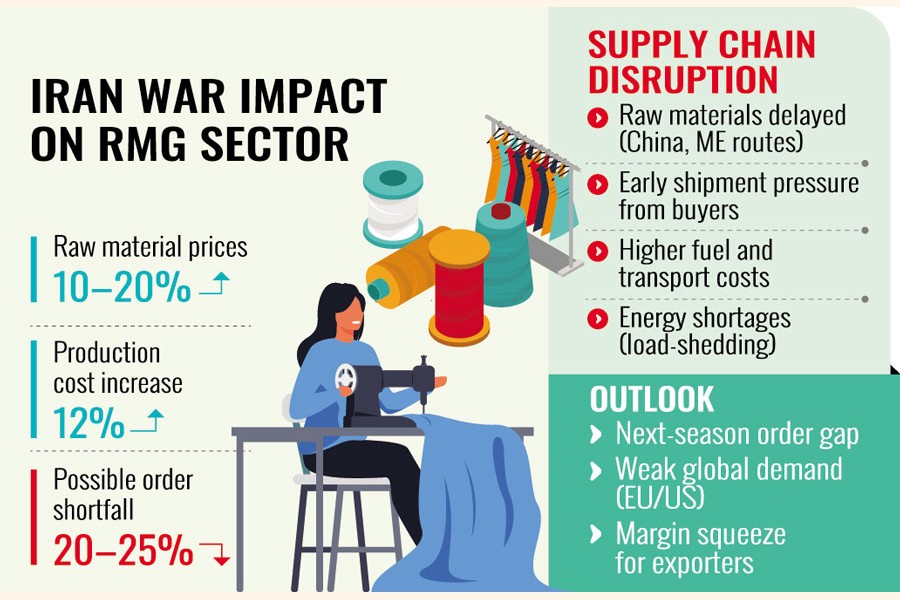
Bangladesh's readymade garment sector is facing mounting pressure as the ongoing Middle East conflict disrupts supply chains, drives up input costs and dampens global demand.
Industry insiders say the impact is being felt across the entire value chain, from raw-material sourcing to shipment schedules and order flows.
With production costs rising sharply and uncertainty clouding future demand, exporters are bracing for a difficult season ahead, even as some buyers push for early deliveries to mitigate shipping risks.
Insiders fear a shortage of work orders in the next season.
Speaking to The Financial Express, Sayeed Ahmed Chowdhury, Director of Square Denim, said that within days of the conflict beginning, letters of credit (LCs) for raw materials were cancelled under force majeure clauses, later being revised at higher prices - especially for cotton, yarn, polyester and other man-made fibres, which rose by 10 to 15 per cent.
Chinese suppliers temporarily stopped offering prices for fibres, delaying procurement, while buyers - anticipating longer shipping times to the EU and the US - began requesting early shipments in April for orders originally scheduled for May-June, he explained.
He, however, noted that many buyers have nominated fabric sources, particularly for woven items, which are largely import-dependent, so sourcing has not been significantly affected in all cases.
Due to disruptions in the overall supply chain and the push for advance shipments, he anticipates a gap or shortfall in work orders of 20 to 25 per cent in the next season.
When contacted, Mahmud Hasan Khan, President of the Bangladesh Garment Manufacturers and Exporters Association (BGMEA), said prices of almost all raw materials, including accessories such as polybags and carton boxes, have increased by around 10 per cent, while dyes and chemicals have risen by 15 to 20 per cent, and yarn, fibre and polyester by up to 20 per cent.
The rise in input costs has pushed up overall production costs by up to 12 per cent, eroding competitiveness, he added.
The BGMEA president, however, welcomed early shipment requests, noting that they could allow exporters to receive payments sooner.
He cautioned that not all factories have the capacity or raw material availability to meet accelerated shipment timelines for their entire order books.
On the energy front, he said factories are struggling due to shortages, adding that BGMEA has asked members to share data on generator capacity and daily energy needs in case of four hours of load-shedding.
Around 266 factories in Dhaka and surrounding areas reported a combined requirement of about 264,174 litres of diesel per day to cope with four hours of load-shedding, he said.
Factories are having to bear the additional cost of alternative energy sources by relying on generators during power outages.
Bangladesh Plastic Goods Manufacturers and Exporters Association (BPGMEA) President Shamim Ahmed said prices of key raw materials, mainly resin, have nearly doubled within a month due to global oil price volatility and geopolitical tensions.
The price of resin has surged to $1,500-1,800 per tonne from $900-950 per tonne before the conflict.
Plastic manufacturers attributed this to the sharp rise in crude oil prices, which have increased from around $60-70 per barrel to $115-120, significantly raising production costs.
The plastic sector, a key backward linkage industry, supplies packaging materials such as cartons and containers to food processing, pharmaceuticals, garments and consumer goods industries.
Fazlul Hoque, former President of the Bangladesh Knitwear Manufacturers and Exporters Association (BKMEA), said imports have been affected more than exports, while shipments to the Middle East, particularly Dubai, have largely halted.
However, he noted that the region does not account for a significant share of Bangladesh's exports, adding that the country mainly sources raw materials from China, India, Indonesia and Korea.
Although imports have resumed after initial disruptions, they are now taking place at higher costs, while both order volumes and prices have declined, he said.
"This has created multi-dimensional impacts," said Mr Hoque, also Managing Director of Plummy Fashions Ltd, adding that rising global oil prices have forced Western consumers to cut apparel spending, further dampening demand. He warned of a bleak outlook in the coming months.
Echoing these concerns, SM Khaled, Managing Director of Snowtex Group, said his company, which produces jackets, has seen a sharp increase in raw material costs, most of which are petrochemical-based, as oil prices have surged.
Shipping costs have also risen significantly, with freight rates from China increasing to $2,600 from $1,600 previously.
Local transport costs have also increased due to delays in fuel supply, with trucks often waiting three to four hours to refuel, reducing operational efficiency. He added that buyers who had earlier indicated plans to place orders at this time have either delayed discussions or reduced volumes by around 10 per cent.
Regarding early shipments, he said some buyers have requested advance deliveries due to concerns over extended transit times caused by rerouted shipping lines.
Munni_fe@yahoo.com
© 2026 - All Rights with The Financial Express

