Islami Bank Bangladesh PLC has become the largest contributor to the central bank's ongoing foreign-exchange (forex) market intervention, holding around one-fifth of the US dollars purchased by the regulator so far this fiscal.
Bangladesh Bank (BB), as part of its forex market intervention strategy under the free-floating exchange rate regime, bought a total of $5.56 billion from commercial banks from July 13 last year until April 15, 2026, in a bid to stabilise the taka-dollar exchange rate.
Of the purchased American greenback, a total of $1.225 billion came from the country's leading Shariah-based bank, which is nearly one-fifth of the total dollars purchased by the BB in the current fiscal (FY26).
According to BB sources, the central bank purchased $5.56 billion from a total of 39 commercial banks through auctions, injecting over Tk 600 billion to this effect.
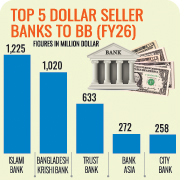
The top fifteen US dollar sellers are Islami Bank ($1,225 million), Bangladesh Krishi Bank ($1,020 million), Trust Bank ($633 million), Bank Asia ($272 million), City Bank ($258 million), Pubali Bank ($184 million), Dhaka Bank ($181 million), Dutch-Bangla Bank ($173 million), South East Bank ($158 million), Eastern Bank ($140 million), Mercantile Bank ($122 million), United Commercial Bank ($120 million), Jamuna Bank ($111 million), Mutual Trust Bank ($109 million) and Agrani Bank ($105 million).
Seeking anonymity, a BB official said the central bank started buying US dollars from commercial banks to keep the exchange rate stable under the existing free-floating exchange rate regime.
Banks having a long position got the opportunity to sell their US currency to the regulator under the mechanism to meet their local currency obligations, he said, adding that it also helps build up forex reserves.
"It's a win-win situation for both banks and the regulator," the BB official said.
The central banker defined that banks which have higher foreign currency payment obligations than forex earnings fall into the category of short positioning.
On the other hand, the official said there are some banks which have more foreign earnings than spending to clear overseas transactions. They fall into the category of long positioning. This means the banks have a surplus in foreign exchange.
On condition of anonymity, a senior banker at Islami Bank said the bank has a tradition of sourcing the highest volume of remittances among banks, but import pressure has fallen sharply in recent times due to the persisting economic sluggishness.
The central bank's ongoing intervention has opened a window for the bank, like others having a long position, to sell their sourced US dollars to the regulator to meet local currency obligations.
"I think this is the right move. Otherwise, the exchange rate might drop significantly and hurt remitters," he added.
Managing Director of Bangladesh Krishi Bank Sanchia Binte Ali said the board of directors of the specialised bank officially instructed them to support the government, especially in the power sector, by clearing international payments a few days after she took charge as the bank's top executive.
As the bank has a good stock of remittances thanks to the trust of Bangladeshi expatriate workers, she said they stepped up to help the economy function.
"Alhamdulillah… we're still bagging a significant portion of remittances here. That's why we managed to sell dollars to the central bank after clearing international transactions," the Krishi Bank's top executive said.
jubairfe1980@gmail.com
© 2026 - All Rights with The Financial Express

