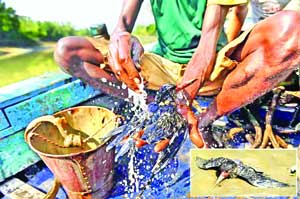
 A kingfisher fell sick (inset) as it dived into the oil-spilled water following an oil tanker’s capsize in a river in the Sundarbans and a man tried to save the bird by washing it with fresh water on Sunday. — Photo collected from local sources
Lives in both water and land have been trapped in the petroleum pollution of the Sundarbans environs for oil spills following a tanker capsize that left its master drowned, experts said.
The pollution spread despite the mopping up of more than 40,000 litres of furnace oil from the rivers and canals inside the world's largest mangrove until Sunday through applying traditional methods.
Meanwhile, a hectic search ended on Sunday morning with a bizarre find of the decomposed body of the sunken oil-tanker Southern Star-7 Master Mokhlesur Rahman.
He had been missing since December 9 when the tanker went under after being rammed by another ship in the Shela River.
The body was spotted in a canal adjacent to the Shela River in Mrigamari area of the Sunderbans, Mongla police station OC Belayet Hossain told the FE.
The oil tanker, loaded with 357,668 litres of furnace oil sank in the Shela after being hit from behind by an empty cargo vessel, MT Total.
Most of the oil got spilled into the water over about 350 kilometres of the Sundarbans-a UNESCO-designated World Heritage Site.
"Nearly 40,200 litres of oil have been collected by local people from the river since introduction of the traditional method Friday. Besides the locals, 50 trawlers and boats of the Department of Forests have been engaged in the process since Sunday," Chief Conservator (Khulna Circle) of the Forest Department Kartik Chandra Sarker said, citing the corporation data.
He said the state-run Bangladesh Petroleum Corporation is collecting oil from the people at Tk30 per litre.
However, people living in the vicinities of the Sundarbans thronged Shela, Pashur rivers without taking any protection in hands and legs.
"An alarming thing is that women and children have also been involved in the process," said biodiversity expert Pavel Partho, who is now staying in the forests.
Talking to the FE over cell-phone he said that oil exploration in the river has caused serious damage to the biodiversity of the mangrove forest.
After hitting the animals, mammals, reptiles and trees, collecting oil from the river is now directly affecting human health, he said.
"Many of the people have caught itching in the eyes and hands… seepage of furnace oil into human body can cause serious damage to health," he said.
"The oil-stained grasses and small saplings by the side of river Shela in Mrigamari, Badamtala and Andharmanik areas have begun to die while the bodies of small fishes and crabs could be seen on the riverbanks of the oil-spill-affected areas," he said.
The grasses and the saplings that were totally oil-stained and became black would die out, he feared.
He said that most of the severely affected bushes and trees on southern side of the Shela river might die for the oil spill.
Partho pointed out that the alarming thing is that the spillage of petroleum products is killing phytoplankton and zooplankton---the primary food producer of Sundarbans.
"Destruction of the primary food producers of a food chain means gradual collapse of the total system."
He also pointed out that the mangrove trees take oxygen through their 'Pneumataphores'. The Pneumataphores are made of Xylem and Phloem tissues, but a layer of oil may close those tissues, which can bring dire consequences over the trees' physiological development.
Dolphin expert and Bangladesh Cetacean Diversity Project (BCDP) principal researcher Rubaiyat Mansur Mowgli said the area where the accident took place is a sanctuary of Ganges Dolphin (Shushuk). Irrawaddy dolphin is also found there when saline water increases.
He said a comprehensive study is needed now to assess the real damage to dolphin. "Before that it is not possible to say anything."
Professor Monirul H Khan, a tiger expert from the Department of Zoology, Jahangirnagar University, told the FE that this seepage may pollute waters of the internal canals surrounding the forest. Royal Bengal Tiger and deer might be forced to drink the water if it enters internal canals.
"If they do so, it will be very dangerous for the population of the rare species, as it could cerate diseases like gastro-internal disorder or kidney failure," said Prof Khan, who led the survey on the population of tigers in the Sundarbans (Bangladesh part) in 2006.
The experts also urged the government to take immediate steps to stop the plying of vessels in and around the Sundarbans permanently to protect the biodiversity there.
Meanwhile, the government is not considering a permanent ban on the plying of water vessels through Shela river in the Sundarbans, Shipping Minister Shahjahan Khan told newsmen Sunday.
His comments came hours after suggestion by an inter-ministerial meeting for a ban on use of the route through world's largest mangrove forest in the wake of oil spill through a huge area of the forest following the tanker shipwreck.
tonmoy.wardad@gmail.com
© 2026 - All Rights with The Financial Express

