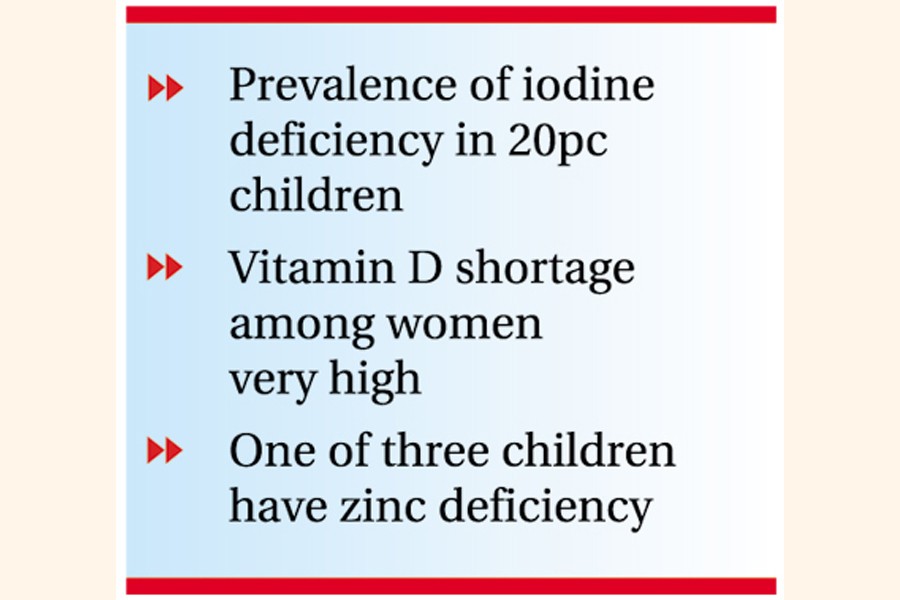
The country's children and women are substantially suffering from multiple micronutrient deficiency, while Vitamin D deficiency among women of reproductive age is alarmingly high, according to a latest government study.
Its findings also suggest that children under five years of age along with non-pregnant, non-lactating (NPNL) women here significantly lack micronutrients.
Among the under-5 children, 31 per cent had zinc deficiency, 20 per cent had iodine deficiency, and 15 per cent had iron deficiency, it revealed.
While in case of vitamins, 22 per cent of children had Vitamin D deficiency, and 7.0 per cent had moderate Vitamin A deficiency, it found.
The National Nutrition Services (NNS) of the Institute of Public Health Nutrition (IPHN) under the Directorate General of Health Services (DGHS), in partnership with icddr,b, presented the dissemination of the Second National Micronutrient Survey, Bangladesh 2019-2020 at a seminar in a city hotel on Sunday.
Syed Mojibul Huq, Additional Secretary of the Public Health Wing of the Health Services Division under the Ministry of Health and Family Welfare, graced the session as the chief guest.
He appreciated the NNS and icddr,b for bringing out some important findings.
Dr Aliya Naheed, Scientist, Health Systems and Population Studies Division at icddr,b and the survey's principal investigator, presented the findings in the seminar.
Dr Mustafizur Rahman, Director of the DGHS and Line Director of the NNS, delivered the welcome speech.
Professor Dr Shah Monir Hossain, Former Director General of the DGHS, moderated the question and answer (Q&A) session of the seminar.
Dr Tahmeed Ahmed, Executive Director at icddr,b, appreciated the government's decision and commitment to carrying out the survey.
Compared to the findings of the First National Micronutrients Survey 2011-12, the prevalence of micronutrient deficiency status improved for three indicators (Vitamin A, Zinc, and Vitamin D), while the iron level declined.
The prevalence of iodine deficiency in children (20 per cent) was reported for the first time in the country in this survey.
It was a cross-sectional study with a complex survey design, in which 250 sub-districts from 64 districts of eight divisions were randomly selected by the Bangladesh Bureau of Statistics (BBS), following the multi-stage cluster sampling method.
These 250 clusters (66 per cent rural and 34 per cent urban), identified from the nationwide Multiple Indicator Cluster Survey (MICS) conducted in 2019, covered 4,090 households including 1,014 NPNL women (15-49 years) and 1,041 under-5 children (6-59 months).
The research addressed the compelling need of assessing deficiency of the common micronutrients across urban and rural areas in all eight administrative divisions in Bangladesh - in order to obtain a credible national-level estimate of the selected micronutrients among under-5 children and NPNL women.
Among NPNL women, 43 per cent had zinc deficiency, 30 per cent had iodine deficiency, 29 per cent had folate deficiency, and 14 per cent had iron deficiency.
An alarming 70 per cent of NPNL women lacked Vitamin D, 20 per cent had Vitamin B12 deficiency, and 7.0 per cent of women had mild Vitamin A deficiency.
Compared to the findings of the First National Micronutrient Survey 2011-12, the micronutrient deficiency status among NPNL women showed improvement in three indicators (Vitamin A, zinc and iodine), deteriorated in three indicators (serum, iron and folate), and remained unchanged in Vitamin D and Vitamin B12.
sajibur@gmail.com
© 2026 - All Rights with The Financial Express

