Much of the public money meant for uplift of rural Bangladesh drains off upazila development projects largely for lax oversight of implementation of works, official findings show.
Under one foreign-funded project, after procuring X-Ray machines and hospital beds at some upazila health complexes those have been kept non-functional for couple of years, a government project-evaluation report says.
Some cracks were found on the walls of a newly constructed technical school building, says the report prepared by the Implementation Monitoring and Evaluation Division (IMED).
The implementing agency -- Local Government Division (LGD) -- has changed project directors (PDs) thrice and currently an acting PD has been working for nearly two years.
Besides, the project authority has allegedly breached the development project proposal (DPP), compromised quality of works and bent the rules in procurement of goods and services, the IMED's in-depth evaluation divulges.
The authority went for direct-procurement method (DPM) instead of open-tendering method (OTM) in some procurement processes, contracted out works to second-lowest bidders instead of the lowest ones, included unnecessary items for procurement in breach of DPP, accepted goods from contractors without quality and performance test, the report adds.
With the financial support of Japan International Cooperation Agency (JICA), the LGD undertook a Tk10.59-billion 'Upazila governance and development project (UGDP)' in December 2015.
The project has already been revised a second time, increasing the cost to Tk12.71 billion and extending the execution time up till June 2024, in what analysts see as an example of many such public-works miscarriages in lower levels in particular.
Out of the Tk12.71-billion cost, the LGD has provided the lion's share worth Tk9.49 billion as block allocation for the development works in 475 upazilas.
The government has taken up the project aimed at training manpower and developing some infrastructures in these upazilas in all 64 districts across the country.
Under the development project, the LGD is working to facilitate development of rural infrastructures, educational institutions, health complexes, agriculture operations, and road, culvert and drainage operations.
The IMED report says, "Switching off the newly set-up X-Ray machines and keeping the new beds vacant, the health-complex authorities are operating the older machines and beds. So, the patients are being deprived of adequate healthcare facilities and the equipment might become dysfunctional."
Despite the setting up of public toilets and washrooms in the markets and bazaars, the beneficiaries are not being able to use those for the locking of doors by market authorities, the report adds.
Some 52.38 per cent of people in the survey areas said they could not use the public toilets as doors are closed, according to the evaluation report.
According to the IMED report, faults in project preparation, cost estimation, design, and in log frame, and faulty calculation of the returns from the projects were also detected.
It says there are some coordination problems between the Upazila Chairman and the Upazila Nirbahi Officer (UNO), as found in some upazilas. "The non-coordination has been affecting the services to the potential project beneficiaries in the upazila areas".
According to the IMED, lack of full-time project director has affected the works as the current PD is the in-charge of two projects simultaneously.
After the start of the project in 2015, the Local Government Ministry appointed its additional secretary as the first PD who served three years and seven months up to December 2018. Then the ministry appointed another additional secretary who served two years up to August 2022.
Thereafter, there has been no full-time project director. Rather an additional secretary is now acting PD in addition to his regular duty.
The departmental evaluation report says improper selection of project areas, inclusion of lower number of jobless people in the training programmes under the project, and absence of adequate PIC (Project Implementation Committee) and PSC (Project Steering Committee) meetings were found.
The LGD had implemented 66.68 per cent of the project till April 2023 although it was started way back in December 2015.
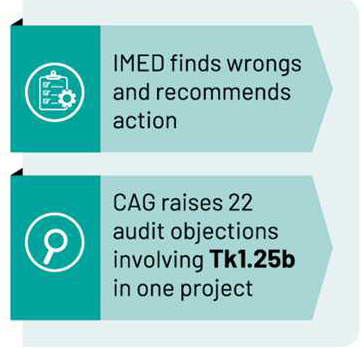
Meanwhile, the CAG has raised 22 audit objections involving Tk 1.25 billion for this ongoing project owing to "violation of the procurement law and rules, and financial irregularities".
Although oxygen cylinder and hospital beds are procured with the project funds, their operation and maintenance are being affected, the evaluation has found.
The IMED report shows that the authority has installed more solar-based street lights (42.24 per cent) in the rich and middle-class areas instead of the poor residential areas (28.57 per cent).
Out of the lights, about 30 per cent of street lights are not operational after installation, the report says, quoting the beneficiaries of those particular areas.
Asked about the findings, the acting director of the project, Dr Maloy Chowdhury, told the FE that they maintained maximum accuracy in project selection from the upazila level.
"And we also tried to procure all the necessary items following the public procurement law and rule," he said.
"I can tell you that this is one of the best projects in Bangladesh in terms of accountability and transparency. We maintained highest possible method to ensure quality implementation," said Dr Chowdhury, also Additional Secretary of LGD.
IMED Secretary Abul Kashem Md Mohiuddin told the FE that they would write to all the line ministries to take "proper action against the irregularities and faults detected in the projects in our evolution".
"Within a certain period of time we will urge the ministries to give back their report regarding the IMED-recommended actions against the irregularities and challenges," he said.
Deputy Team Leader of UGDP Azizur Rahman Siddiki told the FE that they had gone for DPM and RFQ maintaining for those packages which are small and they marinated the public procurement law.
"There were some audit complaints by the CAG which are almost resolved. We are trying to maintain highest transparency and accuracy in procurement," he said.
kabirhumayan10@gmail.com
© 2026 - All Rights with The Financial Express

