Mymensingh municipality has emerged as an area most vulnerable to earthquake in Bangladesh as a government study predicts over a 7-magnitude tremor could knock down more than 97 per cent concrete structures there.
The findings on earthquake-risk assessment show the extent of structural damage, on an average, might be much higher in Mymensingh than in Dhaka, Chittagong and Sylhet.
Such prognosis comes at a time when repeated quake strikes pounded Nepal and shook the entire subcontinent, including Bangladesh, stocking up fears and provoking thoughts on remedial measures.
Tremor experts, urban planners and businesses said quick expansion of trade and business coupled with unplanned urbanisation and poor enforcement of Bangladesh National Building Code (BNBC) left the key district on the river of Brahmaputra in such a vulnerable position.
The worst-case scenario comes into limelight in the second phase of the study, which was carried out by Comprehensive Disaster Management Programme (CDMP) under the ministry of disaster management and relief (MoDMR) in six districts.
The districts are Mymensingh, Rajshahi, Bogra, Dinajpur, Rangpur and Tangail.
According to the study, the findings of which are yet to be released, Mymensingh Pourasava has a total of 45,033 structures in various forms like concrete and masonry.
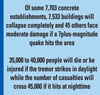
Of some 7,703 concrete establishments, 7,533 (97.77 per cent) buildings will collapse completely and 45 (0.58 per cent) others face moderate damage if a 7plus-magnitude quake hits the area.
The study forecast same picture in terms of masonry structures in the municipality as some 24,583 (91.77 per cent) out of 26,987 of such establishments would completely be knocked down while 152 (0.57 per cent) others would be affected partially in the event of such a tremor.
There are some 10,541 zinc-shed and bamboo structures in the area and nearly 40 per cent of those will be severely affected, the study mentions.
And 4.550 million tonnes of debris, 70 per cent of steel and concrete materials and 30 per cent in the form of brick-and-wood materials will also be generated because of the apprehended sudden collapse.
It says 35,000 to 40,000 people will die or be injured if the tremor strikes in daylight while the number of casualties will cross 45,000 if it hits at nighttime.
According to the possible physical damage state, Rangpur City Corporation stood second on the latest list of earthquake vulnerability where 3,855 out of 6,294 concrete buildings will take complete and moderate knocks.
Of 37,436 masonry structures, some 20,970 in the city corporation area will face complete and moderate damage.
According to the study findings, the earthquake will cause moderate and complete damage to more than 31 per cent concrete structures in Bogra followed by 24 per cent in Dinajpur, over 32 per cent in Rajshahi and 31 per cent in Tangail.
When contacted, National Project Director of the CDMP Phase-11 Mohammad Abdul Qayyum said they had visited each of the structures in various forms in those areas as part of the second phase of the project to make a projection of earthquake vulnerabilities for future plan of action in this regard.
"And we found a horrible picture in Mymensingh where more than 97 per cent buildings are vulnerable to complete collapse due to non-compliance with the BNBC," he said.
Citing study of the first phase, which was conducted in Dhaka, Chittagong and Sylhet in 2009, he said they had collected data of 325,000 buildings in the capital where 78,000 were found in the worst category.
He said the extent of presumed building damage was nearly 30 per cent in Dhaka whereas 78 per cent in Chittagong and 46 per cent in Sylhet.
"So, Mymensingh is worst vulnerable to earthquake as the area is located close to the Dauki fault," he said.
Dauki fault is a major fault line along the southern boundary of Shillong plateau that may be a source of destructive seismic hazards for the adjoining areas, including northeastern Bangladesh.
He further said causalities will be much higher in the three metropolitan cities because of growing population density and increased number of buildings.
Talking about the methodology, another senior CDMP official said they completed the risk assessment through Hazus-probabilistic approaches and checked conditions of both structures and soil.
He suggested making 23 to 25-metre-deep foundation for building a structure to skip the risk of earthquake in Mymensingh and immediate conversion of the masonry structures into RCC (Reinforced Cement Concrete) ones.
President of Mymensingh Chamber of Commerce and Industry Ekramul Hoque Titu said they came to know about the worst-case scenario in the municipality following the recent CDMP study that helps people know soil capacity at various locations here.
"Yes, unplanned urbanisation is taking place here randomly in the absence of proper enforcement of the BNBC because of quick expansion of trades, investments and quality education," he told the FE.
They have planned to initiate frequent meetings, seminars and other types of gatherings to make people aware of the quake-resilient structures in line with the BNBC.
Three active fault lines of the tectonic plates in Modhupur, Dauki and eastern boundary may trigger a major earthquake anytime with the epicentre within Bangladesh territory, according to quake experts.
Professor Dr Mehedi Ahmed Ansary of BUET's Civil Engineering Department noted the level of structural compliance outside Dhaka and Chittagong is very poor.
"There are many engineers available in the mega- cities, and at the same time, development regulatory authorities like Rajuk and city corporations still exist here.
"But in other parts of the country there is a lack of construction regulations and those available do not have enough knowledge regarding the BNBC," he said.
Urban planner Mubasshar Hussein said zone-3 (Dauki Fault) is the most vulnerable for Bangladesh. Then two other zones and Mymensingh district are located under this danger zone.
He said the government must come up with special plan of actions, taking lessons from Nepal, as Bangladesh will face more destruction because of increased vulnerable buildings and unplanned underground utility lines. "If such type of quake strikes the country that would cause heavy explosions and fire because of the underground gas pipelines, which will be a terrible experience," he forewarned.
jubairfe1980@gmail.com
© 2026 - All Rights with The Financial Express

