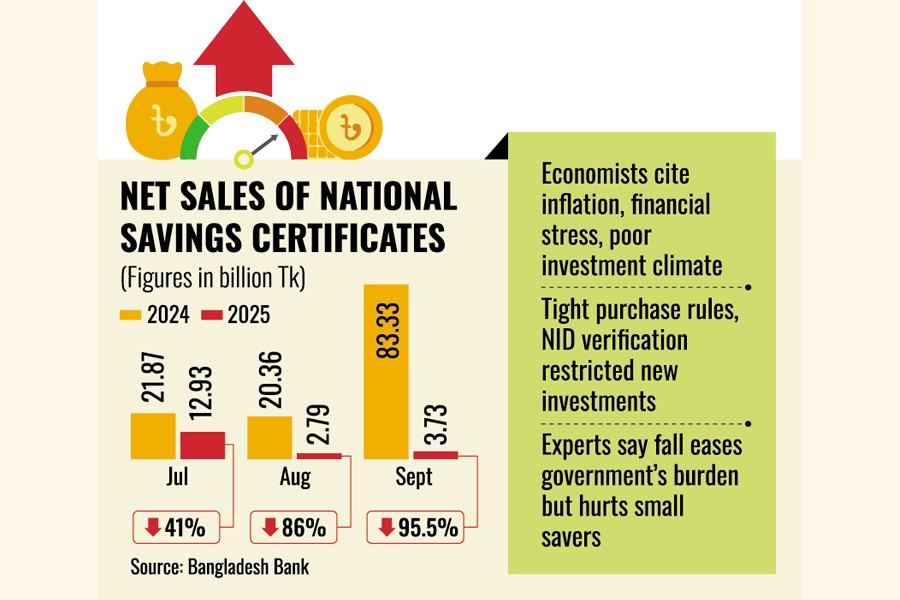
Net sales of National Savings Certificates (NSCs) plunged by 95.5 per cent year-on-year in September 2025, as tighter liquidity conditions and rising living costs continued to erode small investors' appetite for government savings instruments.
 According to Bangladesh Bank (BB) data, NSC net sales dropped to Tk 3.73 billion in September 2025, down sharply from Tk 83.33 billion in the same month a year earlier.
Economists attributed the slump to persistent inflationary pressure, financial stress, and unfavourable investment conditions.
Despite the steep monthly fall, the fiscal year 2024-25 (FY25) ended with some improvement over the previous year. Net sales closed FY25 with a negative balance of Tk 60.63 billion -- an improvement from the Tk 211.24 billion deficit recorded in FY24.
BB data also show that net NSC sales fell to Tk 12.93 billion in July 2025, down 41 per cent year-on-year from Tk 21.87 billion in July 2024. In August 2025, sales dropped further to Tk 2.79 billion, compared with Tk 20.36 billion in August 2024.
Cumulatively, during July-September of FY26, total net sales amounted to Tk 19.45 billion, marking a 52.6 per cent decline from Tk 41.09 billion in the corresponding quarter of FY25.
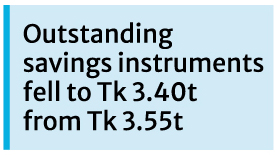
Total outstanding savings instruments stood at Tk 3.40 trillion in September 2025, down 4.2 per cent from over Tk 3.55 trillion a year earlier.
Net sales of savings certificates are calculated by deducting repayments against earlier investments from fresh sales.
"The tightening of purchase rules and real-time verification through NID have limited investment by individuals seeking higher guaranteed returns," said a senior finance ministry official.
Experts warn that while the drop in sales reduces the government's interest burden, it could hurt small savers, pensioners, and middle-income families who have long relied on NSCs for secure, fixed income.
Dr Masrur Reaz, chairman of Policy Exchange Bangladesh (PEB), told The Financial Express that the decline in net sales is "a clear reflection of shifting dynamics in both household savings behaviour and fiscal borrowing strategy."
"High inflation has eroded the real return on savings certificates," Dr Reaz observed. He added that the trend may continue unless inflation eases and the government revises its savings tool policies to make them more attractive and aligned with current market realities.
The Finance Division recently slashed yield rates across several savings schemes, effective from July 1 through December 2025. Officials said the rates would be reviewed again in January 2026, depending on inflationary trends and fiscal needs. The government introduced the National Savings Certificates Online Management System in 2019, making e-TIN and national ID cards mandatory for investors. The system, designed to improve transparency and curb misuse, has also reduced speculative or high-value purchases that previously inflated NSC sales.
sajibur@gmail.com
© 2026 - All Rights with The Financial Express

