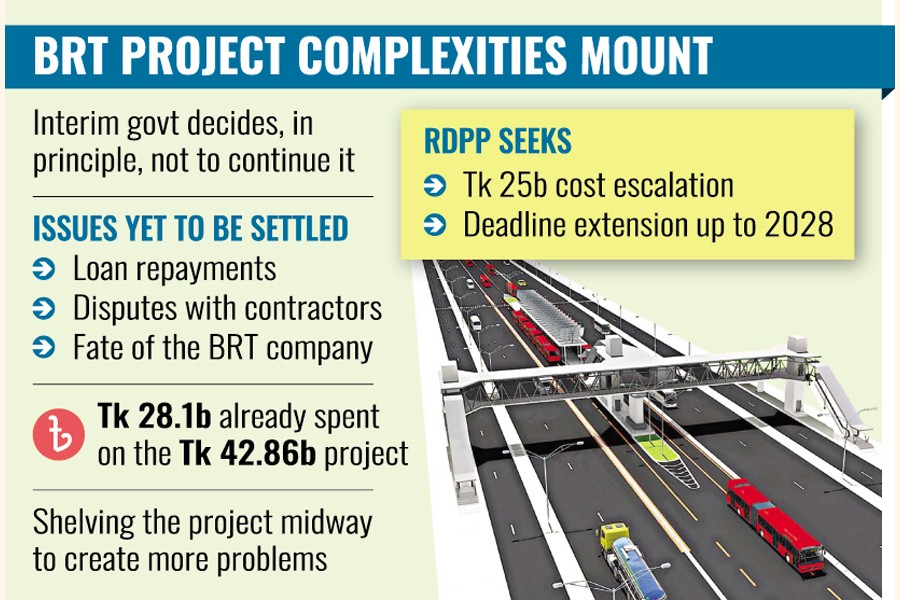
The final decision on the fate of the troubled Bus Rapid Transit (BRT) project is likely to be taken by the next government as closing it midway will create more complexities in the present context, sources say.
Though the government has decided, in principle, not to continue the Tk 42.86 billion project after already spending Tk 28.10 billion, it has yet to overcome challenges like loan repayments, disputes with contractors, and the fate of the BRT company.
The Road Transport and Highways Division (RTHD) formed two committees as per instructions from the Executive Committee of the National Economic Council (ECNEC).
The committees were formed after the ECNEC refused to approve the revised development project proposal (RDPP), which sought a further cost escalation by Tk 25 billion and the deadline's extension up to 2028.
The DPP expired in December 2024.
"No one wants to decide on the project now. That is why it drags on so that the next elected government will make the final decision," says an insider involved in the project.
As both Chinese contractors of the project have demanded over Tk 5.0 billion in variation, the present government does not want to look into that, he says.
Sources say the first committee formed to guide the project forward had no suggestions.
It transferred the decision-making to the interim government.
Moreover, it suggested opening the entire 20.5km corridor for common traffic instead of the dedicated BRT bus services after carrying out minor works like columns, footbridges, road surface levelling, etc.
These remained undone due to the discontinuation of work by the Chinese contractors after demanding payments.
The other committee found faults at the planning stage due to the faulty feasibility study.
It did not directly hold any person or agency responsible, but said the project was faulty from the planning stage due to the faulty feasibility study.
As the two committees did not suggest any solution, the RTHD sought Bangladesh University of Engineering and Technology's (BUET) support to review their reports.
Special Assistant to the Chief Adviser on Rail and Road Transport Sheikh Moinuddin says the DPP has expired, but the project is still alive.
He says the DPP's revision is necessary to approve the expenditure needed to carry out the recommended works before closing the project.
Besides, he says the next government may revive the project if it wants.
But there are other issues that need to be addressed, including the fate of the stations, expansion joints, lifts, escalators, etc., on the corridor.
These were costly and may make traffic movement risky.
Besides, there are also uncertainties over handling the loan burdens without earning from the corridor and deciding the fate of the BRT company's 28 employees.
The project was taken to introduce the first bus-based mass transit from Gazipur to the Hazrat Shahjalal International Airport after a feasibility study in 2011.
The ECNEC approved the project, which was titled the Greater Dhaka Sustainable Urban Transport, at a cost of Tk 20.40 billion in 2012.
But the cost doubled to Tk 42.86 billion to adjust the project's faulty design at different stages, land acquisition later on, drainage system development, and managing construction hazards.
The Roads and Highways Department (RHD) leads the project, but the Bangladesh Bridge Authority (BBA) and the Local Government Engineering Department (LGED) are implementing it by selecting two Chinese companies below the engineering costs.
The BRT corridor development proposal, with technical support of the World Bank, was first made in the strategic transport plan (STP) prepared in 2005.
Though the STP proposed three BRT corridors in the capital, it did not recommend the Gazipur-Airport one.
The corridor's feasibility study was done by the Asian Development Bank (ADB), which found it viable due to the growth of the city and commuters.
Later, other development partners came forward to support the project, including Agence Francaise de Developpement.
The ADB committed to providing $160 million in loans for the infrastructure part development, and AFD $45 million for BRT bus purchase and the corridor's integration with the IT system.
RHD officials say the project's conceptual planning was wrong as daily traffic on the corridor was recorded at 200,000 by counting at two points in September 2024, while the study predicted it at 90,000.
smunima@yahoo.com
© 2026 - All Rights with The Financial Express

