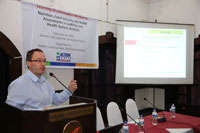
 Damien Joud, head of Department of Food Security and Livelihood (FSL) of Action Contre la Faim (ACF) Bangladesh Mission, presenting an assessment report on food security at the workshop. — FE Photo
Speakers at a workshop on Tuesday said most of the government and non-government agencies, development partners and other stakeholders undertake same type of programmes in the same upazilas of Satkhira. It causes duplication and overlapping as well as keeps the remaining people out of the development purview, they opined.
They also said the long-standing water-logging problem in the district, caused due to both natural and man-made factors, has been affecting livelihood, food security and nutrition status of the vulnerable population of that area.
They made the observations at a learning dissemination workshop titled 'Nutrition, Food Security and WASH Assessments in Satkhira and Health System Analysis' in the city.
Action Contre La Faim (ACF) Bangladesh organised the event in association with European Commission Humanitarian Aid and Civil Protection (ECHO) and World Food Programme (WFP).
The event was attended by ECHO head of office Olivier Brouant, civil surgeon of Satkhira Dr Saleh Ahmed, ACF Bangladesh country director Lamia Rashid and head of nutrition and health Dr Ojaswi Acharya, and experts from WFP, Food and Agriculture Organisation (FAO), CARE Bangladesh, Japan International Cooperation Agency (JICA), FHI 360, UNICEF, USAID and Concern Worldwide, among others.
Seven assessments on - nutrition causal analysis (NCA), health system strengthening diagnosis, health facility assessment, in-depth assessments on FSL (food security and livelihood)-WaSH (water sanitation and hygiene)-nutrition, beneficiary profiling to identify vulnerable groups at risk of under-nutrition and coverage assessment - were presented in the workshop.
Dr Saleh Ahmed, in his presentation, suggested planned and coordinated partnership with development partners to achieve same nutrition goals, multi-sectoral support for poor/ultra-poor families for mainstreaming nutrition, reinforcement of human resources at different levels, systematic capacity building of frontline health workers, and capacity building of supervisory level staffs for monitoring nutrition service delivery.
Assessment findings presented in the programme showed that around 73 per cent of the households (HHs) in Satkhira were concerned about food, and one fourth of the households with children under five years or pregnant women were severely food insecure.
They also showed 42 per cent of the surveyed HHs represented daily workers, who live from hand to mouth, and scored the poorest outcomes in food security and nutrition indicators. Average wage of a day-labourer was Tk 100, which is much lower than the WFP standard of Tk 148 to have three meals.
Besides, Satkhira has scarcity of safe water due to salinity intrusion and high arsenic contamination. Some 53.3 per cent HHs of the daily workers was found using shallow tube-wells (STWs).
Due to poor hygiene practices and lack of sanitation, recurrent episodes of diarrhoea is very common in the district. About 27 per cent of the children with diarrhoea came from the HHs with combination of unhygienic latrines and STWs.
According to assessment findings, acute respiratory infection was identified as the major cause of childhood mortality, and child feeding practices continued to be an issue in childhood nutrition.
Safe water, human waste disposal and hygiene practices contributed to the burden of illness and acute malnutrition (AM) in children.
ACF's integrated SMART survey in January 2014 showed that about 14 per cent (27,357) children aged between 6-59 months suffers from AM.
Dietary diversity of children was less than acceptable level, and about 59 per cent children did not receive an acceptable diet in the previous 24 hours of the survey.
In general, HHs with moderate to severe food insecurity accounted for 68 per cent of the cases of global acute malnutrition (GAM). Additionally, lack of safe water and unhygienic practices continued to be an issue, contributing to the burden of illness and AM in children.
In another presentation on food security, ACF Bangladesh FSL head of department Damien Joud said Satkhira is an agriculture hub within ecologically unique tidal wetlands of both saline and fresh water.
He said there is social conflict with land and political agenda in expansion of shrimp farming. People are pressurised to convert from rice production to shrimp farming, which requires less labourers. Day-labourers are paid poor wages as the unemployment rate is high there.
In answering a question regarding the issue of waterlogging and little progress in health, food security and nutrition in Satkhira, Olivier Brouant said Bangladesh has to deal with its own problems internally, and no outsider or foreigner can solve its social and political issues.
msshova@gmail.com
© 2026 - All Rights with The Financial Express

