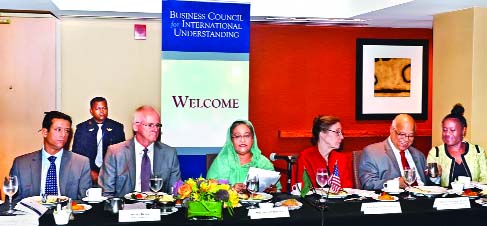
 Prime Minister Sheikh Hasina speaking at Business Council for International Understanding at a hotel in New York Thursday. — Focus Bangla
NEW YORK, Sept 26, 2014 (Agencies): Prime Minister Sheikh Hasina wants to see the volume of US investment in Bangladesh will go past the billion-dollar mark within the next three years.
In 2014, the Prime Minister noted that the US still stands to be the second largest foreign direct investor in Bangladesh. And yet this is still low considering its global investment scales.
Sheikh Hasina said the current US investment in Bangladesh to the tune of US$ 331 million is much below its potential.
The Prime Minister was addressing a luncheon hosted by US Chamber and US Business Council at the Grand Hyatt Hotel here Thursday.
Hasina urged the US investors to create a new business partnership to help Bangladesh become a middle income country by 2021.
"As we aspire to become a middle-income country by 2021, I call upon the US entrepreneurs to create new business partnerships by investing more to take Bangladesh-US relations to newer heights," she said.
"Apart from energy and power sectors, there are some investments slowly building up in financial sectors. Yet we need more diverse groups of US investors taking advantage of Bangladesh's liberal investment policy," she said.
She said her government has leapfrogged the liberal fiscal incentives for foreign investors, including a most generous tax holiday, concessionary duty on import of machinery, remittance of royalty, 100 per cent foreign equity, unrestricted exit policy, a full repatriation facility of dividend and capital on exit and many more.
"We've created 7 Exclusive Economic Zones (EEZ), whereby foreign private companies can take lease of industrial land and set up labour intensive industry. We've an over 80-million young energetic workforce available for industrial recruitment as workers. We also have 160 million consumers as your market," she added.
Apart from power and energy sector, the Prime Minister said her government is keen on increasing FDI in its booming shipbuilding and recycling sectors, chemical fertilisers, automobile and light engineering, agro-processing, pharmaceuticals, ceramic, plastic and jute goods, ICT, marine resource extraction, tourism, medical equipment and telecommunication. The government is also giving more thrust on establishment of knowledge based hi-tech industries.
She went on saying: "We've facilitated US companies such as the AES to be the pioneer of foreign private investment in the power and energy sector in Bangladesh. They launched the Haripur and Meghnaghat power plants and boosted the investment numbers by manifolds.
The Prime Minister mentioned that when she travels to New York to attend the UN General Assembly, she is advised by Bangladesh Ambassador to the United States to meet business and corporate leaders from the USA.
"Unless I am really time-constrained, my answer has been always been a 'yes'," she said.
"This is so due to three reasons. First, is the merit of the excellent bilateral relations that Bangladesh enjoys with the United States," she said.
Second, she said, is the importance that my government attaches to the fast-tracking of trade, investment and business opportunities with the US private sector. "And third, to keep you informed of the social and economic transformations that Bangladesh is undergoing under our Vision 2021," she added.
The other testament to the mutually beneficial relations is the bilateral trade statistics. As of 2014, the United States remains Bangladesh's single largest export destination, mostly the RMG, Hasina told her audience.
And that too after Bangladesh pays a remarkably high tariff at the US ports ranging between 8 and 32 per cent. Last year, Bangladesh exported US$5.2 billion worth of apparels to the US while the US earned US$ 832 million in duties and taxes paid by Bangladesh.
"Imagine if our products had a duty-free and quota-free access to the US ports. This would generate millions of dollars surplus for US retailers. They could in turn enhance money paid to the Bangladeshi manufacturers. And our RMG manufacturers could then spend more money for welfare of the workers," she said.
Briefly describing the country's labour standards, the Prime Minister said during the last one year, her government took significant reforms to improve wages, health, safety and working condition of the RMG workers and their wage hike.
Meanwhile, she said, the year 2013 has ushered in a new era of economic cooperation between the two countries as the government has signed the Trade and Investment Cooperation Forum Agreement (TICFA).
In the face of a steep global recession, the Prime Minister noted that Bangladesh economy grew at 6.2 per cent during the past 5 years, Over the last decade poverty reduced from 57 per cent to under-25 per cent, the GDP per capita increased by 65 per cent, inflation was lowered in from a double digit figure to only 7.5 per cent. Nearly 10 million jobs were created both at home and overseas.
© 2026 - All Rights with The Financial Express

