 Prime Minister Sheikh Hasina on Thursday asked the authorities concerned to introduce water purification and sewage system in all divisional cities, districts, upazilas and union level in phases, reports UNB.
"For this you have to formulate a master plan. And preparing the same model, if we can select the places and start the construction work... we will be able to do that," she said.
The prime minister said this while formally launching the operation of the Dasherkandi Sewage Treatment Plant, first of its kind in the country, at a function at Bangabandhu International Conference Centre.
The plant has been built as part of a master plan taken up by WASA to construct five STPs to treat 100 per cent of the sewage generated in Dhaka, in a modern and environment-friendly way, Dhaka WASA Managing Director Taqsem A Khan told reporters on Tuesday.
At the same function, Prime Minister also laid the foundation stone of the reconstruction and expansion of the Pagla Sewage Treatment Plant in support with the World Bank (WB) and the Asian Infrastructure Investment Bank (AIIB), having capacity of treating 200 million tonnes of sewage.
Hasina said that the government has already announced the My Village, My City where no village will be lag behind, every village will get urban like facilities.
She mentioned that already 98 per cent people of the country have came under sanitation.
"We have already started to provide drinking water, and to make that initiative sustainable we have to implement it through a well planned planning," she said.
She asked the authorities to take quick steps in this regard.
Hasina also asked the people to maintain austerity in using water and electricity.
"Don't use water and electricity unnecessarily, please exercise austrity in using those. You will also be benefitted from it, as the bill of those will be fewer," she said.
The prime minister said that Dhaka Wasa is a service oriented commercial entity.
"For enhancing civic services and implementing development programmes and building skilled management, I am asking Dhaka Wasa to be more active," she said.
Local Government, Rural Development and Cooperatives Minister Md Tazul Islam, Local Government Division Secretary Muhammad Ibrahim, Chinese Ambassador to Bangladesh Yao Wen and Dhaka Water Supply and Sewerage Authority (WASA) Managing Director (MD) Taqsem A Khan spoke at the function.
The Dasherkandi Sewage Treatment Plant is the country's first modern STP and sludge drying-incinerator with capacity to treat 500 million litres sewage.
The plant will play an enormous role in preventing environment pollution and improving the water quality of Rampura canal, Balu River, Shitalakshya River and other water bodies, the authorities said.
Constructed on the East of Aftabnagar area, the plant is being hailed as a milestone in the country's sewage treatment.
In the plant, some 45 tonnes of fly ash will be generated from sewage sludge a day, which can be used as raw materials in cement factories.
The Dasherkandi STP will treat sewage coming from a number of the city's areas, including Tejgaon, Niketan, Badda, Banani, Gulshan (part), Banani, Ramna, Eskaton, Nayatola, Magbazar, Wireless, Mouchak, Outer Circular Road, Mohanagar Housing, Hatirjheel, Kalabagan and Dhanmondi (part).
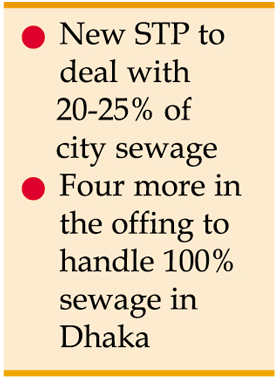
The Dasherkandi plant will be able to treat 20-25 per cent of the 2,000 million litre sewage generated in Dhaka city daily.
He mentioned that the plant is modern and environment-friendly one. The quality of water treated in the plant is good enough.
The four other modern sewage treatment plants will be constructed in Pagla, Rayerbazar, Uttara and Mirpur aiming to gain the capacity to treat 100 per cent sewage of Dhaka city by 2030.
When the Pagla sewage treatment plant is completed, some 40 per cent of sewages generated in Dhaka can be treated.
The Dasherkandi STP was implemented on 62 acres of land at the cost of Tk 34.82 billion. Of the cost, Tk 11.06 billion came from the government's fund, while Tk 100 million from Dhaka WASA, and Tk 23.66 billion from EXIM Bank of China.
The work of the China-funded project started on July 01, 2018. The operation and management of the plant will be run by its contractor, HydroChina Corporation, for one year.
According to the project outline, a waste lifting station on the west side of Rampura Bridge, a five-kilometre trunk sewer line from Rampura to Aftabnagar and Dasherkandi plant and the main treatment plant at Dasherkandi have been constructed.
© 2026 - All Rights with The Financial Express

