Speakers at a policy dialogue on Wednesday said Bangladesh's power and energy sector urgently required policy predictability, institutional reforms, and long-term planning to ensure sustainable investment.
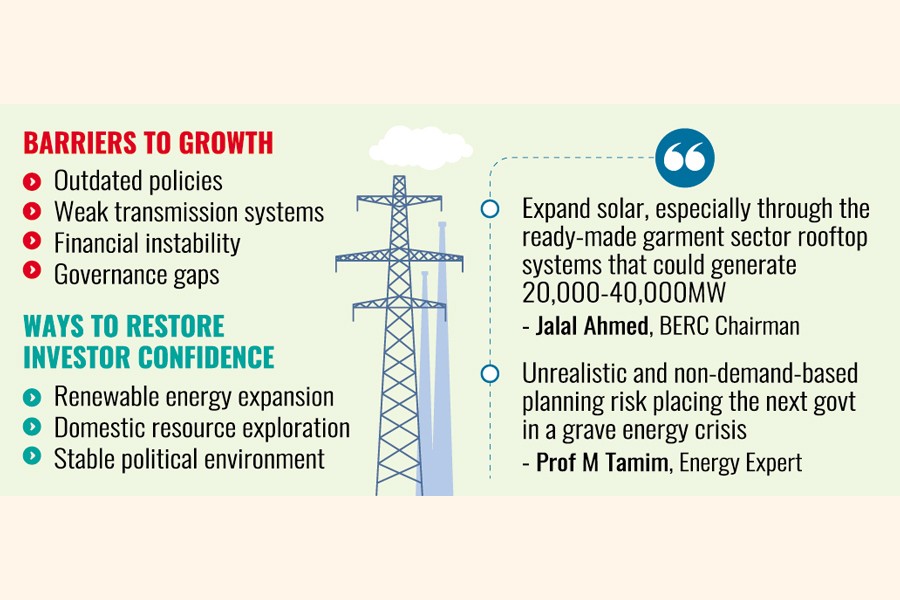
They stressed that outdated policies, weak transmission systems, financial instability, and governance gaps were undermining growth.
Besides, they underscored that renewable energy expansion, domestic resource exploration, and a stable political environment were essential to restore investor confidence.
Above all, they agreed that coordinated action across the government, the private sector, and society was critical for securing the country's economic future.
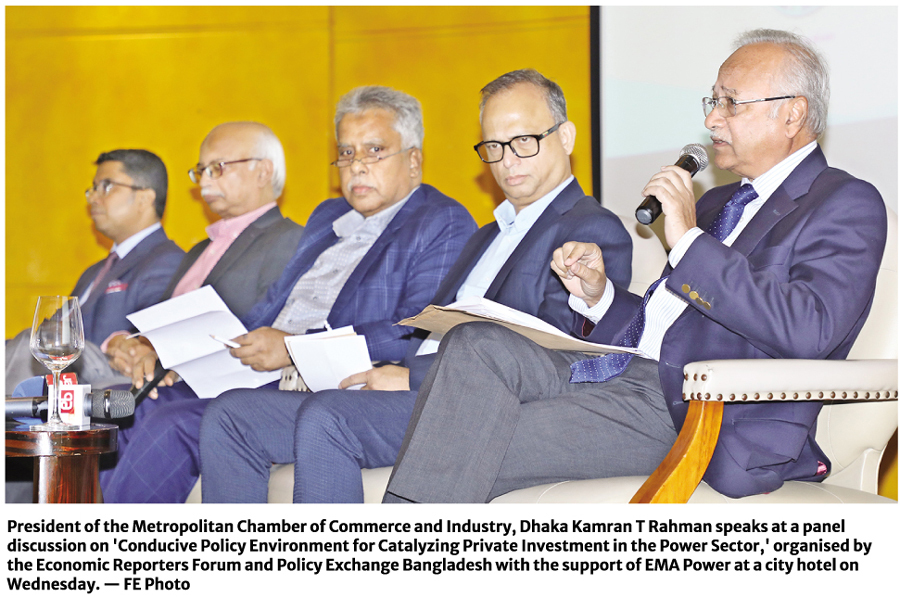
The speakers made the observations at a panel discussion titled "Conducive Policy Environment for Catalysing Private Investment in Power Sector".
Jointly organised by Policy Exchange Bangladesh and Economic Reporters Forum (ERF) with support from EMA Power, the event was held at a hotel in the capital as part of a high-level dialogue titled "Enabling Bangladesh's Growth and Prosperity: Developing a Sustainable Power Sector Investment Climate".
"Bangladesh does not just need more megawatts of power; it needs megawatts that are sustainable, investable, and competitively priced," Abu Chowdhury, director of EMA Power Investment Limited and EPV Thakurgaon Limited.
In his presentation, he cautioned that Bangladesh's energy sector was approaching a structural vulnerability rather than just a capacity shortfall.
He stressed that unless corrective measures were initiated immediately, the country might enter the post-2031 phase with generation assets that would be operationally active but financially unviable, weakening investor confidence in the long run.
"Installed capacity figures paint an optimistic picture, but the real threat lies beneath - declining gas availability, lack of diversified fuel solutions, and mounting delays in project clearances," he said.
Highlighting investors' perspective, Chowdhury noted that tariff instability, regulatory unpredictability, and excessive dependence on subsidy-based fuel imports were discouraging both local and foreign investments.
He urged policymakers to "rethink long-term contracts, accelerate renewable integration, and ensure credible return guarantees for private energy investors," adding that the window for meaningful intervention was shrinking.
Bangladesh Energy Regulatory Commission (BERC) Chairman Jalal Ahmed said the country urgently needed updated policies and realistic planning, noting that the 1996 energy policy was outdated and repeated reliance on high growth projections had created excess generation without transmission readiness.
Referring to the single-buyer model, he stressed that "if the buyer is not financially solvent, the entire power chain suffers."
He highlighted future dependence on renewables and pointed to regional examples, especially Pakistan and India where solar energy adoption was scaling rapidly.
Ahmed said major plants, including an 800MW unit in Khulna, might stay idle for years and urged policymakers to expand solar, especially through the readymade garment sector rooftop systems that could generate 20,000-40,000MW.
BNP Vice Chairman Abdul Awal Mintoo said sustainable growth and investment were impossible without "better politics," as inflation and declining savings had weakened domestic investment capacity.
He cautioned that youth unemployment and a shrinking agricultural workforce demanded urgent reforms and called for combined efforts from politicians, businessmen, and the civil society to restore stability.
ERF President Doulot Akter Mala said a reliable, affordable, and sustainable energy system was essential for industrial expansion and economic progress.
She noted that tariff pressures, liquidity issues, financing uncertainties, and shifting global sustainability standards required a predictable long-term investment framework.
Business Initiative Leading Development (BUILD) Chairman Abul Kasem Khan said power remained the engine of economic growth, supporting exports and private sector confidence.
Referring to Japan International Cooperation Agency's (JICA) Big-B initiative in Cox's Bazar, he stressed that long-term, sustainable energy policy was vital for securing private investment and maintaining economic momentum.
Prof M Tamim, vice-chancellor of Independent University Bangladesh, said unrealistic and non-demand-based planning risked placing the next government in a "grave energy crisis."
He criticised the renewable expansion plan as bureaucratic ambition without proper groundwork and urged accelerated domestic gas exploration through competent international firms.
Jamaat-e-Islami Shura Council member Dr Mobarak Hossain said previous governments had severely damaged the energy and power sector.
He stated that his party would work closely with experts to rebuild institutional capacity and improve sectoral performance.
Dr Mahdi Amin, adviser to BNP's acting chairman, said energy security remained one of the country's biggest economic constraints despite heavy investments.
He called for a transparent, balanced energy mix; stronger domestic resource exploration; and reforms aligned with economic liberalisation to attract foreign investors with merit-based, deregulated systems.
Metropolitan Chamber of Commerce and Industry President Kamran T Rahman said Bangladesh's 28,000-29,000MW installed capacity remained underutilised due to a weak grid, costly fuel, and idle plants.
He stressed that local and foreign investors needed long-term visibility on tariffs, fuel mix, and procurement, alongside regulatory modernisation, competitive bidding, and credible sectoral finances.
Bangladesh Garment Manufacturers and Exporters Association (BGMEA) President Mahmud Hasan Khan said long-term price predictability was essential for industrial competitiveness as frequent policy shifts disrupted factory planning.
He urged the government to remove tax anomalies that were hindering rooftop solar expansion and sought clarity on the emerging merchant PPA regime, noting unresolved issues regarding wheeling charges and billing modalities.
Among others, Enamul Haque, chief risk officer and managing director of Standard Chartered Bangladesh; Md Ariful Hoque, director general of Bangladesh Investment Development Authority (BIDA); Ahmed Zubaer Mahmud, additional director of the Bangladesh Bank; and Imran Karim, chairman of Confidence Power Rangpur Limited; addressed the event.
bdsmile@gmail.com
© 2026 - All Rights with The Financial Express

