The government posted a sharply higher budget surplus for the first quarter of this fiscal year ending September last as revenue growth surpassed government spending during the period.
This is a rare fiscal breathing space to take actions to stimulate the growth momentum and fight the inflationary pressure through imports and other operations, for example, strengthening the open market sale (OMS) activities.
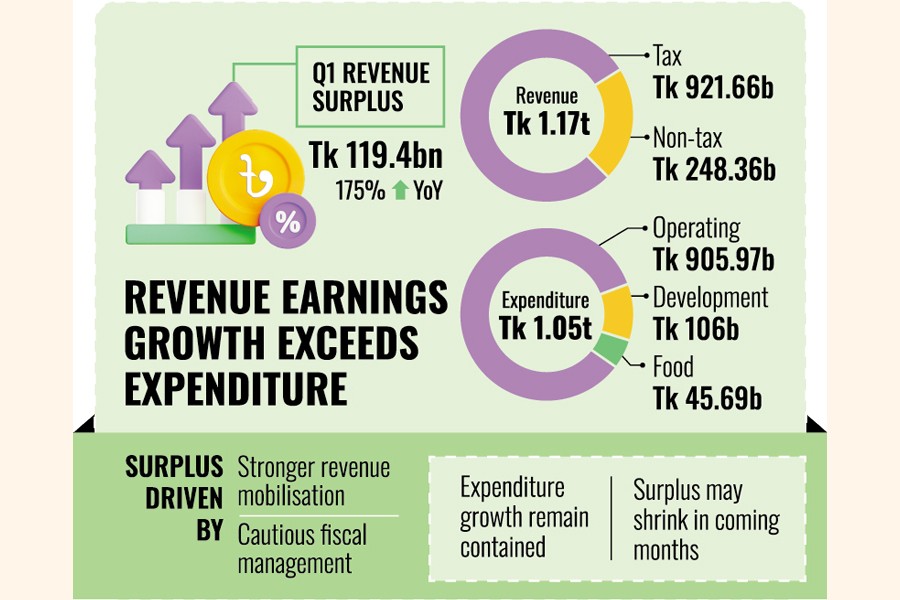
The Finance Division posted Tk 119.37 billion surplus for the July-September period of this fiscal year.
This is nearly 175 per cent higher than that in the same period a year earlier.
The surplus was driven by stronger revenue mobilisation, which reached approximately Tk 1.17 trillion, while the expenditure growth remained contained.
Tax revenue, consisting of both National Board of Revenue (NBR) and non-NBR sources, amounted to Tk 921.66 billion during the period under review.
Non-tax revenue, consisting of the government's levy and fees as well as dividend earnings from state-owned entities, including the Bangladesh Bank, amounted to Tk 248.36 billion during the period.
On the spending side, the total expenditure reached Tk 1.05 trillion, well below revenue inflows.
Operating expenditure, consisting of salary, subsidy, and others, stood at Tk 905.97 billion.
Development expenditure for the period remained, however, subdued at over Tk 106 billion.
Food-related expenditure, mainly the public procurement of both rice and wheat, reached Tk 45.69 billion.
The government procures the staples to provide the same to the safety net programmes and for market intervention.
Officials familiar with the matter told The Financial Express this sharp improvement was due to improved tax administration and cautious fiscal management.
"Revenue performance has improved, but development expenditure remained restrained," the Finance Division official said, wishing anonymity.
However, challenges to keep the revenue growth momentum during the coming months remain.
The surplus may shrink in the coming months, at a time when development expenditure accelerates and subsidy payments need to be made.
This surplus, however, curtailed the government's reliance on domestic borrowing, contributing to the lower treasury yield.
jasimharoon@yahoo.com
© 2026 - All Rights with The Financial Express

