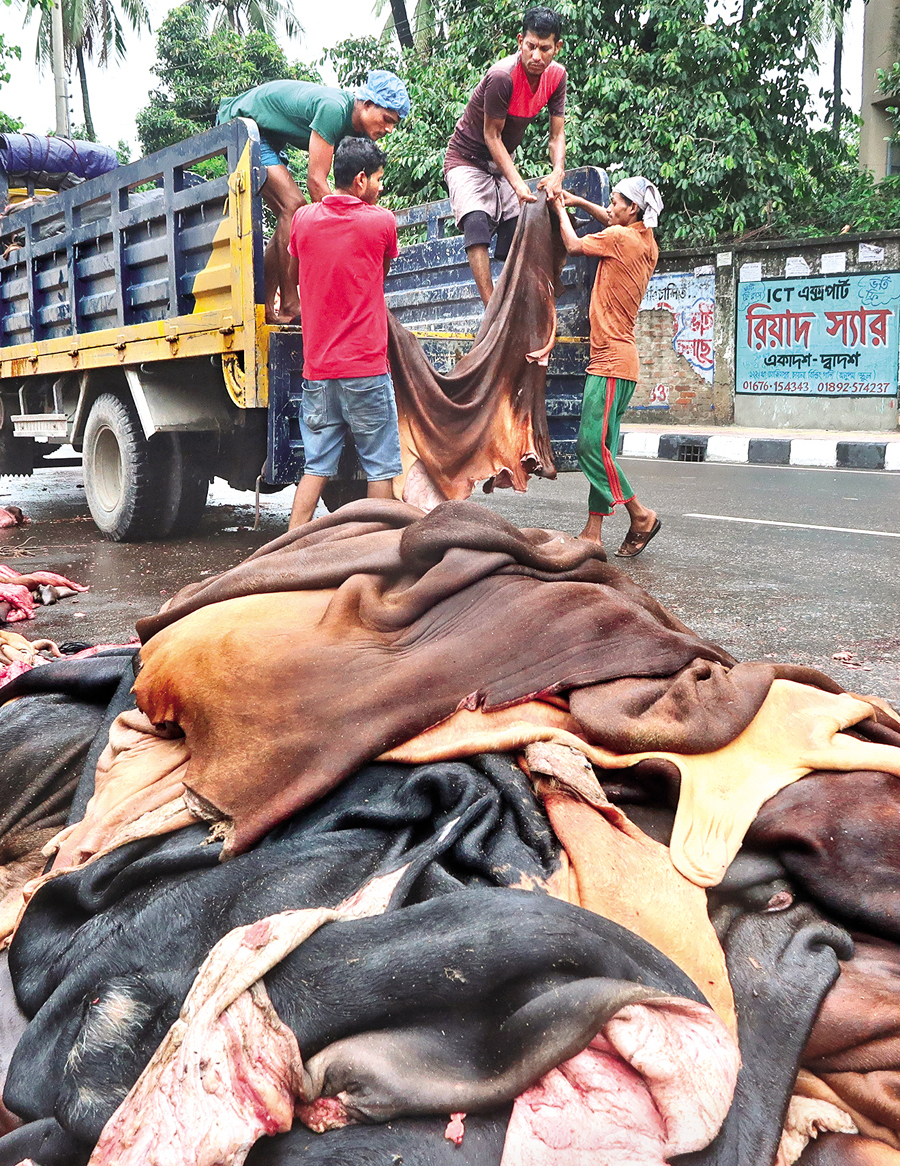
Pieces of rawhide of sacrificial animals are being loaded onto a truck to take them to Posta in old Dhaka for preservation. Traders collected the rawhide on the day of Eid-ul-Azha. The photo was taken in Azimpur area of the city. — FE Photo
Days of heavy rain and the resultant waterlogging have severely hampered rawhide trade this Eid-ul-Azha, forcing seasonal traders to count heavy losses from rawhide sales wholesale.
They got much lower prices for cattle hide than the government-fixed rates.
The trading rate of cowhide was still much below the official rate of Tk 50-55 per square feet/sq ft while a sizeable amount of goat skins was found going to trash as nobody was ready to buy them in Dhaka city.
Seasonal traders bought cowhide at Tk 400-750 (Tk 25-30 sq ft) each skin from households depending on size while most of them could now hardly sell as per the government rate of Tk 50-55 sq ft to skin merchants in Posta, the city's key rawhide market.
Faridul Islam, a seasonal trader, bought 25 big-sized cow skins from West Dhanmondi households at Tk 650-700 each.
He sold the items at Tk 850-950 only to a trader in Posta on Friday noon, marking a loss including the costs of salt for preservation.
"It's not possible for me to preserve the skins at home during these heavy rainy days as water falls in the space where I used to stock skins."
Mr Islam said water-logging in Rayerbazar-Mohammadpur-Beribandh area forced many seasonal traders to sell skins much earlier.
"The price is less than half the government-fixed rate.
A large skin's minimum price should be Tk 1,420 (28 sq ft), but Posta traders were asking the highest Tk 1,100 for any cowhide," said Riad Sarker, another trader.
Rezanur Rahman, a West Dhanmondi resident, donated the skins of an ox and two goats to a nearby madrasa-cum-orphanage.
He said the madrasa authorities received the cowhide but did not take goat skins.
"On my repeated requests, the meat trader, who prepared my sacrificial animals, took goat skins with him."
Rafiqul Islam Mridha, a meat trader-cum-seasonal rawhide trader, said a goat skin would need one kilogram of salt worth Tk 45 to preserve but "we could hardly sell it at Tk 20".
"The cowhide trade has become uncertain. Who will then take the risk for goat skins?" he said.
However, the government set the goat skin price at Tk 18-20. So, a salted goat skin should be at Tk 90-160 (5.0-8.0 sq ft), according to insiders.
When asked, Bangladesh Hide and Skin Merchants Association secretary general Tipu Sultan said the management of overall rawhide collection this year was going on as expected.
"We've so far received an estimated 100,000 pieces of rawhide in Posta to fulfil our target," he told the FE on Saturday evening.
Mr Sultan said the business in Posta started receiving rawhide carried by traders from different parts of the country, especially in Dhaka and neighbouring areas.
Sultan claimed they were buying cowhide at Tk 700-1,200 (Tk 35-43 per sq ft) depending on size.
He also claimed that most of the seasonal traders expressed satisfaction with prices they were receiving.
The traders at Posta are preserving rawhide with salt.
They will send those skins to Savar tannery estate after 10-12 days.
Bangladesh Tanners Association (BTA) leaders at a press conference at a city hotel on Saturday said an estimated 0.45-million pieces of rawhide were collected at tanneries in Savar until Saturday.
Tanners will collect the rawhide preserved with salts from next week.
The trade body however feared that there are chances of the rawhide getting smuggled to neighbouring India.
"Like previous years, there is a possibility of rawhide smuggling to the Indian state of West Bengal," said BTA chairman Shaheen Ahmed.
He said there are around 40 tanneries certified by the Leather Working Group who need large numbers of cowhide.
Tanners do not get fair prices from the international market since the tannery estate in Savar is not environment-compliant, he said, adding that the Bangladesh Small and Cottage Industries Corporation (BSCIC) has failed to prepare the estate.
"The government should assign any other organisation to renovate the tannery estate and work comprehensively on the common effluent treatment plant (CETP)," he said.
He suggested that the government make a reinvestment of Tk 5.0-7.0 billion to renovate the CETP in order to help the sector rebound.
The BTA said prices of the goat skins plummeted since most of the specialised tanners had been closed.
Meanwhile, senior commerce secretary Tapan Kanti Ghosh said there was no scope for illegal smuggling out of the country, although there was excess supply of skins of sacrificial animals.
"Law-enforcement agencies, including the BGB and the district administration, are on high alert. All measures have been taken by the government to ensure that hides are not smuggled in any way," he said.
He said this while conducting a rawhide trade management and market monitoring drive in Faridpur district, according to a statement.
About prices, according to Mr Ghosh, prices remain slightly lower during Eid due to oversupply of hides and skins.
The hides could be sold at a good price later if preserved appropriately.
The department of livestock services said more than 10-million cattle have been sacrificed this Eid while tanneries countrywide are expected to receive an estimated 9.5-million pieces.
Our Chattogram correspondent adds: Seasonal leather traders alleged that they were receiving lower prices from wholesaler counterparts.
Mohammed Muslim Uddin, president of Chattogram Leather Aratdar Samity, said the collection of sacrificial cattle leathers this year has decreased compared to last year's.
"Our target was 0.4-million pieces. We've so far collected 0.3-million pieces. Traders are preserving leathers at 225 arats in Chattogram," said Mr Muslim.
Sources said Chattogram had 13 tanneries earlier. But 11 tanneries faced closure last year. The remaining two have a demand for 0.15-0.2 million pieces of hides annually.
Talking to the FE, some traders alleged that there was no cooperation from the government for genuine leather traders or owners of tanneries here in Chattogram.
"So, the leather or tannery industry is facing a crisis because of the closing of maximum tanneries in Chattogram," they added.
tonmoy.wardad@gmail.com, saif.febd@gmail.com and
nazimuddinshyamol@gmail.com
© 2026 - All Rights with The Financial Express

