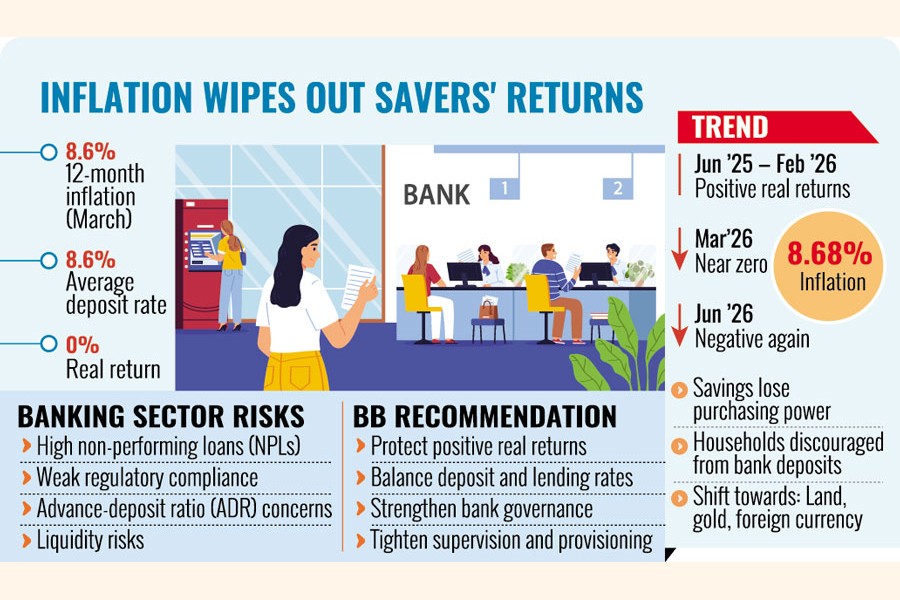
Depositors are earning virtually no real return on their new savings as inflation has remained broadly in line with deposit interest rates, according to a latest publication of Bangladesh Bank, prompting the central bank to warn of continued pressure on households' purchasing power.
The real interest rate on deposits measures the actual return on savings after adjusting for inflation.
Real returns on fresh deposits turned positive in June 2025 and remained so until February this year. However, they fell to nearly zero by the end of March 2026.
The observation was made in Bangladesh Bank's latest 'Banking Sector Update', which reviewed developments up to March 2026.
The publication said depositors' purchasing power remained under pressure as the gap between average deposit rates and inflation remained negligible.
"Depositors continue to experience near-zero real returns," the central bank said in the report.
The report stressed that maintaining an appropriate balance between deposit and lending rates is essential to protect depositors while ensuring businesses and households continue to have access to affordable credit.
The 12-month average inflation rate stood at 8.6 per cent in March, while the average deposit rate remained almost at the same level, leaving the real return on deposits close to zero.
"It is important to balance interest rates to protect depositors while promoting affordable credit," the publication said.
Economists said persistently low or negative real returns discourage financial savings, weaken confidence in the banking system and encourage households to shift funds into alternative assets such as land, gold and foreign currency.
They noted that the 12-month average inflation rate rose to 8.68 per cent in June, while deposit rates remained broadly unchanged or below inflation, pushing real returns back into negative territory.
The report, however, identified several structural weaknesses that continue to weigh on the banking sector, including a high level of non-performing loans (NPLs), weak compliance with prudential regulations and inadequate discipline in maintaining the advance-deposit ratio (ADR).
According to the central bank, elevated NPLs continue to constrain banks' profitability, reduce their lending capacity and increase provisioning requirements.
The report also pointed to lapses in maintaining prudent ADR levels, indicating that some banks remain exposed to liquidity risks despite improvements in overall sector liquidity.
It cautioned that these vulnerabilities require sustained policy attention and stronger regulatory enforcement.
"Without these corrective measures, current vulnerabilities could evolve into systemic risks and trigger wider market volatility, undermining financial stability and economic development," the report said.
Bangladesh Bank has been pursuing a series of reforms aimed at restoring confidence in the banking sector.
These include strengthening bank governance, improving loan classification and provisioning standards, enhancing supervision, and aligning the country's regulatory framework with international banking standards.
The report said ensuring positive real returns on deposits would be important for mobilising domestic savings, which remain a key source of financing for private-sector investment and economic growth.
It also emphasised that a sound banking sector is indispensable for maintaining macroeconomic stability, supporting productive investment and strengthening financial resilience.
jasimharoon@yahoo.com
© 2026 - All Rights with The Financial Express

