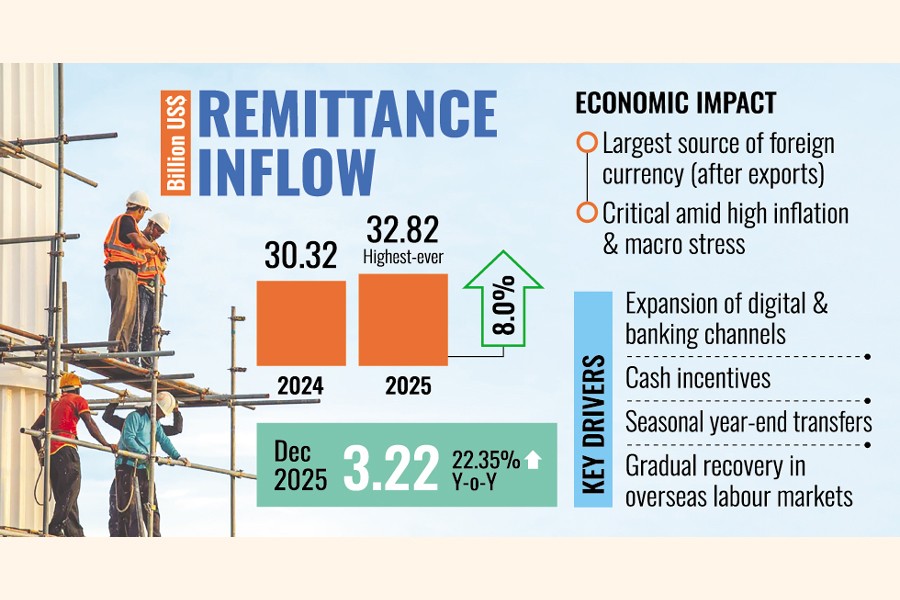
Remittance inflows to Bangladesh surged to an all-time high of US$32.82 billion in the calendar year 2025, underscoring the growing role of migrant workers in supporting the country's economy at a time of persistent domestic and global challenges.
The record inflows have provided crucial relief to the external sector, bolstering the current-account balance, strengthening foreign- exchange reserves and stabilising the forex market, even as concerns lingered over global uncertainty and tighter immigration policies in key host countries.
The 2025 figure marks an increase of more than 8.0 per cent from the US$30.32 billion received in 2024, according to Bangladesh Bank data released on Thursday.
December capped the year on a strong note, with inward remittances reaching US$3.22 billion during the month, up 22.35 per cent year-on-year.
The strong performance contrasts with earlier concerns that global economic uncertainty and tighter immigration policies in some host countries, including the United States, could dampen inflows.
Remittances remain the country's single largest source of foreign currency, surpassing foreign direct investment and official development assistance, except for export earnings.
Central bankers and commercial bankers attribute the rise to a combination of factors, including cash incentives for remitters, the seasonal tendency of overseas workers to send more money in December, and a gradual recovery in labour markets across several major destination countries.
"Banks have expanded digital and banking channels for overseas workers, making formal transfers cheaper, easier and more convenient," said Syed Mahbubur Rahman, managing director and chief executive officer of Mutual Trust Bank PLC.
He said the wider use of digital platforms is helping divert remittance flows from the informal hundi system to regulated channels, improving transparency and lifting official inflow figures.
The increase in remittances is particularly significant as the central bank and the government seek to restore macroeconomic stability, amid persistently high inflation, said Dr Zahid Hussain, an independent economist.
He noted that stronger inflows have placed the external sector in a more comfortable position.
"However, the sustainability of remittance growth will depend on labour market conditions abroad and a stable political and economic environment at home," he added.
According to the Bureau of Manpower, Employment and Training (BMET), more than 4.0 million Bangladeshis left the country for overseas employment over the four years up to fiscal year 2024-25, reinforcing the critical role of migrant workers in the national economy.
jasimharoon@yahoo.com
© 2026 - All Rights with The Financial Express

