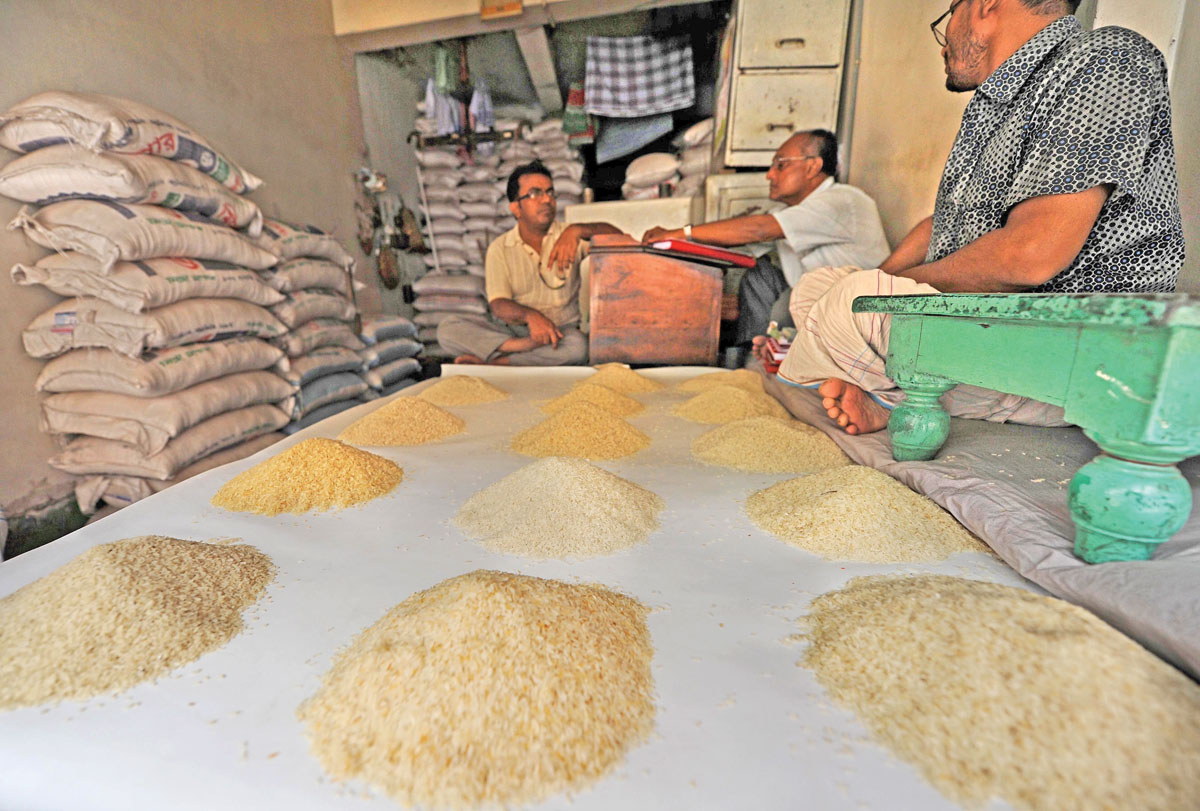
The country is experiencing an uptrend in prices of rice though the global prices continue to maintain a downtrend.
Disruption in transportation caused by political chaos, market manipulation by big players, hoarding in large scale fearing lower production are the major causes behind the surge in price despite a satisfactory production scenario, market experts and sector insiders said.
According to international web-portals like IndexMondi, Bloomberg, research agencies like International Rice Research Institute (IRRI) and USDA, rice prices in global market declined by 5.0 to 5.5 per cent in the past two months thanks to the good harvest in major rice producing countries including Thailand, Vietnam, India, China, the USA and Bangladesh.
An IRRI report indicates a "further fall in rice price as the crops in the fields of most rice growing countries are looking good as the stockpiles of rice in producing countries reach the highest in 12 years".
The US Department of Agriculture (USDA) estimates reserves in Thailand will increase 24 per cent to 15.5 million tonnes in 2013-2014 as global output rises 1.7 per cent to an all-time high of 476.8 million tonnes.
Bloomberg said the price of 5 per cent broken Thai white rice, an Asian benchmark, will drop by 12 per cent to $390 per tonne in next six months which will be a five-year low.
But the global trend has a little impact on Bangladesh as prices start increasing despite a good harvest of 33.76 million tonnes in the last fiscal year (July 2012 to June 2013).
The country is expecting a bumper production in the upcoming Aman harvest due to fine weather, Department of Agriculture Extension (DAE) officials said.
"Rice price has increased by 10 to 15 per cent (Tk 6 to Tk10 per kg of various varieties) in last two months," an official of Department of Agricultural Marketing (DAM) said.
The price is 40 to 45 per cent higher in October, 2013 compared to the corresponding period of 2012, the official said.
He said: "Big millers have a huge stock this year. Political uncertainty is also encouraging them for hoarding."
According to kitchen market sources, rice prices in major cities including Dhaka, Chittagong, Jessore, Khulna, Rangpur, Rajshahi, Sylhet, Comilla were hovering between Tk 34 (Swarna variety in Rangpur) and Tk 50( Miniket in Dhaka) on October 30, 2013 which was Tk 24 to Tk 40 in the same period of 2012.
When contacted, convener of Bangladesh Auto, Major and Husking Mills Owners Association (BAMHMOA) KM Layek Ali told the FE that increase in transportation cost and a slight decline in production are responsible for the surge in rice prices.
He said truck fare has increased by 25 per cent in six months as truck owners hardly rent their vehicles for the fear of damage due to political unrest.
"The fall in boro rice production is one of the causes for the price hike," he said.
"But the price may come down with the beginning of the Aman harvest," he added.
The situation has turned critical as truck owners in rural and suburban areas are now avoiding renting their vehicles for fear of damage due to political chaos that reached its peak in 2013.
Pabna Truck Owners Association president Mizanur Rahman Mohon said that the district has 4050 trucks which transport commodities and other items across the country.
Nearly 150 trucks loaded with vegetables, rice and other goods leave Ishurdi, Sujanagr, Pabna, Shajatpur in Sirajganj upazilas for Dhaka everyday in normal situation.
"The number has come down to 75 to 80 now. Political vandalism is forcing the truck owners to keep their vehicles in the garage rather to go for a trip," he added.
Bus Truck Owners Association of Bangladesh President Ali Khabir Chan also echoed with Mr Mohon and said it is highly risky for an owner and also for a truck driver to bring out vehicle on the road in such a chaotic situation.
A S M Golam Hafeez Kennedy, Associate Professor, Agricultural Economics and Rural Sociology, Bangladesh Agricultural University pointed out that the growing political turmoil in the country is encouraging the well-off families in storing rice.
"Most of the wealthy segment of farmers still have paddy in their Gola (rice storage of farmers) fearing an unprecedented surge of price in upcoming months," he said.
"But a good production in the upcoming Aman harvest may help reduce the price," he predicted.
Rice production in the country was the second highest of 33.76 million tonnes in the last financial year. The country has a demand of nearly 31.0 million tonnes of rice annually, according to the Directorate General of Food (DGoF).
© 2026 - All Rights with The Financial Express

