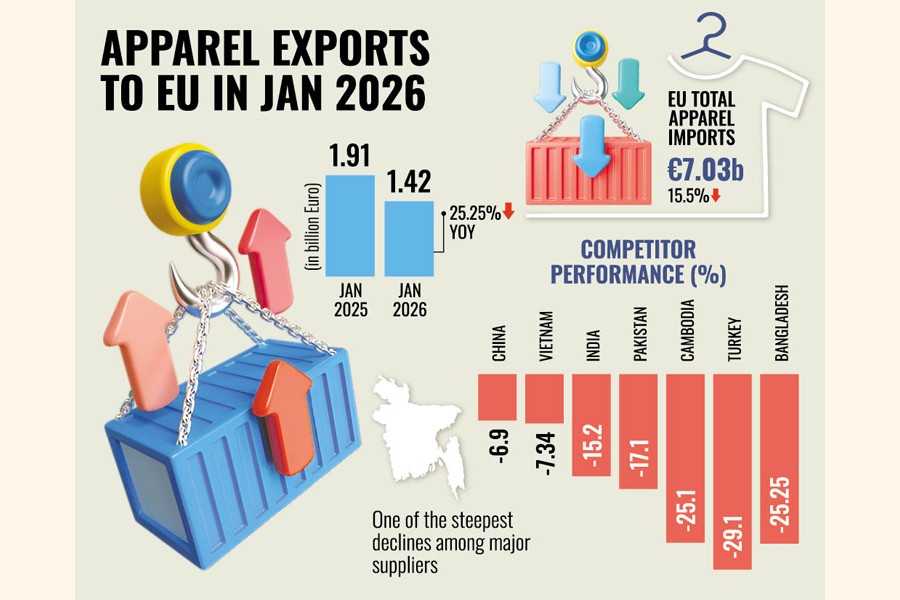
Apparel exports to the European Union began 2026 on a weak footing, with shipments registering one of the steepest declines among major suppliers as demand and prices both softened.
The downturn mirrors a broader slowdown in global apparel trade, with industry insiders warning that a combination of subdued consumer demand, shipping disruptions and geopolitical uncertainty is putting mounting pressure on exporters.
The country earned 1.42 billion euros in January 2026, marking a sharp 25.25-percent year-on-year decline from 1.91 billion euros in January 2025, according to Eurostat data released on March 20.
Knitwear exports to the EU fell to 843.3 million euros, down 26.4 per cent from 1.15 billion euros.
Woven garment shipments dropped to €585.6 million euros from 766.0 million euros, marking a 23.6 per cent decline, the data showed.
Overall, EU apparel imports in January 2026 fell by 15.5 per cent to 7.03 billion euros, down from 8.32 billion euros a year earlier.
Bangladesh's apparel exports to its single-largest market, the United States, also faced a setback in January, as America's overall garment imports declined significantly.
Bangladesh earned $791.77 million from RMG exports to the US in January 2026, registering a 0.9 per cent year-on-year decline, according to the latest data.
Talking to The Financial Express, Mohiuddin Rubel, additional managing director of Denim Expert Ltd, said EU apparel imports in January 2026 fell by 15.48 per cent in value, driven by an 8.36 per cent decline in volume and a 7.76 per cent drop in prices.
This dual weakness, softening demand and falling prices simultaneously, signals a structural market shift rather than temporary discounting, he added.
European consumers are facing cost-of-living pressures, while Red Sea shipping disruptions forced retailers to front-load orders into late 2025, creating a difficult environment, he explained.
Suppliers are now facing acute margin compression, losing revenue on both fronts - fewer orders and lower per-unit prices.
Bangladesh has been hit particularly hard because it specialises in bulk, low-margin garments that EU retailers tend to cut back on during downturns.
The country also relies heavily on disrupted ocean shipping routes and continues to face domestic energy and financial constraints that affect production capacity.
Although Europe's economy was expected to improve in the coming months, recent tensions involving Iran and the United States have introduced new uncertainty, Mr Rubel, a former BGMEA director, said.
This geopolitical instability threatens global supply chains and disproportionately affects vulnerable economies like Bangladesh, which is highly exposed to energy shocks from regional conflicts.
Despite earlier expectations of a recovery from April, geopolitical risks now cast doubt on that outlook.
Bangladesh, as one of the world's most vulnerable countries to energy disruptions, faces additional headwinds beyond the structural decline in imports, he noted.
Meanwhile, China, the largest supplier, showed relative resilience, with apparel exports to the EU declining by 6.9 per cent to 2.22 billion euros from 2.38 billion euros.
EU imports from Vietnam fell by 7.34 per cent in January 2026 to 362.9 million euros.
Turkey's exports dropped sharply by 29.1 per cent to 620 million euros from 874.66 millioneuros.
India recorded a 15.2 per cent decline, earning 336.23 million euros in January 2026.
Cambodia also saw a notable drop, with exports to the EU declining by 25.11 per cent to 313.48 million euros.
Pakistan experienced a 17.1 per cent decline in apparel exports to 288.8 million euros, according to Eurostat data.
Munni_fe@yahoo.com
© 2026 - All Rights with The Financial Express

