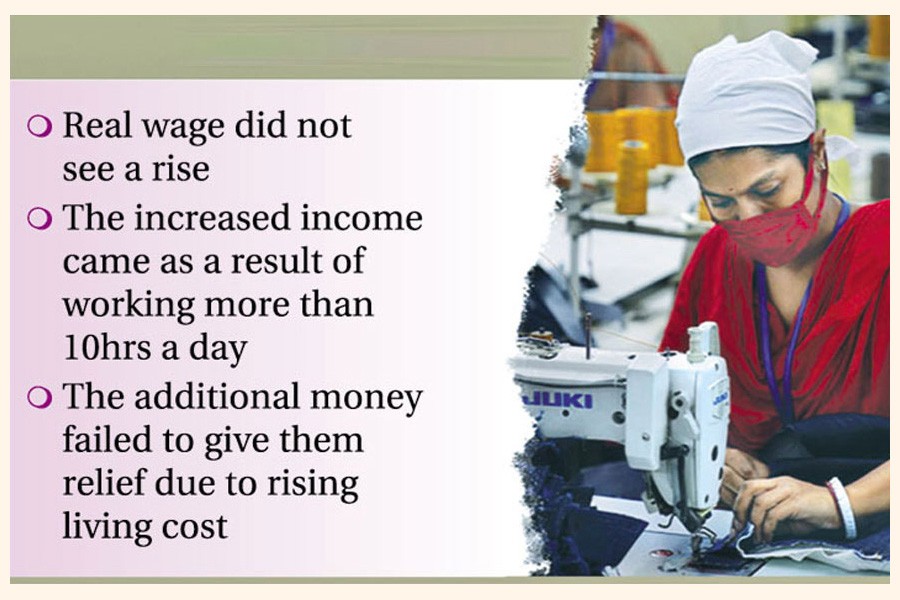
Garment workers' income during the first three months of 2022 increased, mainly due to excessive workload and overtime, according to a latest survey.
Though their real wage did not see a rise, the income increased as they worked more than 10 hours a day followed by flooded work orders and the shortage of workers, it said.
The additional income, however, failed to give them relief or help them go back to pre-Covid situation as the cost of living has increased manifold, it found.
Garment workers' cost of living or house rent has gone up by 17 per cent over a period of two years from 2020, while their expenditure for rice -the most consumed item - has increased as rice price has gone up by 12 per cent between 2017 and 2022, according to the survey.
The findings of the survey, titled 'The Lives of Garment Workers during Covid-19', jointly conducted by the South Asian Network on Economic Modeling (SANEM) and Microfinance Opportunities (MFO), were presented at a webinar on Thursday.
Dr Selim Raihan, Professor, Department of Economics, University of Dhaka and Executive Director, SANEM, and Daniela Ortega Sambo, Director of Operations, Project Lead of the Garment Worker Diaries, MFO, also spoke at the webinar.
Lawfully, a worker's regular working time is eight hours and can do additional two hours as overtime.
Workers went back to work quickly after the Covid lockdown in April 2020, said the study, adding that the number of working hours had increased ever since.
They worked especially long hours in the run up to Eid al-Adha in July 2020 and again in June 2021.
"The long days translated into many workers working excess hours, which are any hours worked during the day that exceed the legal limit of 10 hours a day."
From January to March this year, workers worked 11 hours a day, according to the survey report.
"But they were engaged in working more hours because they enjoyed it, things are not like that. They did more overtime as they could manage to earn additional money by doing so," said Farah Marzan, Project Field Manager, Garment Worker Diaries, while presenting the findings.
Before the pandemic, an operator used to get support from three helpers; at present, they do not get such support, thus increasing their workloads, she explained.
SANEM Chairman Dr Bazlul Haque Khondker explained that the income of male and female workers increased to Tk 13,000 and Tk 12,000 during the first quarter of 2022, respectively, from Tk 12,100 and Tk 10,600 of corresponding period of 2021, as they worked more than 10 hours a day.
Despite some increase in income, they could not go back to the pre-Covid situation as Tk 3,000 per month house rent that remained stable for three years from 2018 went up to TK 3,500 in 2022.
Rice price also increased from Tk 40 per kg to Tk 54 in between January 2017 and January 2022, Dr Khondker explained.
With rising cost of living, the purchasing power of RMG workers is declining despite the additional income.
Mr Khondker, however, suggested keeping the workloads at a tolerable level for sustainability.
Asked, SANEM officials could not give details whether 5.0 per cent annual increment was included in the RMG workers' wages.
The survey also showed that digital payment went down to 53 per cent in March 2022 - this reached to 76 per cent in April 2020 mainly due to the government's wage support programme.
After the end of the programme, many factories have reverted to paying their workers in cash, said the survey without detailing the reasons.
Regarding vaccination, the study shows about 80 per cent of the respondents have received at least one dose of the Covid-19 vaccine - female 77 per cent and male 88 per cent.
Education of children suffered during the Covid pandemic due to a lack of access to the infrastructure supporting online education, said the survey, suggesting careful planning and additional efforts by schools or the relevant authorities with BGMEA coordinating the effort.
SANEM and MFO have been jointly conducting a series of surveys since March 2020 to better understand how the lives of garment workers in Bangladesh have evolved during the Covid crisis.
These surveys are being conducted under the project titled 'Garment Worker Diaries'.
A selected pool of 1,300 garment workers from Dhaka City, Savar, Gazipur, Narayanganj and Chittagong were surveyed every week.
Munni_fe@yahoo.com
© 2026 - All Rights with The Financial Express

