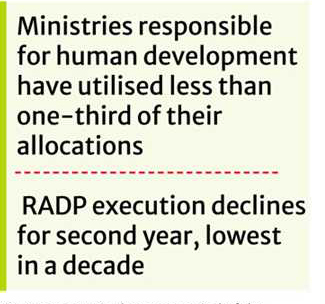
Core ministries responsible for human development have utilised less than one-third of their Revised Annual Development Programme (RADP) allocations during the first nine months of the current fiscal year, according to the latest data from the Implementation Monitoring and Evaluation Division (IMED).
The underperformance of these key ministries, including the Ministry of Primary and Mass Education, Ministry of Health and the Ministry of Education, dragged overall RADP implementation down to 36.19 per cent during the July-March period of FY'26, marking a second consecutive annual decline and the lowest execution rate in a decade, the IMED's monthly ADP progress report revealed on Sunday.
The report shows that ministries and divisions spent Tk 756.07 billion against a total RADP allocation of Tk 2.09 trillion in the first nine months. The implementation rate fell from 36.65 per cent in the same period of the previous fiscal year and 42.30 per cent in FY2023-24.
In absolute terms, development expenditure declined by Tk 72.87 billion year-on-year, representing an 8.79 per cent drop from last year's Tk 828.94 billion.
Economists and development experts attributed the slowdown to weak implementation capacity, lack of institutional will and poor accountability.
They noted that around Tk 1.33 trillion would need to be spent in the remaining three months to fully implement the RADP, a target they described as 'highly challenging' under existing fiscal discipline constraints.
Data further show that out of Tk 1.28 trillion allocated from the government's own resources, only Tk 422.93 billion was utilised during the period, representing a 33.04 per cent utilisation rate.
In contrast, utilisation of foreign assistance stood higher at 40.08 per cent -- Tk 288.6 billion spent against an allocation of Tk 720 billion.
Among key social sector institutions, the Medical Education and Family Welfare Division spent Tk 2.66 billion, or 19.68 per cent of its Tk 13.54 billion allocation, while the Health Services Division utilised Tk 6.78 billion, equivalent to 21.69 per cent.
The Ministry of Primary and Mass Education spent Tk 20.13 billion, or 24.99 per cent of its Tk 80.54 billion allocation.
The ICT Division achieved 28.90 per cent implementation, while the Road Transport and Highways Division recorded 31.39 per cent utilisation.
Other ministries showed slightly better performance, with the Ministry of Women and Children Affairs utilising 32.90 per cent of its allocation, the Ministry of Disaster Management and Relief 33.02 per cent, and the Technical and Madrasa Education Division 33.56 per cent.
The overall slowdown in ADP implementation has raised concerns over its long-term implications for human development outcomes.
Experts warned that persistent underutilisation in the education and health sectors-already constrained by limited allocations and repeated budget cuts-could hinder future human capital development.
IMED data also point to structural weaknesses in project execution, with officials citing administrative disruptions, delays in appointing project directors, procurement bottlenecks and ongoing project reviews as key factors behind the sluggish implementation pace.
jahid.rn@gmail.com
© 2026 - All Rights with The Financial Express

