The government will strengthen technology-driven monitoring and take tougher legal action to curb tax evasion by wealthy individuals and large corporate entities, says Finance Minister Amir Khosru Mahmud Chowdhury while detailing financial-sector action plans.
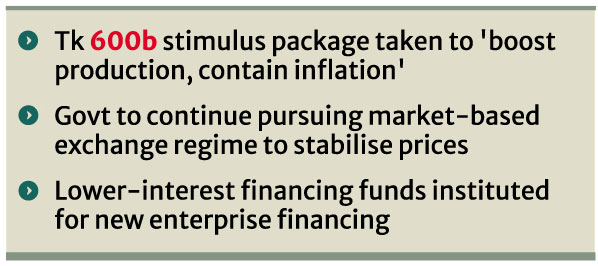
He mentions that the new government is maintaining a tight monetary policy and introducing a Tk600-billion stimulus package to boost production and contain wayward inflation.
The finance minister disclosed the measures Sunday during the question hour in the ongoing first budget session of the 13th Jatiya Sangsad.
 He was responding to separate written questions from lawmakers Md Fazle Huda of Naogaon-3 and A.K.M. Fazlul Haque Milon of Gazipur-5 during the parliamentary sitting chaired by Speaker Hafiz Uddin Ahmed Bir Bikram.
The finance minister mentions that the government has adopted a series of stringent measures, including technology-based monitoring and risk-based audits, to reduce the revenue-collection gap and prevent tax evasion by high-income individuals and major corporate entities.
To make the tax system more transparent and accountable, the government is expanding the taxpayer database, strengthening information sharing with various public agencies, and taking strict legal action against deliberate tax-evaders. At the same time, it is working in close coordination with Bangladesh Bank to contain inflation.
He says the policy interest rate (repo rate) has been maintained at 10 per cent for the first half of fiscal year 2026-27, while a Tk600-billion stimulus package has been introduced to boost production and improve supply.
The government will also continue to pursue a market-based exchange regime to help stabilise prices.
The finance minister explains that the current government's strategy is to increase revenue collection without imposing additional tax burdens on ordinary citizens. Instead, it is focusing on curbing tax evasion by large corporations and high-income earners.
As part of the initiative, electronic tax-return system for corporate taxpayers is being expanded rapidly. The National Board of Revenue is also enriching its taxpayer database and integrating information through API-based data exchange with various government agencies.
Risk-based audits and investigations have been strengthened by using industry-specific benchmark indicators to assess expected tax revenue from different sectors. The scope of online withholding-tax collection has also been expanded, while deliberate tax-dodgers are being subjected to strict legal action.
On inflation, the finance minister has said the surge in prices, which began in April 2022, started easing from November 2024 following a series of measures taken by the government and Bangladesh Bank. Inflation gradually declined to 8.17 per cent on a point-to-point basis in October 2025 before rising again to 9.42 percent in May 2026 due to domestic-and international -market pressures.
To address demand-driven inflation, he says, Bangladesh Bank has kept the policy interest rate unchanged at 10 per cent for the first half of the current fiscal year. However, the government believes that supply-side constraints remain a major driver of inflation. To address this, the central bank has announced the aforesaid stimulus package aimed at increasing production and ensuring an adequate supply of goods.
According to the finance minister, Tk 410 billion of the package will come from surplus liquidity held by commercial banks, while the remaining Tk 190 billion will be financed by Bangladesh Bank from its own resources.
He adds that the government will continue its flexible, market-based exchange-rate policy to stabilise the US dollar and support long-term inflation control.
Replying to a written question from Kurigram-3 lawmaker Md Mahbubul Alam, the finance minister explains that new entrepreneurs will be eligible for collateral-free loans of up to Tk 1,0 million at a maximum interest rate of 7.0 per cent. Those able to provide collateral will be able to borrow up to Tk 3.5 million.
He says the central bank of Bangladesh has introduced several initiatives to make financing more accessible for young entrepreneurs. The banking regulator has increased the size of its refinancing fund for new entrepreneurs in the cottage, micro and small enterprise (CMSME) sector from Tk 1000 million to Tk 5000 million.
The finance minister has also said a separate Tk 5000-million refinancing facility, known as the Startup Fund, has been established to facilitate financing for startup entrepreneurs. Under the scheme, startups will be able to access loans at an interest rate of just 4.0 percent.
In addition to lending support, the Bangladesh Bank has facilitated the establishment of Bangladesh Startup Investment Company PLC, an equity- investment company formed with the participation of 39 scheduled banks. The company will provide equity financing to promising startups alongside conventional loan facilities.
Further elaborating on the measures on economic and finance front, he says a Tk10-billion fund, financed by Bangladesh Bank and implemented through Karmasangsthan Bank to provide low-interest loans to trained, experienced and unemployed youth and women for cottage, micro and small enterprises, was successfully completed on July 14, 2025. A new Tk 12-billion fund is now in its final stage of approval.
The minister notes that these programmes are nationwide and will also benefit entrepreneurs in the northern Kurigram-3 constituency too.
mirmostafiz@yahoo.com
© 2026 - All Rights with The Financial Express

