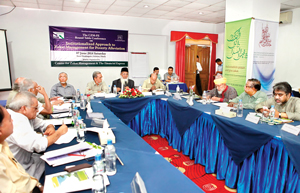
 Former CEC Justice Mohammad Abdur Rouf speaking as the chief guest at a conference titled \'Institutionalised Approach to Zakat Management for Poverty Alleviation\' jointly organised by the Centre for Zakat Management (CZM) and The Financial Express (FE)
Economists, religious scholars, academicians at a roundtable demanded Saturday tax exemption on zakat payment similar to facility enjoyed by corporate social responsibility (CSR) fund.
They expressed the opinion that zakat can immensely contribute to poverty alleviation and take the place of foreign aid if properly collected and disbursed through state machinery or agencies. In many Muslim countries zakat payers get tax exemption, and Bangladesh can follow the path to encourage zakat payment.
"If the zakat funds are properly mobilised, these could replace foreign aid and be utilised on poverty alleviation programmes," said Dr Mohammad Ayub Miah, chief executive officer (CEO) of Centre for Zakat Management (CZM) in his keynote speech at the conference.
CZM and The Financial Express (FE) jointly organised the roundtable titled "Institutionalised Approach to Zakat Management for Poverty Alleviation" at a city hotel where a number of religious scholars, economists, academicians and bankers attended.
Islamic Banking Consultant of AB Bank Ltd M Azizul Huq moderated the conference while CZM Chairman Niaz Rahim offered vote of thanks.
Speaking as the chief guest, Justice Mohammad Abdur Rouf said zakat is one of the five basic principles of Islam and it is neither an aid to the poor from rich people nor a voluntary donation.
"Zakat is mandatory for the rich and the poor's right on the rich's wealth," he said.
He urged the CZM not to use more than 20 per cent of zakat money for their management cost as the cost will come from zakat collection.
He said many people pay zakat but it needs an institutionalised approach to manage zakat for poverty alleviation that could be supportive to government efforts and be an economic tool for social development.
Former adviser to the caretaker government Prof A B Mirza Md Azizul Islam said most of the well-off Muslims pay zakat on their own ways. But it does not make any difference from charity. The zakat money is not used for sustainable development.
He said zakat payers should get tax exemption on their spending on zakat like CSR activities.
Former vice chancellor of South East University Prof Shamsher Ali urged the CZM to play the role of a facilitator to take up giant development projects, instead of doing it themselves.
"One or two such successful development projects will encourage others to participate with the CZM," he said.
Professor of Economics at Dhaka University Abu Ahmed said the activities of CZM should not be limited to a few people. It has to be reached to the common people.
He urged them to work complying with the state laws and rules to be acceptable to all. To do so, people of the government have to be engaged with the process.
Executive Editor of The Financial Express Shahiduzzaman Khan said the FE is proud to be part in the roundtable.
He expressed the hope that pro-poor activities of the CZM will contribute to eradicating poverty in the country.
Senior journalist Sadek Khan said zakat is part of an economic system, the oldest state-sponsored social welfare system.
President of World Islamic Economic Forum Salahuddin Kasem Khan said the zakat system was in vogue here and disappeared during the British colonial period, but it has to be restored now.
"You have to reach people at the grassroots level to tell them who you are and how you would spend the zakat money to earn trust of the people who would give money to your zakat fund," he told the CZM staff.
"If CSR can get tax rebate or exemption, why would zakat payers not get it?" he said.
Chairman of EXIM Bank Foundation A K M Nurul Fazal Bulbul said the country's Islami banks pay a large sum of zakat money each year, but they do not get any tax privilege on the spending despite making repeated requests to the policymakers.
He urged the government to give tax privilege on zakat spending.
Senior journalist Ershad Majumdar said there is no disagreement on the zakat collection and disbursement. But no sustainable way of zakat collection and its use has been developed as yet.
Former secretary to the Bangladesh government Dr Muhammad Mahbubur Rahman said many people do not know how to pay zakat. CZM can organise programmes to make the people aware of it.
"Whoever be in the power, we have to pay zakat, so we must find a solution under the state structure," he said.
He said to use experiences of other Muslim countries like Malaysia, Kuwait and the Maldives etc which use zakat is a very sustainable way.
Prof of Banking and Insurance Department at Dhaka University M Muzahidul Islam said the government can use zakat money for the poverty alleviation. They can do it themselves or can take help from non-government agencies like CZM.
North South University Professor Dr M Mahbubur Rahman said there have not been enough research and studies on zakat in Bangladesh to identify details of zakat collection and its use.
He stressed the need for ensuring transparency in the CZM activities.
Country Director of Islamic Relief Worldwide Shabel Firuz said the poor needs money to be owners of assets.
He said Bangladesh has about 6.0 million extreme poor families. On the other hand, around US$ 3.0 billion can be earned from zakat. So, poverty alleviation is within the reach of Bangladesh, he added.
In his keynote paper, CZM CEO Dr Mohammad Ayub Miah said basically the responsibility of institutional zakat management lies with the government. Even a Muslim government may assign it to corporate organisations.
"In the absence of state initiatives, private sector organisations should take initiative for mobilisation and distribution of zakat in a collective manner," he said.
CZM has identified the following areas of intervention for distribution and utilisation of zakat fund: (a) Jeebika: Zakat based livelihood & human development programme; (b) Mudareeb: Micro enterprise development programme; (c) Naipunna Bikash: Technical training and employment for unemployed youths; (d) Genius: Scholarship programme for the undergraduate students; (e) Gulbagicha: Education & nutrition programme for the distressed children; (f) Ferdousi: Women and children's welfare programme; (g) Insaniat: Humanitarian assistance programme; and (h) Dawah: Awareness building & motivational programme.
He said CZM has proved its worthiness in terms of its capacity for institutionalised management of zakat. CZM ensures hundred per cent transparency of the savings fund of the members. The beneficiaries have full control over their funds.
He urged all to have trust on them and give zakat to their fund for the welfare of the country.
© 2026 - All Rights with The Financial Express

