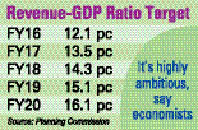
The government is set to enhance its revenue mobilisation target to 16.1 per cent of Gross Domestic Product (GDP) in the final year of the proposed Seventh Five-Year Plan (SFYP), officials said Tuesday.
The proposed target is 5.3 percentage points higher than that of the projected rate of 10.8 per cent in the just-concluded financial year (FY) 2014-15.
Economists, however, said the revenue generation target is highly ambitious in the SFYP as the recent past record of the National Board of Revenue (NBR) and other government bodies is not encouraging.
Official statistics showed the government has been able to raise the tax-GDP ratio from 10.2 per cent to 10.4 per cent during the first four years of the just-concluded 6th FYP period, implemented between FY2011 and FY2015.
The actual data of the revenue income in the terminal year (FY2015) of the 6th FYP is yet to be finalised. In the terminal year, the government aimed at raising the tax-GDP ratio to 10.8 per cent.
The General Economics Division (GED) has already drafted the SFYP, to be implemented during the FY2016-FY2020 period. The draft is expected to be finalised by next month.
Economist Dr Zaid Bakht said the revenue income target as per cent of GDP in the 7th Five-Year Plan will be challenging for the country.
"Since the capability of the NBR has not improved up to the mark, the higher tax income target will be challenging in the coming years. However, massive reforms can help achieve it," he told the FE.
Dr Bakht, Research Director at the Bangladesh Institute of Development Studies (BIDS), said the government will have to work to increase the tax-nets including individual income tax and revenue from house rents.
"In most of the cases, many house-owners do not pay adequate taxes on their income from rents and thousands of taxable persons are still out of the tax net. If the government can trace them, the country's direct tax will increase to a remarkable amount," he said.
The GED has set a target to raise the revenue-GDP ratio to 12.1 per cent in starting year of the SFYP (FY2016), 13.5 per cent in FY2017, 14.3 per cent in FY2018, 15.1 per cent in FY2019 and 16.1 per cent in the terminal year of the SFYP (FY2020) from that of 10.8 per cent in the last FY2015.
Economist Dr Mirza Azizul Islam said more than five percentage points jump in the revenue income as per cent of GDP within five years is too ambitious and difficult to achieve.
"In addition, the government has lowered corporate tax and advance income tax (AIT) on exports. These measures are likely to reduce the overall revenue earnings," he said.
Dr Islam said unless a massive reform in the tax structure is struck, the ambitious revenue target will be highly challenging.
GED Member Professor Shamsul Alam has defended the target of the revenue-GDP ratio saying since the economy is surging in impressive rates, the higher revenue income will be possible.
The government has taken a better plan to conduct reforms in revenue earnings system which is expected to boost tax income of the government in the coming years, the confident GED Member, who is preparing the SFYP, told the FE.
Tax-GDP ratio is one of the poorest in Bangladesh compared to that of other countries in South Asia. It is 15 per cent in India, 12 per cent in Pakistan, 13 per cent in Sri Lanka, 13 per cent in Nepal and 14 per cent in Bhutan. The ratio is 25 per cent in Vietnam and 18 per cent in China.
kabirhumayan10@gmail.com
© 2026 - All Rights with The Financial Express

