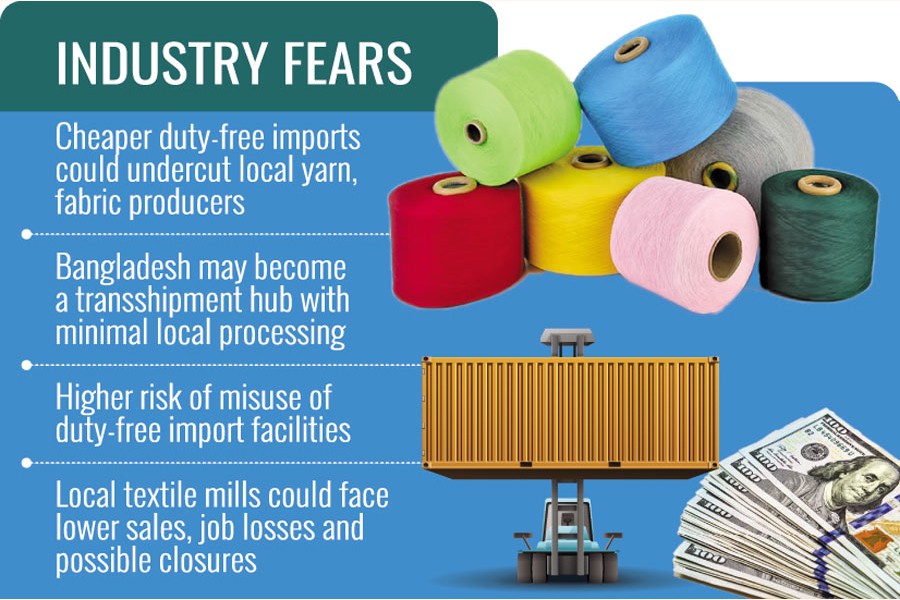
Primary textile millers have expressed deep concern over a proposed budget measure to abolish the minimum value-addition requirement for exports produced from duty-free imported raw materials.
They warned that the move could weaken domestic backward-linkage industries, increase import dependence and even force some factories to shut down.
The concern stems from a proposal in the national budget for FY2026-27 to remove the existing 30 per cent value-addition requirement for exporting goods manufactured from duty-free raw materials imported against bank guarantees without a bond licence.
The government has also proposed extending the facility to 10 new sectors in addition to the existing eight industries - including readymade garments, leather goods and plastics - allowing them to import raw materials against bank guarantees without obtaining a bond licence.
The measure has been proposed as part of efforts to expand export-oriented industries and diversify the country's export basket.
However, textile millers argue that the proposal could have unintended consequences for local backward-linkage industries, particularly the spinning, weaving and textile sectors that supply the garment industry.
They claim the facility would create uneven competition by allowing duty-free imported raw materials to flood the market, making it difficult for local producers to compete.
Industry leaders said the government could consider extending the facility to selected emerging sectors to support export diversification, but warned against applying it broadly, particularly to the readymade garment sector, the country's largest export earner.
They also argued that the proposal runs counter to the country's export-import policy, which requires a minimum level of value addition, and could complicate Bangladesh's efforts to secure preferential market access after graduating from Least Developed Country (LDC) status.
Speaking to the Financial Express, Md Salehud Zaman Khan, Managing Director of NZ Tex Group, described the proposal as a "suicidal decision" if implemented in its current form.
Explaining his concerns, he said exporters could theoretically import raw materials worth Tk 100 and re-export products worth only Tk 101, as there would be no minimum value-addition requirement.
"We are not against duty-free imports through bank guarantees, but there must be a value-addition threshold. There can be debate over whether it should be 25 per cent or 30 per cent, but some minimum requirement must remain," said Mr Khan, a former vice-president of the Bangladesh Textile Mills Association (BTMA).
He warned that Bangladesh could effectively become a transshipment route for foreign goods, creating risks related to rules of origin.
"Products made in China or elsewhere could simply be relabelled as 'Made in Bangladesh' with minimal processing," he said.
Value addition represents the country's net export earnings and should remain a key policy consideration, he argued.
Mr Khan further noted that after LDC graduation Bangladesh will no longer automatically enjoy duty-free market access in major export destinations such as the European Union, the United Kingdom, the United States, Japan and other markets.
To maintain preferential access under future trade arrangements, he said, Bangladesh would need to increase value addition in key export sectors to more than 40-50 per cent.
Industry insiders said the Ministry of Commerce has already begun discussions with trading partners, including the European Union, the United Kingdom and Japan, on Free Trade Agreements (FTAs), Comprehensive Economic Partnership Agreements (CEPAs) and other bilateral and multilateral trade arrangements aimed at preserving market access after graduation.
They noted that many of these negotiations place significant emphasis on value-addition requirements and rules of origin.
According to industry sources, double-stage transformation requirements under Product Specific Rules (PSRs) are expected to become increasingly important, while obtaining GSP+ benefits from the European Union would require at least 40 per cent value addition.
They added that current duty-free access to markets such as Australia and Canada already requires a minimum value-addition threshold of 50 per cent.
The issue of double-stage transformation has also featured prominently in recent trade negotiations concerning continued preferential access for Bangladeshi exports, they said.
Khorshed Alam, Chairman of Little Star Spinning Mills Ltd, alleged that the proposed measure could further increase misuse of duty-free import facilities at a time when the domestic market is already saturated with imported raw materials brought in under bonded arrangements.
He claimed local spinning mills are struggling to sell yarn and fabric because they cannot compete with imported alternatives.
According to Mr Alam, domestic spinners previously supplied textile inputs worth around US$12 billion annually to the local market, but that figure has now fallen to between US$7.5 billion and US$8.0 billion.
He alleged that the remaining demand - worth around US$4 billion - is being met through imports brought in under bonded facilities.
"If the value-addition requirement is abolished, our sales will decline further and many mills may face closure," said Mr Alam, who is also a BTMA director.
When asked for his assessment, Policy Exchange Bangladesh Chairman M Masrur Reaz described the proposal as "a development in the wrong direction".
Given Bangladesh's upcoming LDC graduation and ongoing negotiations over GSP+ facilities with the European Union, he said the country should focus on strengthening backward-linkage industries rather than encouraging greater reliance on imports. "Bangladesh needs to enhance its domestic industrial base and backward-linkage capacity to improve export competitiveness. This policy risks undermining that objective by encouraging imports," he said.
In an immediate reaction to the budget, BTMA President Showkat Aziz Russell urged the government to retain the value-addition requirement, taking into account the competitive challenges Bangladesh will face after LDC graduation.
He warned that removing the existing 30 per cent value-addition obligation for imports made under bank guarantees could pose serious risks to domestic industries and create opportunities for misuse of the facility.
"The withdrawal of the existing 30 per cent value-addition requirement on raw material imports through bank guarantees may pose a risk to local industry and there is a danger of abuse," he said.
Munni_fe@yahoo.com
© 2026 - All Rights with The Financial Express

