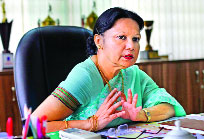
 Professor Nazma Begum — FE Photo
Private investment remained almost stagnant for the last couple of years mainly due to absence of business-friendly environment in the country, said a senior economist.
It was rising in absolute term, but hovering at around 23 per cent in real term or as a ratio of Gross Domestic Product (GDP), Professor Nazma Begum, Chairperson at the Department of Economics, University of Dhaka, pointed out.
Against the backdrop, she suggested providing incentives in the upcoming budget for the fiscal year 2017-18 (FY18) to push up the private investment.
"Private investment is rising in absolute value as economy is growing," she told the FE. "But as percentage of GDP, it is almost stagnant."
A provisional estimate of Bangladesh Bureau of Statistics (BBS) showed that private investment increased to Tk 4.50 trillion in the outgoing FY from Tk3.98 trillion in the last FY.
At the same time, the ratio of private investment to GDP is estimated to be 23.01 per cent which was 22.99 per cent in FY16.
"Our Seventh Five Year Plan has identified private investment as one of the main driver to achieve the development goals," she added. "If we can't enhance the private investment, it will be very difficult to achieve the goals and targets."
Dr Nazma was of the view that the status of the country's investment environment is not very good or optimistic as reflected in the cost of doing business indictors that the World Bank releases annually.
"Bangladesh ranked 176th among 190 countries of the world in the overall index of ease of doing business means the country is among the few countries where investing and running business is very difficult," she continued.
She mentioned that ranking in different indictors provide the better scenario of the country's investment environment.
For example, as per the report, it takes as long as 404 days to get electricity connection in Bangladesh while it is on average 137 days in South Asia.
"Again, on enforcing the contract, we are ranked at 189th and it takes as long as 1,442 days in Bangladesh which is not encouraging for investment," she added.
The senior economist observed that the macroeconomic situation was comfortable.
"The inflation is reasonably low now while GDP growth is above 7 per cent though remittance and exports have slowed down recently," she said.
She pointed out that the foreign investment improved slightly in the recent years. According to Bangladesh Bank statistics, the net inflow of foreign direct investment (FDI) increased by around 4.50 per cent to $2.33 billion last year which was $2.23 billion in 2015.
Dr Nazma, however, opined that the positive macroeconomic trend is yet to attract adequate private investment.
"We need to improve our infrastructure," she added. "We need to work more in the area of governance to improve it." She stressed the need for monitoring the development works.
"We have to ensure accountability and transparency of the project implementation, the budget implementation through intensive and evidence-based monitoring," she said.
"We also need to improve the implementation capacity and enhance effective coordination among the different ministries and bodies to support private sector," she continued.
The economist, however, mentioned that the situation could not be changed overnight and it would take time to improve the governance.
In this connection, she said that the Special Economic Zones (SEZs) should be made operational. "The zones which are closer to the ports should be operational on priority basis."
On budgetary measures to boost the private investment, Dr Nazma was of the view that the domestic market oriented small and medium enterprises (SMEs) should get some fiscal policy supports and incentives.
"So far, there is a trend to give more support to the export-oriented industries due to their lobbying capacity and some other reasons," she added.
In the FY18 budget, Dr Nazma recommended taking more initiatives for better maintenance of the existing infrastructure, including the ports.
She also stressed on providing support to the labour market as there was a huge mismatch between the demand of industries and supply of labour force in the market.
"Investors are not getting their required skilled workers due to lack of relevant training while many young people are looking for jobs," she added.
Dr Nazma, the first woman chairperson of the department of economics in the history of Dhaka University, pointed out that through providing skills training, many unemployed people would get jobs.
"The employment generation will boost effective demand as well as consumption which will ultimately draw more investment," she explained.
"There is also no alternative to investment in education and so more allocation is required," she added.
Dr Nazma, however, mentioned that it is not the budgetary allocation but the lack of implementation and realisation, which is more important.
"The budget should be made performance based," she added. "There is a gap between allocation, target and implementation. With yawning gap, we can't get the benefit of a big budget."
asjadulk@gmail.com
© 2026 - All Rights with The Financial Express

