Bangladesh has shown remarkable progress in the production of vegetables, with output growing at more than 15 per cent over the last five years, insiders said on Saturday.
Despite impressive year-on-year growth, vegetable prices continue to burden lower-middle and poor households, experts said. The high prices are attributed to problems in marketing agricultural products, including profiteering by middlemen and transportation costs, they added.
According to Bangladesh Bureau of Statistics (BBS) data, the country's total vegetables production was estimated at 17.09 million tonnes in the last fiscal year (FY2024-25), 15.29 per cent higher than five years ago.
The BBS's recently published Statistical Book 2025 shows that vegetables production in FY2021 stood at 14.82 million tonnes, maintaining steady year-on-year growth over the last five years.
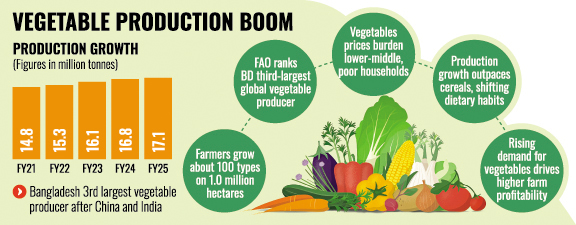
The United Nations Food and Agricultural Organization (FAO) has ranked Bangladesh as the third-largest vegetables producer globally, highlighting its impressive output.
Vegetables are an essential part of the Bangladeshi diet, complementing rice, the staple food. They are highly nutritious, containing vitamins, minerals, and other valuable nutrients.
BBS data shows that vegetables production growth has outpaced cereal production over the years, reflecting a gradual shift in dietary habits toward more nutritious foods.
Dr Muhammad Shafiullah, assistant professor at the University of Nottingham Malaysia Campus, and Dr Faridul Islam, Economics lecturer at Morgan State University, USA, noted in their research that rising demand for vegetables has driven prices higher, allowing farmers to earn greater returns compared to rice. This profitability has fuelled the production boom.
FAO credited Bangladesh with posting one of the highest year-on-year increases in vegetables production, trailing only Uzbekistan and Nepal during the first decade of the 21st century.
Data indicates that vegetables production has more than doubled in just over a decade, making Bangladesh one of the fastest-growing vegetables producers in the world.
Officials and experts say this growth is due largely to better seeds and technologies compared to the 1980s and early 1990s, rather than expanding farmland. Department of Agriculture Extension officials also cite policy support, farmers' adoption of hybrid seeds, home gardening, and off-season and all-season cultivation as contributing factors.
Some of the most commonly grown vegetables in Bangladesh include aubergines, tomatoes, cabbages, cauliflowers, various gourds, pumpkins, lady's fingers, cucumbers, radishes, beans, carrots, spinach, amaranths, yard-long beans, drumsticks, and arums. Many are rich in vitamins A, B, C, E, and K, folic acid, calcium, phosphorus, and iron.
Despite this growth, rice and other cereals occupy over 75 per cent of the country's 8.5 million hectares of arable land, leaving limited space for vegetable cultivation. Experts note that further growth will require a cultural shift from a rice-centric diet to a more balanced intake of vegetables and proteins.
BBS data shows production steadily increased from 14.82 million tonnes in FY2021 to 17.90 million tonnes in FY2025.
Emeritus Professor and agricultural economist Dr MA Sattar Mandol said vegetables have now become a cash crop, driving higher production.
He added that rising market demand, repeated farming methods, high-yield seed varieties, and changing food habits also contributed to growth.
Vegetables exports have risen year-on-year, further incentivising production, Dr Mandol said. However, high market prices continue to fuel inflation.
According to FAO, China ranks first, India second, and Bangladesh third in global vegetables production. Farmers now grow around 100 types of vegetables on nearly 1.0 million hectares, producing about 17 million tonnes annually.
© 2026 - All Rights with The Financial Express

