Bangladesh has large-scale underinsurance both for life and non-life assets and the deficiency poses potential threats to sustainable economic development, according to a latest study.
The study was conducted under the Bangladesh Insurance Sector Develop-ment Project (BISDP) of Bangladesh, funded by the World Bank (WB).
An extensive fact-finding drive unveils that the current insurance- protection gap in Bangladesh is more than seven times the country's gross domestic product (GDP).
The study report notes that the life industry has the biggest protection gap.
And the non-life protection is also very low, the report reads.
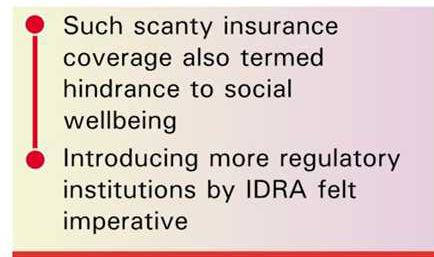
Underinsurance represents a gap between the current state and the full potential of the insurance industry in serving the economy. This is a hindrance or even threat to economic development and the wellbeing of society.
This protection-gap study is part of efforts under Bangladesh government's goal to fulfill the national aspiration of ensuring increased penetration ratio in the insurance sector.
Currently, the insurance penetration in Bangladesh is very low (0.8) compared to other developing countries, resulting in lack of necessary protection in different spheres of life and economy.
It has been found out that among the core reasons for the slow take-up of life and non-life insurance is a lack of understanding of its benefits.
This fact, combined with a lack of awareness of insurance, especially in suburban and rural areas, has contributed to the low insurance-penetration rate.
Insurance companies in Bangladesh have various insurance plans to reach out to the needs of underserved markets and low-income earners.
The study has yielded a set of recommendations for raising the penetration and thus reducing the protection gap.
"Driving insurance penetration through mandatory and social insurance schemes" is among the dos.
Also, it is imperative to strengthen regulatory capacity through structured interventions.
The regulator may introduce key institutions and platforms in the ecosystem, the study suggests in this regard.
The regulator -- the Insurance Development and Regulatory Authority (IDRA) -- should also strengthen corporate-governance guidelines.
Its recommendations for the insurers call for development of customer-centric product design, introduction of new insurance products, and establishment of sharia-compliant takaful products.
In terms of claims and investment, the study prefers adopting digital intervention, distribution channels through digital channels, and the use of technology across the value chain.
The survey under the World Bank-assisted project also identified lack of bancassurance as one of the reasons for the yawning coverage gaps.
When contacted, CEOs of the insurance industry agreed that this study, more or less, reflected the picture of the industry.
"This is a new study, and to my understanding, this is more or less ok as there are no other studies to compare," said NC Rudra, CEO at Meghna Life Insurance.
He strongly feels that bancassurance should be introduced for raising penetration. "This is a very much popular distribution channel in many countries," he mentioned.
Md Imam Shaheen, managing director and CEO of Asia Insurance, told the FE that the non-life-sector protection gap is lower as there is mandatory insurance for some business properties.
The MD, however, says actually there is a need for more studies to assess the accurate picture of the industry. "One study cannot be sufficient."
The IDRA recently organised a workshop with the stakeholders on the findings of the study to seek out modalities of execution of the recommendations.
jasimharoon@yahoo.com
© 2026 - All Rights with The Financial Express

