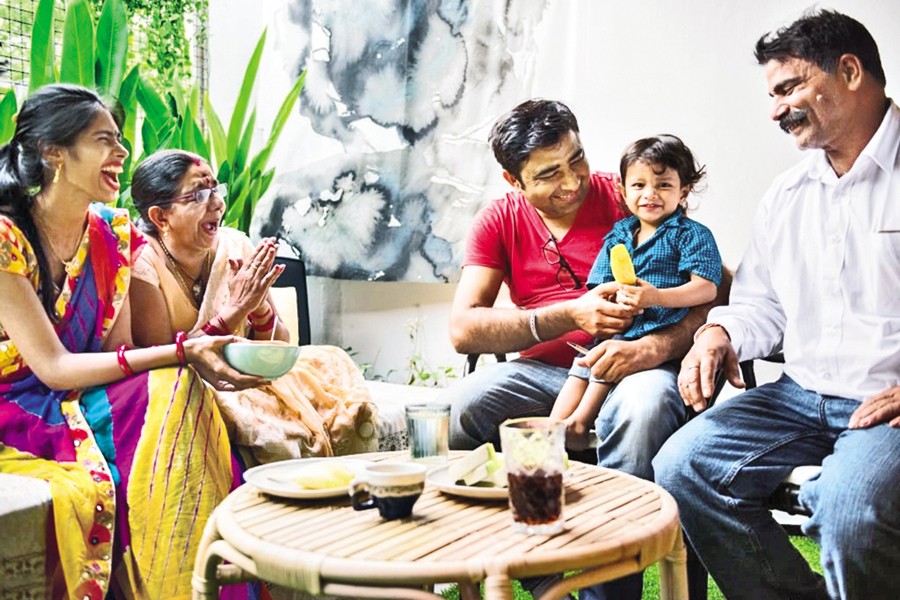
When Sakib Hasan was a child, his family atmosphere would turn festive whenever there would be news of a relative coming to visit them. His mother would send him to the barber for a haircut, wash the walls and floors of the whole house, bring out new bedsheets, plates, and glasses, and cook delicious dishes consisting of fish and meat of various kinds.
 In his childhood, Sakib had seen relatives visiting them all year round. There used to be one or two relatives staying at their house every month, and they wouldn't get tired of it. Nowadays, the arrival of relatives to their home has become limited to the two Eids only, and even the number of relatives paying a visit on these two occasions has declined considerably.
There has also been a reversal to this custom. Sakib doesn't go to his relatives' too.
This writer talked to various people to discover the reasons behind this. Many factors came up in the conversations, but everyone agreed on one similar phenomenon - social media.
The proliferation of social media has diminished people's need to meet a person physically to know what he is up to. In the past, there was no constant posting of pictures, videos, or statuses. There were no instant messages or cheap voice calls; the only way to exchange information was either through costly phone calls or letters through post offices.
But now, communication has become a matter of seconds, thanks to the rise of social media platforms. Our private lives have become public, and everything-from our newly bought apartments to the dish we cook for our dinner is open to all. We're constantly updating our social media feeds, and to learn about a person's whereabouts, we only need to look at their Facebook wall.
"Such ease in getting information has damaged our curiosity and our desire to meet people in person," said Nusrat Jahan, a master's student of Development Studies at Jahangirnagar University.
Another reason contributing to the decline in visiting our relatives is the breaking up of joint families and the formation of nuclear families.
In the age of joint families, people would feel encouraged to pay a visit as they would meet many people at once. The care of the elderly and the affection of the younger members of a house would make us feel at home.
"But now, it feels like I'm intruding into the private lives of some distant people whenever I visit a nuclear family. I feel uncomfortable and eagerly wait for the moment when my visit will be over," said Ariful Islam, a Community Mobilizer at International Organization for Migration (IOM).
Empowerment of women and economic progress are also responsible for the limited visit. Traditionally, women of the house have been the host of invitations. As they're employed now, they're no longer available to host a dinner.
The long shifts at work and the thought of earning more money to pay the children's school fees have taken away many women's interest and ability to invite relatives and host a dinner party.
"I don't feel the energy to talk to people after a hard day at work. On weekends, my only thought is to sleep as much as I can and spend some time with my kids and husband. I feel irritated whenever my husband says that someone or some people are coming over for dinner. Most of the time I order food from restaurants and put on a fake smile on my face just to maintain formality. It's irritating and an extra burden to host people nowadays," said Tasnim Sultana, a Content Writer at Digitech.
There has been a change in the mentality of the people too. A lot of people are suffering from a growing feeling of isolation. Today's young generation doesn't even remember the name of their uncles or aunts, as they've never met them in person. These young people want to be alone with their gadgets; they don't feel interested in meeting new people and engaging in conversations.
As a result, the parents of these kids never feel the urge to invite their relatives, thinking the guests will be hurt due to the rude behaviour of the kids.
Another big reason people don't go to their relatives' anymore is the comparison effect. As everyone is connected on social media, they're constantly watching other people's updates, like purchasing a new handset or necklace. As people are barraged with photos and videos of the buying spree of their relatives, they're left with no choice but to compare themselves and feel low if they can't keep up. As a result, they start to envy their relatives and ditch the idea of visiting them, thinking that they won't be able to appear as sophisticated as their relatives.
There is no easy answer to how these issues will be solved. There is no going back, and it seems that the distance between us and our relatives will continue to grow with time.
Still, we have to try to bridge the gap. One positive thing is that humans can't live without face-to-face contact. No matter how much we interact on social media or how busy we get, we always feel the urge to meet a person, look into their eyes, and engage in a real conversation.
This is just basic human nature. The more virtual we become, the more we forget the urge to develop personal contacts. What we need to do is just to give our relatives a try, think of them as our friends and well-wishers, and strengthen these natural relationships.
abubased15@gmail.com
© 2026 - All Rights with The Financial Express

