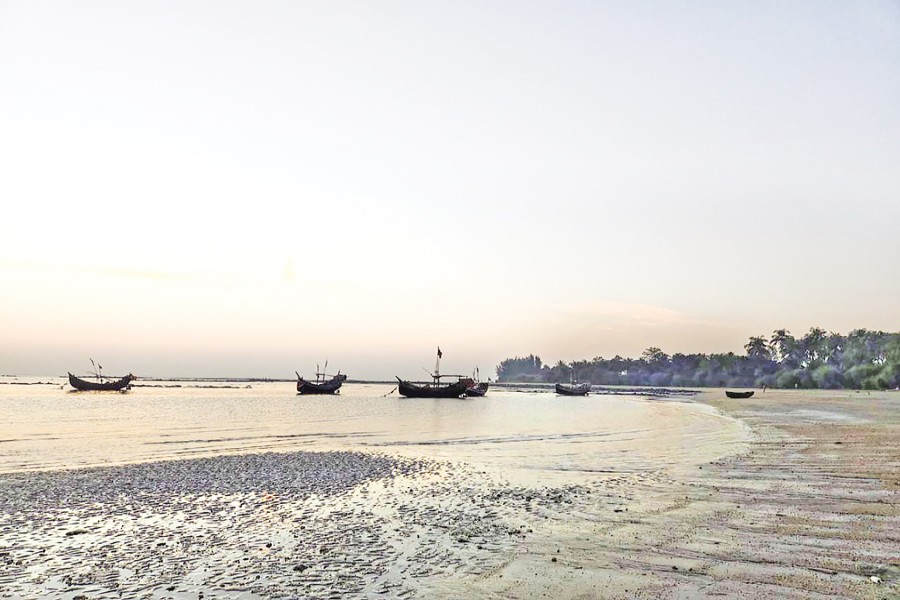
For the first time in recent memory, Saint Martin's Island has gone quiet long before the season's end. The last tourist vessel left the Teknaf jetty on a warm Friday afternoon, and by the next morning, the island's waters carried only the sound of waves. The Ministry of Environment, Forests, and Climate Change imposed a strict nine-month suspension of vessel services to the island, effectively cutting it off from tourism until November.
Saint Martin's tourist season stretches from October to March, a window long celebrated by travellers eager to escape the city's dust and the winter's dullness.
This time, the government shut the door two months earlier. The decision came with a notification outlining twelve specific rules meant to protect the island's ecosystem, coral beds, and long-strained biodiversity.
For years, the island has been overwhelmed by thousands of daily visitors, unregulated boat traffic, and the persistent shadow of plastic waste. Now the government is trying to slow the damage by controlling access more tightly than ever.
Those rules, enforceable under the Bangladesh Environment Conservation Act, mandate that no vessel may head to Saint Martin's without prior approval from the ministry. Even when the island reopens, tourists will have to book their tickets through the Bangladesh Tourism Board's official portal, each carrying a QR-coded pass.
The daily number of permitted visitors will be capped at two thousand-a far cry from the overwhelming crowds that often trooped in during peak seasons.
While the changes feel radical, the island's decline has been gradual and painful, and officials argue that such restrictions are the only way to prevent irreversible harm.
Yet beyond the policy discussions and legal directives lie the people whose lives and memories are tied to the island's shores. Travellers returning from Saint Martin's in recent months carry mixed emotions-some disappointed, others hopeful.
JH Raju, who visited just weeks before the ban, sounded frustrated as he recalled how costly and limited the trip felt. "Previously, you could manage the whole trip within four to five thousand taka," he said. "But now, per person will cost around ten to twelve thousand, and the island has nothing to offer. You cannot go to Chera Dwip." For many like him, the new regulations, increased travel expenses, and restricted movement have stripped the island of its charm, making the journey feel heavier than the joy it once promised.
But not everyone shares the same disappointment. Another traveller, Fayaz Ahmed, described a very different experience, one shaped by an understanding of ecological necessity.
"My experience was good. From an environmental point of view, these restrictions are necessary," he said. "It seemed to me that restricting tourists made the beach and overall environment better than before." His observations touch on something that many regular visitors have felt in recent years: the more crowded the island grew, the less beauty it seemed to hold.
Cleaner beaches, quieter nights, and more transparent waters are becoming rarities, and the brief enforcement of stricter rules gave him a glimpse of what Saint Martin's could look like if treated gently.
Fayaz also reflected on the people who rely entirely on tourism for survival.
The island's population-small, resilient, and heavily dependent on visitors- now faces a long period of uncertainty. Hotels, tea stalls, boat operators, souvenir sellers, coconut vendors, and young workers who earn seasonally will all feel the impact of the prolonged ban.
"The people who fully depend on tourism have it the hardest," Fayaz said. "The government can place some extra charges on tourists to improve the lives of the islanders. This will create a sense of responsibility among visitors as well."
His comments did not stop there. Despite the new rules, some issues remain unresolved. "Single-use plastic still hasn't been fully controlled," he pointed out, adding that Bangladesh could learn from models used in Thailand, where refillable glass bottles replace disposable water bottles. "Saint Martin's is our national asset. It is our collective responsibility to protect it," he said in Bengali-a sentiment born out of both affection and urgency.
These sharply contrasting views from travellers mirror a larger tension surrounding the island itself. Saint Martin's is a place where beauty coexists with fragility.
Coral colonies-once vibrant and abundant-now struggle to recover. Turtles that come ashore to nest often encounter artificial lights or human disturbance. Waste clogs shallow waters, fishing nets tangle unseen life, and every season of excessive tourism pushes the ecosystem a little closer to collapse.
Environmentalists have been warning for years that unless the island is given time to heal, it may one day lose the very characteristics that make it special.
Yet memories of the island run deep. For generations, Saint Martin's has been the symbolic escape, the place of first solo trips, group adventures, family stories, honeymoon photographs, and early morning walks to Chera Dwip.
The idea that such a beloved destination could slip away feels almost personal to many Bangladeshis. The sudden quietness, then, is haunting not because it signals closure, but because it forces reflection. What does it mean to love a place? Does love mean visiting it endlessly, or stepping away long enough to let it breathe?
The islanders themselves now wait in suspended time. In the coming months, their fishing activities will continue, but the absence of tourists will be deeply felt.
Their rhythm of life, once tied to the movement of boats and the demand for hospitality, must adjust. Some hope the government will offer support; others fear being overlooked in the broader conservation push.
If the restrictions succeed in restoring ecological balance, many believe the island's long-term economic potential will be more substantial. But the pathway there is uncertain and filled with sacrifices they must shoulder today.
Meanwhile, the travellers who once flocked to Saint Martin's now watch from afar, carrying their divided impressions. Some will miss the island's easy access and affordable trips. Some will applaud the authorities for taking long-overdue action. Some will wonder if they will ever experience the island as they once did, spontaneous, carefree, full of movement. And others, like Fayaz, will hope that these hardships will eventually protect a place they consider part of their identity.
This pause-unexpected and uneasy-may offer the clearest opportunity yet to rethink how the island should welcome people going forward. Perhaps it will return in November cleaner, calmer, and more resilient. Possibly, travellers will approach it with greater respect.
Businesses may learn to balance profit with ecological sensitivity.
What is certain is that the island stands at a crossroads, shaped by the choices of those who visit, those who govern, and those who call it home. It remains a jewel of Bangladesh, but one whose shine dims with every careless footprint.
As the waves continue to break gently on an unusually empty beach, one truth rings louder than ever: saving Saint Martin's will require patience, cooperation, and a willingness to change not just how we travel, but how we value the natural world.
hasan.zahidwalkingtales@gmail.com
© 2026 - All Rights with The Financial Express

