The old houses of Bangladesh often had a quite aesthetic look: one- or two-storied buildings with broad verandahs, patterned grills, mosaic floors, colored glass windows, and sloping roofs. Boundary walls were low enough to let one see hibiscus bushes or bougainvillaea inside. A front garden was almost expected.
Even modest homes had decorative details: a curved balcony railing, hand-made ironwork, terrazzo steps, geometric ventilation blocks, or a gate with floral motifs. Perhaps most striking was the care given to the nameplate.
As I recall, I had my grandparents’ two-storied home in Kushtia named ‘Ashiyana’, which is a Persian-origin word meaning home. The house had a lawn, a garden, and a small designed gate that anyone could open.
There was a time when keeping the names of the houses was a trend, a big tradition. A house might be called Shantinir, Shyamoli, Momotaniloy, Shonchoiyeeta, Nasaki House, Pretty Cottage, Madhobilata, Bonolota, Neelima, Uttoron, Swapnonir, or Sanjher Maya, Upohar, Dokhina, Pichudak.
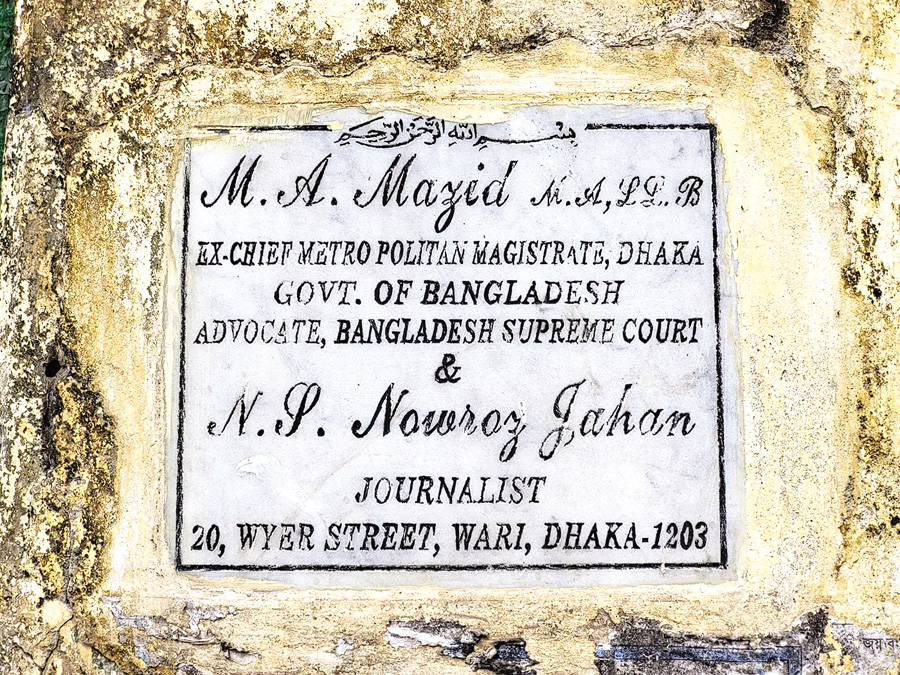
The names appeared on polished granite, marble, ceramic tile, or cast-iron plaques beside gates and verandahs. The Bengali letters were not chosen casually. They were drawn with flourish and care, sometimes engraved deeply into black stone, sometimes painted in gold, sometimes shaped in calligraphic script that echoed the curves of Bengali or English handwriting.
For the previous generations, a house was rarely an investment but the result of a lifetime of savings imagined as a family legacy; its name mattered.
A one-story home named Madhobilata would often have an actual madhabilata vine spilling over the front gate. A house called Shantinir might sit quietly behind a low boundary wall, shaded by mango or krishnachura trees. Another house named Smriti Chinho; perhaps the home reflects its residents’ memories.
Names reflected a generation that wanted houses to mean more than just property, naming after their beloved daughters, wives, mothers, or fathers. In those days, people would practice culture, read books, sing songs, and go to the theatre. The brought up was very much cultural. Therefore, many names came from literature, nature, or aspiration, like from Tagore, Jibanananda Das, or the romantic vocabulary of Bengali poetry.
The names themselves revealed the sensibility of an older middle-class and upper-middle-class Bangladesh, valuing beauty and sentiment in everyday life. Therefore, the nameplate was once treated almost like the house’s signature.
Families commissioned masons or sign makers to engrave the name into granite or marble.
In many older homes, the typography was elegant, with letters elongated, curved, or ornamented, in the Bengali calligraphic style. Today, such nameplates are becoming rare.
In much of urban Bangladesh, especially in Dhaka, the old houses are disappearing. One-story and two-story homes are being demolished and replaced by apartment blocks and commercial buildings. The new structures are taller, more profitable, and more practical for a crowded city. But they are also more anonymous.
Where an old house once carried a name like “Shantinir” engraved in stone, a new apartment block may be named after the development company or maybe ‘Lake view or rose view’, where there is no sign of a lake or roses
The typography is usually machine-cut acrylic or stainless steel, often in identical fonts repeated from building to building.
Part of this change is practical. Real estate companies, rather than families, usually develop modern apartment buildings. The owners of different flats may have little connection to the building’s name. A poetic name no longer grows naturally from the life of one household.
When talking about naming houses with a few people, many agreed that when someone is purchasing a flat, they want it named in a modern English name rather than a Bengali one. Therefore, it has been mandatory to use such polished names.
The economics of land have also changed. In a city where every square foot is expensive, gardens are the first to disappear. The house itself becomes less a place of memory and more a financial asset. As architecture changes, so does language. A house named Sanjher Maya evokes a very different feeling from a building called ‘Tower-7.’ One suggests dusk, trees, memory, and a family sitting on a veranda. The other suggests parking spaces and elevators.
nawmiafra25@gmail.com