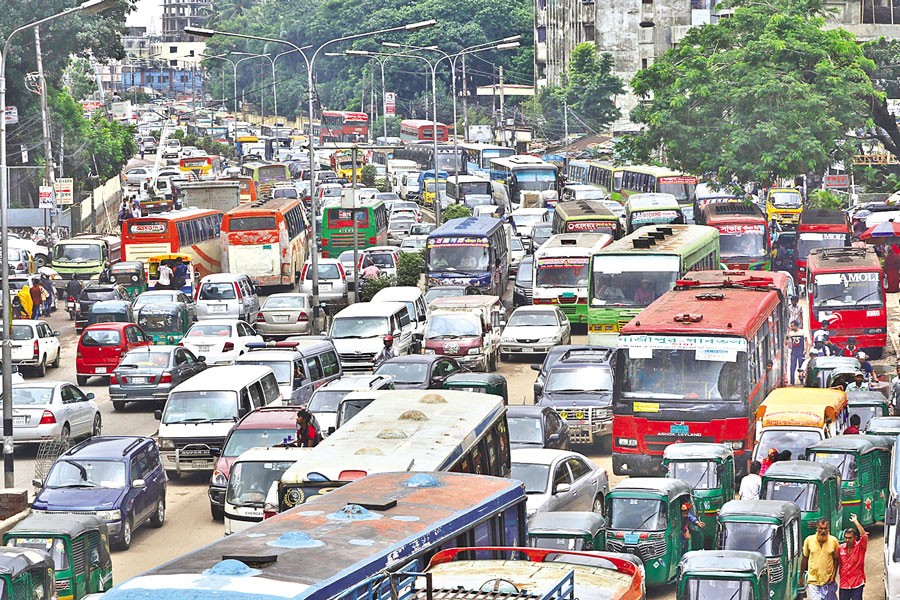
Being the 7th least livable city in the world by the Global Livability Index 2022, Dhaka has tons of problems that essentially make the living standard of its residents terrible.
If you breathe in its air, you will be seriously exposed to diseases like lung cancer, as Dhaka often tops the list of the most polluted cities on earth regarding air quality. If you have to go out on the roads of Dhaka, its intolerable noise will get you closer to hypertension, inflammation, fluctuation of blood pressure, loss of productivity and fall in quality and quantity of sleep as Dhaka has been ranked world's noisiest city in 2023 by United Nations Environment Program (UNEP). While the acceptable level of noise set by UNEP is 50 decibels and 45 decibels for day and night, the average noise level in Dhaka is 119 decibels.
In addition, the chance of getting run over by a vehicle is never very low on the roads of Dhaka. According to Road Safety Foundation's statistics, the number of road accidents in the capital is increasing. While some 137 people were reportedly killed in 131 road accidents in Dhaka in 2023, the number of such accidents and casualties had risen to 259 and 246, respectively, in 2022.
Apart from these, there are problems like water pollution, solid waste disposal and improper waste management, increased temperature, overcrowding, and lack of recreational facilities and public space. Yet, none of this can beat Dhaka city's traffic congestion and transportation problem.
All the components of living standards, including life expectancy, level of income, physical health, quality of the environment, personal safety and access to services, get affected by the mismanaged traffic and transportation system.
On the one hand, it damages health, environment, safety and life expectancy by contributing to all the aforementioned problems like air and noise pollution and road accident. On the other hand, it absorbs a significant portion of our working hours on a daily basis. If not, we have to compromise the hours for recreational and personal activities to compensate for the loss in work hours.
If you are a resident of Dhaka, you are to leave for your destination of 6.4 km with at least an extra hour in your hand. Experts anticipate Dhaka's declining average traffic speed will fall to 4.7 kilometres per hour by 2035. The wasted hours amidst the noise, polluted air, and stress of being late take their toll on physical health and productivity.
Naturally, it gets impossible for an employee to give their best in the workplace after such a journey, and usually, it results in a loss in income. Students and patients suffer greatly, and missing an appointment for a traffic jam or the death of a patient on their way to the hospital are common incidents in Dhaka.
Complemented by this traffic congestion, the insufficiency of public transport makes the experience
worse. Statistics from Copenhagen Consensus Centre show that there are 33 times more cars than buses on the roads of Dhaka. Surprisingly, these cars account for just 13 per cent of passenger transport, while buses account for 49 per cent. It's no surprise that a great number of passengers on the bus don't get a seat and reach their stoppage standing for even hours, especially in the peak hours of the day.
When they want to escape the waste of time and hassles of overcrowded public transport, a bulk sum gets spent on CNG or Uber. Traffic jams and transportation problems often make such painful trade-offs inevitable, especially for the middle-income group. If you are to take a bike to reach the restaurant on time, you might have to make up the extra spending by compromising a food item or two afterwards.
Being the 'jadur Shohor' (city of magic) and having a lot to offer for a prosperous life, Dhaka pulls its residents back at the same time. It may provide you with the best workplaces, hospitals, education institutions or restaurants. Still, a several-hour-long journey through the congested traffic to that destination may kill your very will to be in Dhaka.
There's a chapter titled 'The meaning of being unhappy is to hate the city you live in' in Nobel Laureate Writer Orhan Pamuk's famous book 'Istanbul.' However, Pamuk associated it with Istanbul's historical downturn. Melancholy, his own adolescence crisis and all, its interpretation in our context can be pretty straightforward. If you look out, you can find a lot who live a challenging and miserable city life solely because they haven't been able to cope with the everyday struggle of traffic congestion and transportation problem of Dhaka.
mahimduds12@gmail.com
© 2026 - All Rights with The Financial Express

