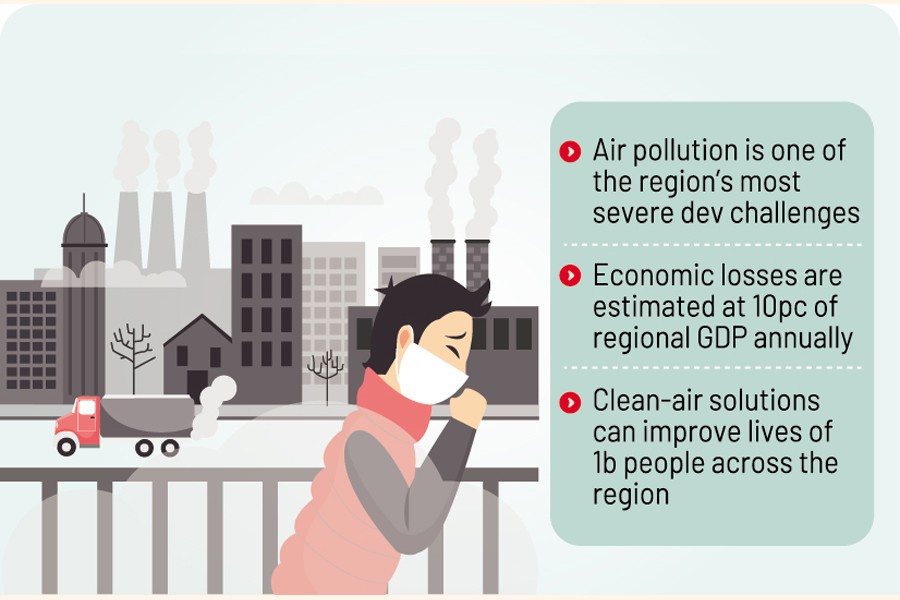
As many as one million people die annually in South Asia, including in Bangladesh, due to air pollution, while clean air solutions can improve lives of nearly one billion people across the region, according to a latest report of the World Bank (WB).
The report said air pollution across the parts of South Asia, known as the Indo-Gangetic Plains and Himalayan Foothills (IGP-HF), is causing major losses in health and productivity and remains one of the region's most severe development challenges. Economic losses are estimated at close to 10 per cent of the regional GDP annually.
The WB on Monday released the report titled "A Breath of Change: Solutions for Cleaner Air in the Indo-Gangetic Plains and Himalayan Foothills". It found that a handful of actions, if taken across a range of sectors and jurisdictions, can significantly reduce pollution, improve public health, and support stronger economic growth.
Air pollution in the IGP-HF, which comprises parts of Bangladesh, Bhutan, India, Nepal, and Pakistan, originate from five key sources. These include households burning solid fuels for cooking and heating, industries burning fossil fuels and biomass inefficiently and without appropriate filter technology, motorists using inefficient internal combustion vehicles, farmers burning crop residues and managing fertilisers and manure inefficiently, and households and firms burning waste.
The report highlights solutions that can be readily adopted and scaled up, including electric cooking; electrification and modernisation of industrial boilers, furnaces, and kilns; non-motorised and electric transport systems; better crop residue and livestock waste management; and improved waste segregation, recycling and disposal.
The WB report groups clean-air solutions into three mutually reinforcing core areas. First, abatement solutions that reduce emissions at their sources in cooking, industry, transport, agriculture, and waste management.
Second, protection measures that strengthen health and education systems, so that children and vulnerable communities are safeguarded during the transition to clean air.
Third, strong institutions supported by regulatory frameworks, market-based instruments, and regional coordination that sustain multi-sector and multi-jurisdictional progress over time.
"This report shows that the solutions are within reach, and it offers a practical roadmap for the decision-makers to implement coordinated, feasible, and evidence-based solutions at scale. There are strong financial and economic rationales for the South Asian enterprises, households, and farmers to adopt cleaner technologies and practices, and for the governments to support them," said Martin Heger, WB Senior Environmental Economist, in a media statement.
"Achieving cleaner air will require continued collaboration, sustained financing, and strong implementation at local, national and regional levels. By acting together, the governments can follow this pathway to cut pollution, save millions of lives, and deliver cleaner air for all," said Ann Jeannette Glauber, WB Practice Manager for Environment, South Asia.
nsrafsanju@gmail.com
© 2026 - All Rights with The Financial Express

