A government proposal to spend Tk 488.07 million on strengthening wildlife conservation has come under scrutiny after project documents revealed that nearly 87.5 per cent of the allocation has been earmarked for buildings, administrative expenses, vehicles, consultants, and other overheads, leaving only a small portion for direct conservation activities.
The Project Evaluation Committee (PEC) of the Planning Commission's Agriculture, Water Resources and Rural Institutions Division recently reviewed the proposal submitted by the Ministry of Environment, Forest and Climate Change.
During the meeting, committee members questioned how major allocations for buildings, vehicles, honorariums, and other administrative expenditures would contribute directly to wildlife conservation, according to officials who were present there.
The committee also sought detailed justification for several cost estimates, describing some proposed expenditures as excessive, and recommended that the implementing agency revise and rationalise the budget for a number of components before the project is considered for approval.
The financial breakdown of the "Strengthening Wildlife Conservation in Bangladesh" shows Tk 426.95 million out of the total Tk 488.07 million has been allocated for non-core expenditures, leaving only around Tk 61.1 million for field-level conservation measures.
The single largest expenditure is Tk 154.86 million, 31.73 per cent of the project cost, for constructing buildings, including a 1,100-square-metre dormitory.
Administrative expenses account for another Tk 112.82 million, 23.12 per cent of the total, while Tk 67.46 million has been proposed for equipment and vehicles.
Professional services, consultants, and honorariums would consume Tk 46.79 million, with another Tk 24.40 million allocated for fees, charges, and commissions.
Transport-related expenditure alone accounts for Tk 61.72 million, 12.65 per cent of the total project cost.
Moreover, Tk 29.14 million has been proposed for vehicle procurement; Tk 24.40 million for transport services; Tk 3.25 million for petrol, oil, and lubricants; Tk 3.0 million for travel expenses; Tk 1.30 million for vehicle maintenance; and Tk 0.63 million for gas and fuel.
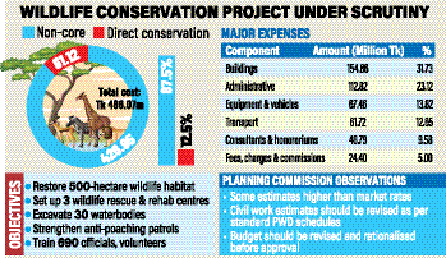
According to the committee's observations, the estimated prices of office equipment, computers, furniture, and electrical installations appear higher than the prevailing market rates.
It instructed the department to revise civil work estimates in line with the standard Public Works Department schedules.
The commission also objected to proposals for hiring junior procurement and financial consultants, saying the Forest Department already has permanent officials capable of carrying out those responsibilities.
The project nevertheless contains ambitious conservation targets.
These include restoring 500 hectares of wildlife habitat through fruit and fodder plantations, establishing three wildlife rescue and rehabilitation centres, excavating 30 waterbodies, strengthening anti-poaching patrols, and training 690 officials and volunteers.
Conservation specialists, however, argue that the spending pattern appears inconsistent with those objectives.
With only about Tk 61 million left for direct conservation activities after administrative and infrastructure allocations, they question whether the project can meaningfully improve habitat restoration, anti-poaching operations, and wildlife protection across all 64 districts.
The project documents acknowledge that Bangladesh faces mounting pressure from habitat destruction, illegal wildlife trade, and increasing human-wildlife conflict, underscoring the need for stronger field interventions.
jahid.rn@gmail.com
© 2026 - All Rights with The Financial Express

