Bangladesh is facing increased natural disasters such as cyclone, salinity, flood and coastal erosion even though the country has achieved some success in climate change adaptation and mitigation.
Experts made the remarks while speaking at a webinar titled 'Overcoming Climate Risks: Challenges & Solutions for Bangladesh'. The webinar was part of The Financial Express and Innovision series discussion titled "Bangladesh Miracle Webinar series-02".
Rubaiyath Sarwar, Managing Director of Innovision Consulting Ltd, moderated the event.
Jarin Tasneem Oyshi, Senior Research Associate and Task Manager, Centre for Climate Change and Environmental Research, BRAC University delivered the keynote speech at the event held on Thursday evening.
Bangladesh is facing increased natural disasters such as cyclone, salinity, drought, heavy rainfall and thunderstorm, coastal erosion, flood and flash flood, she said in her presentation.
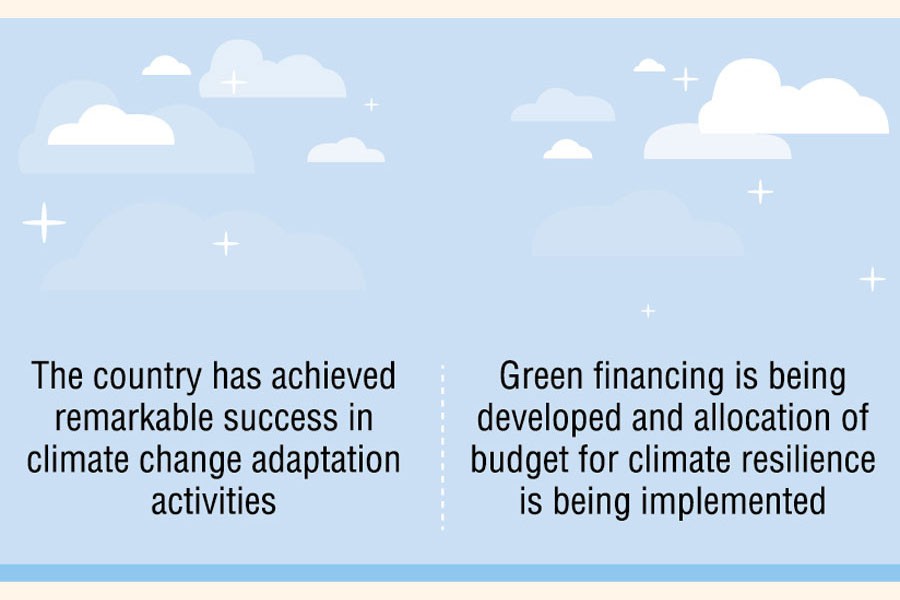
Over the last few years, Bangladesh has achieved remarkable success in climate change adaptation activities (such as disaster management, rehabilitation) and also made progress in mitigation of climate risks, she added.
The National Adaptation Programme of Action (NAPA), Bangladesh Climate Change Strategy and Action Plan for Bangladesh were adopted by the Ministry of Environment and Forest in 2009, she mentioned.
Dr Md. Golam Rabbani, Head, BRAC-KfW Climate Bridge Fund Secretariat, said approximately one billion US dollar is being invested per year in Bangladesh for climate change adaptation and mitigation. Green financing is being developed and allocation of budget for climate resilience is being implemented. Emphasis is put on solid waste management, and rainwater harvesting to address the climate effect, he added.
Moushumi Zahur, Assistant Professor, Department of Mathematics and Natural Sciences, BRAC University said women are not getting facilities properly when the female members are often left behind. She also suggested revising the gender action plan.
Dr Helal Ahammad, Professor, Department of Economics, Director, Economics Research Platform, School of Business and Economics, North South University, said developed countries are mainly responsible for greenhouse gas emission.
"Climate change impacts the land productivity which affects agriculture. Emphasis should be laid on altering crop varieties and expanding water harvesting technologies to conserve soil moisture," he added.
Dr. Nandan Mukherjee, Post-Doctoral Researcher, UNESCO Centre for Water Law, Policy and Science, School of Social Sciences, University of Dundee, said the climate threat is so significant that human civilization is supposed to take this as seriously as a world war crisis, but the people are not giving it that level of importance.
Thousands of hectares of land in the southern region of our country have become unsuitable for agriculture because of climate change. Other regions are also affected by floods, salinity and other natural disasters, he added.
nsrafsanju@gmail.com
© 2026 - All Rights with The Financial Express

