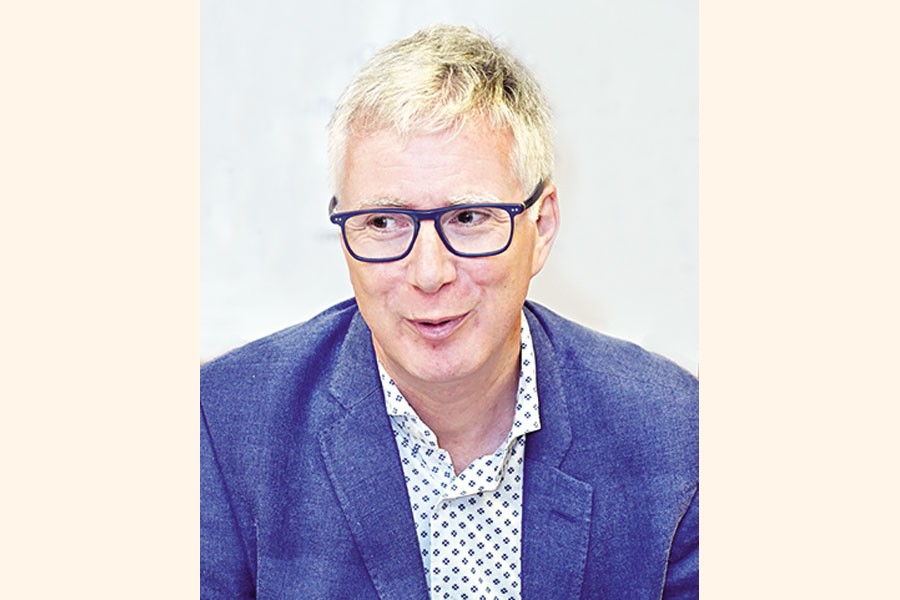
 Peter Holland
 The consistent efforts of Bangladesh towards improving eye health are being recognised around the world which is why the country has been accorded a key role in the first-ever Global Summit for Eye Health, said Peter Holland, Chief Executive of the International Agency for the Prevention of Blindness (IAPB).
In an interview with The Financial Express during his brief visit to Dhaka, he said Bangladesh's role in promoting eye health at both the national and international levels hasearned it the position of an important partner in the summit, which will be held on November 2 this year in Antigua and Barbuda.
Holland made the visit to formally invite Bangladesh to co-host the landmark summit. Prime Minister Tarique Rahman, during a meeting with the IAPB chief on Monday, accepted the invitation.He also accepted the invitation to attend the event.
"The event will be the first ever global summit for eye health… I came and asked on behalf of the government of Antigua whether Bangladesh would be willing to co-host the summit and your Prime Minister graciously agreed to be a co-host."
The summit, hosted by the government of Antigua and Barbudain collaboration with IAPBand the World Health Organization (WHO), will bring together heads of government, ministers, development partners, international organisations, academics, eye care professionals and private-sector leadersto accelerate political commitment to tackling avoidable vision impairment and blindness by encouraging countries to move from policy commitments to concrete national action.
The IAPBchief said Bangladesh's involvement sends an important message about the country's standing in global health diplomacy.
"Bangladesh's involvement is really an expression of the leadership that the country is playing on eye health both nationally and globally. Bangladesh has been one of the strong advocates globally for how important eye health is to development, to the development of economic growth and to areas like education and children's learning as well."
The importance of eye health is receiving more attention than before thanks to the United Nations General Assembly passing its first-ever resolution on vision in 2021. This resolution asked nations to include eye careinUniversal Health Coverage programmes, adding that visual impairment is not just a medical problem but also a major impediment to education, work, and productivity. Since then, organisations working in this field have been seeking political commitment to implement global commitments at the national level.
Holland said Bangladesh has been at the forefront of that international effort.
"Bangladesh has long been a leader on global eye health. It is one of the co-chairs of the UN Friends of Vision, a group of United Nations ambassadors in New York dedicated to advancing the importance of vision and eye health. Bangladesh was one of the founding co-chairs, alongside the governments of Antigua and Ireland," he said.
IAPB estimates that at least one billion people around the world suffer from impaired vision which can be prevented. The main reason behind all this is the existence of cataract and refractive error, which can easily be corrected using cost-effective means.
Holland said the summit, which will be held alongside the Commonwealth Heads of Government Meeting (CHOGM), is intended to convert broad international promises into measurable national commitments.
"We have had some attention globally on eye health. The summit is intended to turn the promises that governments have made at a global level into action nationally. What we are asking is that governments come with tangible commitments about what they are going to do to really implement eye care in their countries and make eye care accessible to as many people as possible."
He said governments alone cannot achieve that goal and stressed the need for broad-based partnerships.
"We hope that eye care sector organisations and private sector organisations will also come with their commitments about how they are going to support that because the achievement of eliminating avoidable sight loss globally will need to be done in partnership. It will need to be done in partnership between governments, between sector organisations like the international non-governmental organisations, eye hospitals, academic institutions and the private sector as well."
Bangladesh has made great strides in providing eye care, owing to cooperation among the government, specialised eye care hospitals, development organisations and their international partners. However, there are issues of preventable blindness and visual impairment that continue to pose public health concerns, especially in underprivileged areas of the country.
Holland expressed confidence that Bangladesh's leadership would help mobilise stronger international action to ensure that quality eye care becomes accessible to millions more around the world.
IAPB is an alliance for the global eye care sector with more than 200 members from the NGO and corporate sectors worldwide leading the effort to provide eye care to more than a billion people who do not have access.
rahmansrdk@gmail.com
© 2026 - All Rights with The Financial Express

