Despite government efforts, early initiation and exclusive breastfeeding rates in Bangladesh are still not satisfactory, speakers told a seminar on Tuesday.
More than one-third of the mothers are still out of breastfeeding practice and the scenario is worse among working mothers, they said.
The speakers suggested a mass awareness campaign sensitising the people to the importance of the breastfeeding facility in the workplace.
An enabling workplace accommodation to support working parents, especially women, is critical to improving breastfeeding practice in Bangladesh, they said.
Such an enabling environment for breastfeeding helps enhance productivity and retain skilled workers in factories, according to them.
The observations and recommendations were made at a seminar on 'Creating an enabling environment at workplaces to support working parents in protecting, promoting and supporting breastfeeding' in Dhaka city.
The National Nutrition Services (NNS) under the Ministry of Health and Family Welfare in association with UNICEF Bangladesh hosted the seminar to raise awareness among stakeholders.
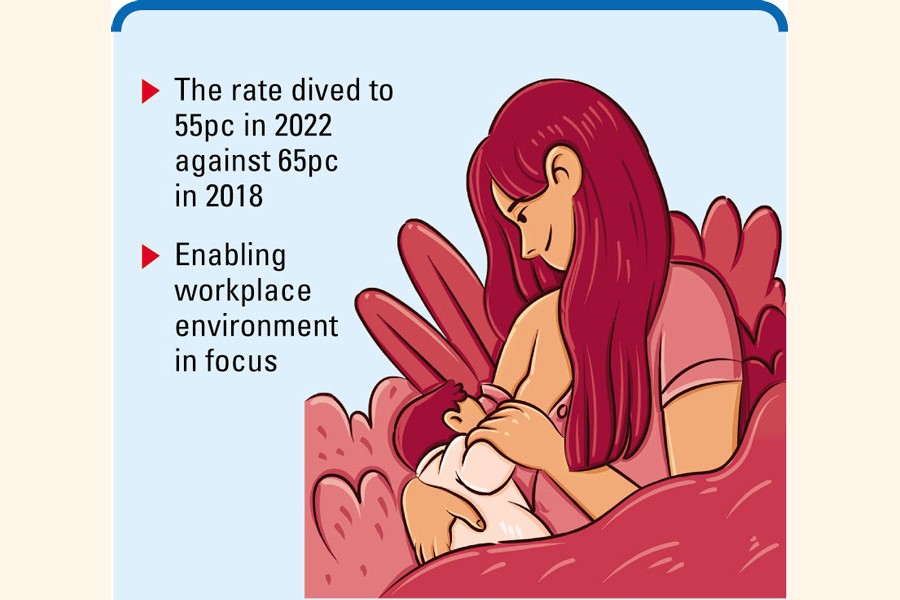
The exclusive breastfeeding rate in Bangladesh went down to 55 per cent in 2022, which was 65 per cent in 2018, said NNS programme manager Dr M Islam Bulbul as a keynote presenter.
Breast milk has maternal antibodies that help babies fight diseases while exclusive breastfeeding protects against infections from unclean food and liquids, which is a leading cause of death of children in Bangladesh.
Infants exclusively breastfed for six months are 11 times less likely to die from diarrhoea and 15 times less likely to die from pneumonia, according to Dr Bulbul.
Explaining human and economic benefits for supporting breastfeeding in the workplace, he said it helps reduce the employee turnover rate and a company save money by eliminating the need to hire and train new staff.
This facility also helps improve the corporate image of businesses, reduce maternity-related absenteeism and increase the retention of female workers, among others, according to the keynote.
Addressing the event, DGHS director general Dr Abul Bashar Mohammad Khurshid Alam emphasised improving the breastfeeding practice in the country.
The sustainable development goal (SDG) might not be achieved without ensuring breast milk to children, he added.
In 2017, health and labour ministries took an initiative namely 'Mothers@Work' with an eye to supporting workplaces, including in the largest apparel sector, to create an enabling environment for working mothers to exercise their maternity rights and avail breastfeeding support in the workplace. An estimated 193 garment factories have so far been involved with the initiative.
Sirajul Islam Rony, president of Bangladesh National Garment Workers-Employees League, said many garment factories still fire pregnant women on various excuses, although many compliant units provide lawful benefits.
In the absence of maternity benefits and functional childcare centres with breastfeeding facilities, many women garment workers do not go back to their respective workplaces, he alleged.
Mr Rony strongly criticised that government employees get six months' maternity leave while the tenure is four months for the private sector.
munni_fe@yahoo.com
© 2026 - All Rights with The Financial Express

