Asia-Pacific countries, including Bangladesh, should adopt an environment-friendly, climate-resilient and inclusive agriculture policy to ensure food security, experts told a conference on Wednesday.
They called for adopting an integrated approach that uses modern technologies and safeguards rights of marginal farmers in this regard.
This was observed at the inaugural ceremony of a two-day 'Asia Pacific Right to Food and Agrifood System Conference 2023' held at Nabab Nawab Ali Chowdhury Senate Bhaban on the Dhaka University campus.
Right to Food Bangladesh (RtF BD) hosted the conference in cooperation with the European Union, Care Bangladesh, Plan International, Austrian Development Cooperation and Asian Farmers' Association for Sustainable Rural Development.
Parliament Speaker Dr Shirin Sharmin Chaudhury attended the event as the chief guest and planning minister MA Mannan as the special guest with RtF BD chairman Dr Qazi Kholiquzzaman Ahmad in the chair.
DU vice-chancellor Prof Dr Md Akhtaruzzaman, Nepal Agriculture and Livestock Development joint secretary Sanjeev Kumar Karn, and CARE Bangladesh country director Ramesh Singh were guests of honour.
RtF BD general secretary and WAVE Foundation executive director Mohsin Ali delivered a welcome speech.
Addressing the congregation, Dr Shirin spoke about Bangladesh's success stories involving food production as well as security.
Since independence, an array of initiatives has been taken for the sake of agriculture, leading Bangladesh to become a role model for food production.
Due to global crises like coronavirus pandemic and Russia-Ukraine war, Dr Shirin said, many countries were facing supply-chain disruptions affecting food chain.
"Now, we need an inclusive and sustainable food management system for all to overcome the situation."
She hoped that the conference would help identify different challenges and ways forward regarding food production and security in the region.
Mr Mannan said Bangladesh was focusing more on an environment-friendly agriculture system to use organic fertilisers.
Highlighting Bangladesh's overall food system management, he said the country was in a better position in terms of agri-production and management.
However, the minister recognised the need for ensuring the rights of marginal farmers.
"There might not be hunger pangs among poor farmers now, but they deserve a more comfortable life," he said, adding that equity has to be ensured.
Dr Kholiquzzaman said all people's equal access to food was important for food security.
Almost all the coastal countries of the region, including Bangladesh, are victims of climate change, creating challenges in ensuring the right to food.
Around 600 food and agri-food system experts and activists, civil-society leaders and other stakeholders from countries like the Philippines, Nepal, India, Pakistan, Australia and Thailand joined the conference in person as well as virtually.
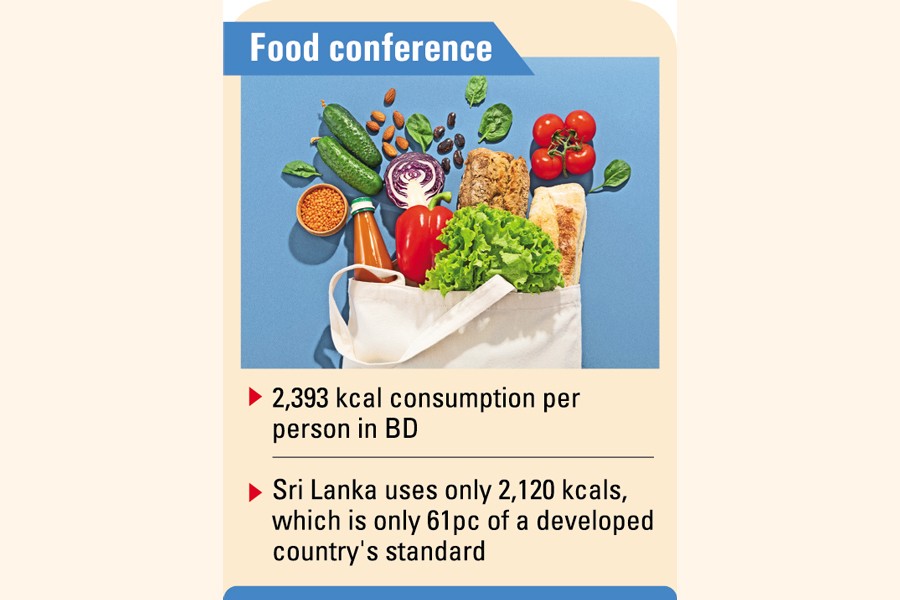
Our DU Correspondent adds: Only 2,393 kcals (kilocalories) per person, per day are consumed in Bangladesh, covering 67 per cent of a developed country's standard.
Bangladesh is also third worst among four countries (Bangladesh, Pakistan, India and Sri Lanka) of South Asia in calorie intake per kilogram.
Prof Dr MM Akash, chairman of Economic Research Bureau at DU, presented these average indicators related to food economy at a seminar styled 'Legal Framework and Fundamental Concerns on Right to Food in Asia-Pacific Region' held on the sidelines of the conference.
Sri Lanka uses only 2,120 kcals, which is only 61 per cent of a developed country's standard, while India is the second-worst country, which is 65 per cent. Pakistan has the least gap in the list as it enjoys about 79 per cent of the standard barometer.
saif.febd@gmail.com and aburakibdu420@gmail.com
© 2026 - All Rights with The Financial Express

