BENAPOLE, June 13: Flower growers in Gadkhali of Jashore district have incurred a loss of more than Tk 50 crore (Tk 500 million) in the last two and a half months due to the coronavirus pandemic.
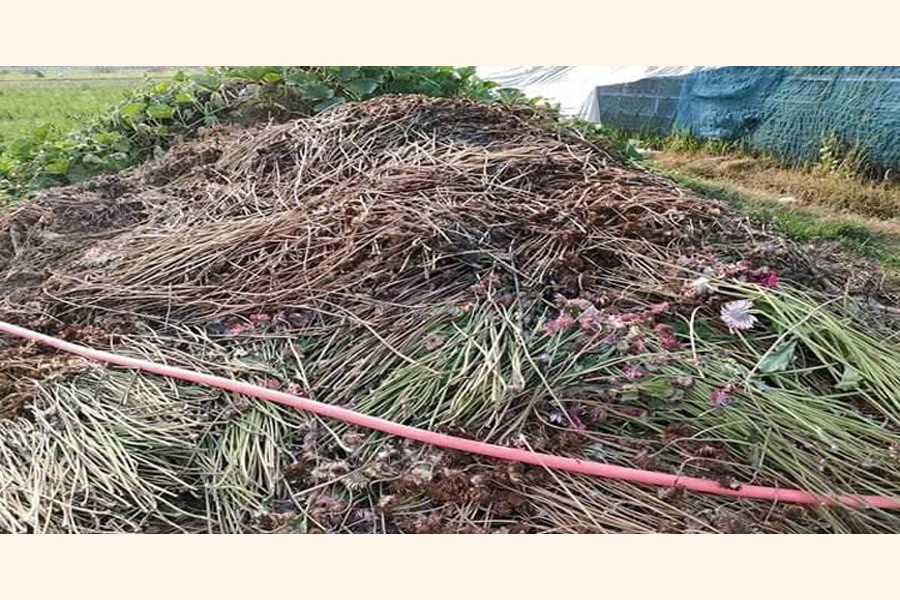
Basically, the flower growers here look at different national days. But due to the coronavirus, they could not do any business in February and March and super cyclone Ampan later damaged a huge number of flowers fields.
In the last two and a half months, flower farmers and traders have suffered a loss of more than Tk 50 crore due to the pandemic.
Lives and livelihoods of thousands of people who are dependent on flower cultivation in the area have been devastated by the coronavirus.
Since there is hardly any sale of flowers here, many growers are grazing their cows and goats in the flowers fields.
Flower production started commercially in Godkhali in the year of 1980. It has the largest wholesale market for flowers in the country.
Wholesalers from different regions including Dhaka and Chittogram come to Gadkhali to buy flowers. Hundreds of crores of taka are transacted in flower production and trade here every year.
Various types of flowers are cultivated on about 6,500 hectares of land in 65 villages of Jhikargachha and Sharsha upazilas of Jashore.
Red, blue, yellow, purple and white flowers can be seen on the horizon on both sides of the road in the villages of the two uapzilas.
Hundreds of flower growers from Panisara union of Jhikargachha start coming to Gadkhali market every day.
Small and big wholesalers from different parts of the country also buy flowers from there. After that, the flowers spread all over the country, even outside the country, through wholesalers and retailers.
Almost every field in Panisara, Haria, Krishnachandrapur, Patuapara, Syedpara, Matikumra, Baisa, Kauba, Phulia and Sharsha's Navaran, Ulashi, Gadkhali and Shyamlagachhi villages of Gadkhali union of Jhikargachha is still in full bloom.
Hundreds of hectares of land are cultivated with different types of flowers including marigold, rose, gladiolus, tuberose, gerbera, cosmos, daisy gypsy, dahlia and chrysanthemum.
Before the coronavirus outbreak, the flower market of Gadkhali used to freeze as soon as the sun rose.
But that scene has not come for more than two and a half months.
Abdur Rahim, president of the Bangladesh Flower Society (BFS), said, 'This time he planted flowers on 6,500 hectares of land in Jhikargachha and Sharsha upazilas. Due to the good weather, there was a possibility of producing a record amount of flowers this time.
He said nine types of flowers are sold and bought in Gadkhali market. Every year from January to April is the season of flowers.
The damage to the flower sector caused by the coronavirus and the recent cyclone Ampan is irreparable.
Government support is needed to save this promising sector at the moment.
However, the government's incentive of Tk 5,000 crore at four per cent interest is also meant for flower farmers.
But in the present situation, there is no guidance on how the florists and traders will get this loan of agricultural incentives.
"In this situation, I am making a special demand to the government policymakers to provide quick loans to those involved in the full sector, including 80 per cent share croppers," Abdur Rahim added.
Yunus Ali of Panisara village said the storm had caused more damage to gerbera flowers.
It costs Tk 36 lakh per acre to cultivate jarbera flowers. The cost per acre of tuberose cultivation is two and a half lakh taka, rose four and a half lakh taka, gladiolus four lakh taka and marigold cultivation two lakh thirty thousand taka.
Rahmat Gazi, a florist from Haria village in Gadkhali, said, "I planted roses on 2.5 bighas of land. Preparations were made for the production ahead of the Bengali New Year festival. Several lakh taka were invested in the rose garden. Just then the coronavirus came. I couldn't sell flowers anymore. Who will buy flowers if you celebrate the first Baishakh sitting at home? After that, most of the flowers were uprooted and the stalks were broken due to Ampan storm. It has caused extensive damage. Shops are closed, markets are not sitting. We are in a very bad condition."
Jahangir Hossain, a farmer in Patuapara area of Jhikargachha, said, 'I cultivated roses on three bighas of land. Damaged flowers and trees have to be cut from the garden every day to feed the goats and cows. Because if the roses are not cut, the garden is ruined. On the one hand, there is no trade in flowers, on the other hand, labour costs have to be counted for cutting flowers. '
benapolejessore@gmail.com
© 2026 - All Rights with The Financial Express

