SM Najmus Sakib
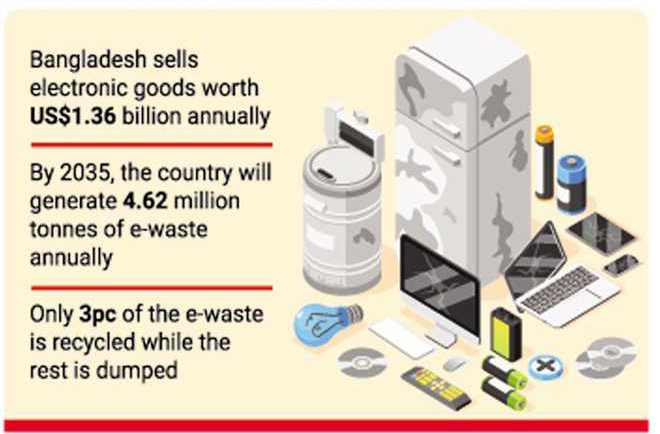
A huge amount of investment is needed to tap the full potential of the e-waste recycling industry as the country can recycle a maximum of three per cent of the e-waste despite there being a large market for electronic goods.
Most of the electronic companies do not have a formal business model, recycling units or recycling capacity and storage capacity for e-waste, finds a new survey.
Therefore, the rest of the e-waste is dumped in landfills, rivers and other natural places posing serious environmental and health hazards, according to the sector insiders.
Bangladesh sells electric goods worth US$1.36 billion a year and generates about 2.81 million tonnes of e-waste, of which 40 per cent are refrigerators and 30 per cent televisions.
In terms of number, the most usable electronic device is mobile phone.
A research of Bangladesh University of Engineering and Technology (BUET) estimated that the total annual collection of e-waste in the country will increase to 4.62 million tonnes by the year 2035.
E-waste collection in Bangladesh is increasing at the rate of 20 per cent annually, according to the research and advocacy organisation Voices for Interactive Choice and Empowerment (VOICE).
Ahmed Swapan Mahmud, executive director of VOICE, told the FE, "There is hardly any government investment in the e-waste recycling sector and therefore we want to have an efficient and environment-friendly recycling industry under a public and private partnership initiative."
"We surveyed nine electronic goods manufacturing companies in the local market and almost all of them don't have recycling capacity and storage capacity for keeping their e-waste, which is alarming," he added.
"In Bangladesh, there is no formal business model for the electronic goods business and recycling. Most of the major global and local companies collect e-waste from vendors, informal recycling markets and recycle those in a hazardous manner."
There is no designated point for the recycling. Therefore, it creates serious environmental and public health risks.
"We mainly reviewed the e-waste management rules 2021, and a survey on the business model of e-waste. The rule is good but we rather emphasised the implementation due to lack of visible action to stop illegal dumping of e-waste," he continued.
VOICE shared the findings of the survey and review titled "Review of E-waste Rules 2021 and Business Models' Compliance of Electronic Goods Manufacturers with Environmental Sustainability" at a programme at its Civic Centre in the city on Saturday.
Experts at the event opined that profitable public and private partnership efforts should be taken for an effective waste management business model to ensure a better and livable environment. Eminent journalist Selim Samad presided over the programme.
Mihir Biswas, joint secretary of Bangladesh Poribesh Andolon(BAPA); environmental activist Aminur Rasul and Johirul Hasan of Sony-Rangs spoke at the event.
Selim Samad said the government needs to conduct a research on the number of electronic products being converted into electronic waste every year in the country.
Inclusion of all ministries, city corporations and district administrations are crucial to build an eco-friendly e-waste recycling system in the country, he maintained.
nsrafsanju@gmail.com
© 2026 - All Rights with The Financial Express

