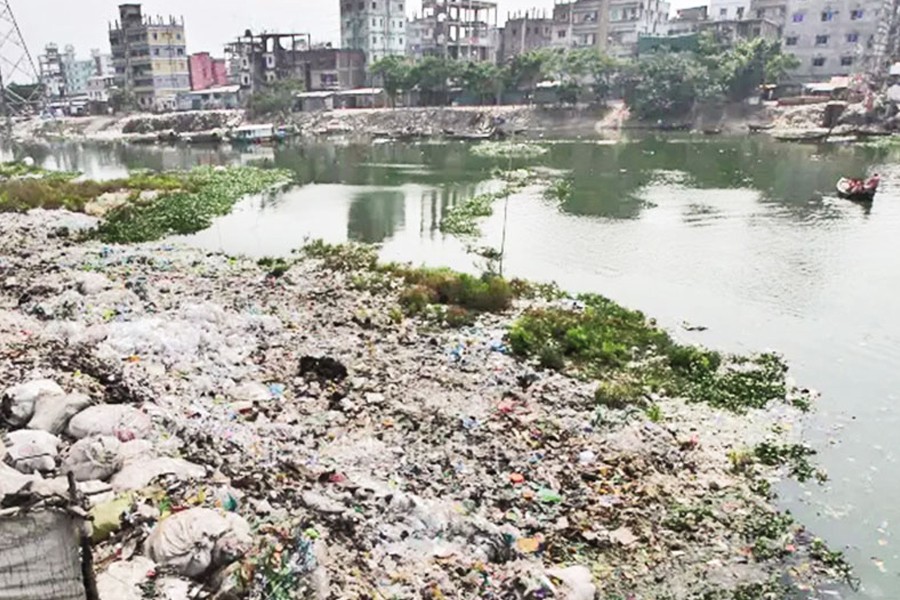
To make the Buriganga River pollution-free, the government has taken the initiative to bring the Effluent Treatment Plant (ETP) systems of industries that discharge liquid waste under online monitoring system, alongside conducting regular enforcement activities to ensure that these treatment plants remain operational at all times, reports BSS.
The Director General of the Department of Environment, Dr. Md. Lutfor Rahman, told the news agency that efforts are being made to restore the river's natural flow by increasing the water flow in the Buriganga.
Besides, the Bangladesh Inland Water Transport Authority (BIWTA) is carrying out regular dredging operations to increase the river's navigability by removing polluted sediment.
To prevent water pollution, the government plans to monitor ETP systems online, he added.
As part of this initiative, IP cameras will be installed in pollution-prone areas, he said.
In addition, dedicated control rooms will be established at shipbuilding and ship repair yards to monitor and control the discharge of hazardous waste, he added.
An ETP is a wastewater treatment system that treats contaminated liquid waste generated by industries before it is released into the environment.
In other words, the primary purpose of an ETP is to reduce industrial wastewater to safe levels through chemical, biological, and mechanical treatment processes before it is discharged into rivers, canals, or other water bodies.
He said wastewater discharged from factories contains various toxic chemicals, dyes, oil, heavy metals and other hazardous substances.
If untreated wastewater is released directly into drains or rivers, it can pose serious threats to the environment, aquatic life and public health, he said.
ETPs are primarily used to prevent environmental pollution and make water reusable, he added.
A visit to different areas along the Buriganga River in the capital found that untreated industrial waste, household garbage dumped directly into the river and plastic waste have turned the river water black and foul-smelling.
Numerous dyeing and washing factories, as well as shipbuilding and ship repair yards (dockyards), have been established along the banks of the Buriganga and its surrounding areas.
© 2026 - All Rights with The Financial Express

