Education Minister Dipu Moni says comprehensive changes to Bangladesh's education system were necessary in order to prepare the country for further development, reports bdnews24.com
"To realise the dreams, goals and ambitions of a developed, prosperous nation by 2041, we need to update our education system," she said in an interview with the news agency on Monday.
"This cannot be done with small, gradual changes. That is why we are instituting change at a systemic level."
By properly harnessing Bangladesh's labour force, the country will be able to attain the Sustainable Development Goals set by the UN, the minister said.
Major changes are coming to the school and college curriculum and their system of assessment in the next few years.
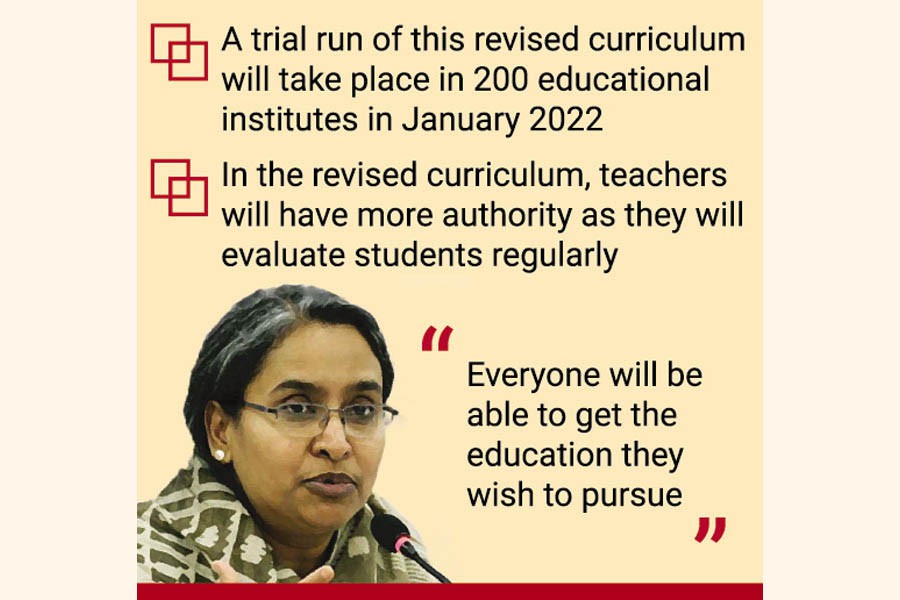
A trial run of this revised curriculum will take place at 200 educational institutions in January 2022, the start of the new academic year.
From 2025, students across the country will study under the new curriculum. However, the reforms will be implemented in phases starting in 2023.
The government's first priority in education is to ensure that it is accessible to all, Dipu Moni said.
To do this, the government is taking steps to build educational infrastructure, such as the 12 institutes of science and technology Prime Minister Sheikh Hasina promised to develop in her election campaign, the minister said.
Asked about the quality of the education that is provided at higher levels, the minister said: "Our first priority must be to ensure that everyone has access to education."
"First, we are putting our energy into building infrastructure. We are aware of concerns regarding the quality of education and we are working to improve it. But, ensuring everyone is able to get the education they wish to pursue is our priority."
"We will also open up opportunities in higher education for all," Dipu Moni said.
"We are introducing shorter, more specialised courses in addition to undergraduate and postgraduate degrees. These include training courses, technical courses and diploma courses that will give students a more focused education."
The revised curriculum will also include a religious education subject starting at the primary education level. This subject will be a combination of moral and religious teachings, said Dipu Moni.
"Every religion teaches values and morality. The students must learn about morality and then about the core areas of their respective religions and their practices," she said.
As the government highlights a culture of tolerance and mutual respect, the minister was asked if the reformed curriculum will require students to learn about religions other than their own.
"Students should learn about their own religion and those of others as well. This will teach them to be more tolerant. Violence occurs because many have a poor understanding of the religions of others. We must teach them that someone is not different just because they belong to a different religious community," Dipu Moni said.
In the revised curriculum, teachers will have more authority as they will evaluate students regularly, and without a traditional standardised examination system.
Under these circumstances, it is possible for teachers from a specific religion to abuse their authority and uphold the perceived supremacy of their own religion while evaluating students from other communities.
© 2026 - All Rights with The Financial Express

