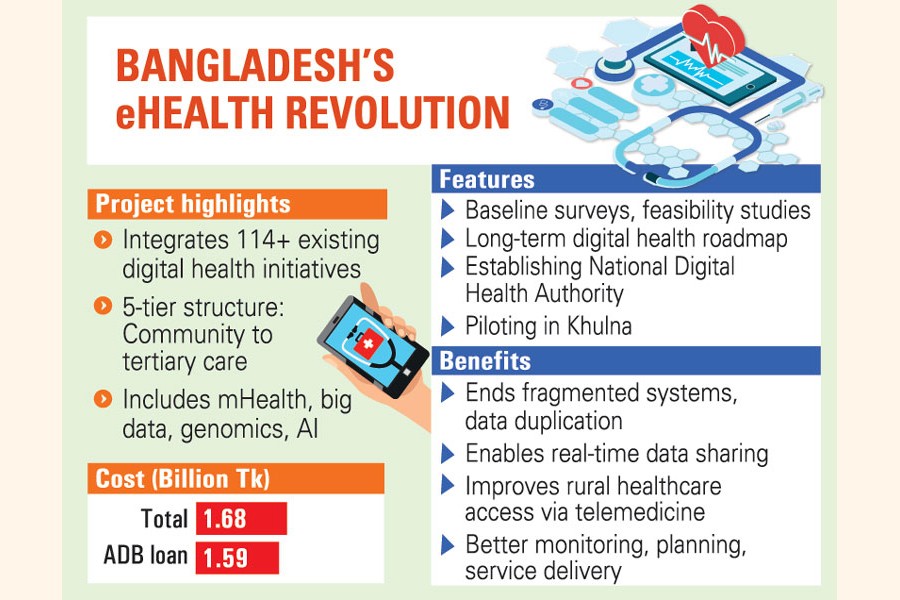
The government is set to roll out a comprehensive digital health system, integrating a broad range of eHealth services, including mobile health (mHealth), while expanding into emerging areas, such as big data analytics, genomics, and artificial intelligence, officials at the Ministry of Health and Family Welfare say.
The proposed system will bring more than 114 existing digital health initiatives under a unified framework, alongside the deployment of new software and hardware, to deliver a five-tier structure of health, nutrition, and population services from community-level facilities to tertiary care.
The health ministry has sent a proposal titled "Project Readiness Activities for Health Sector Digital Transformation Programme" to the Planning Commission, involving an estimated cost of Tk 1.68 billion, including Tk 1.59 billion in loan support from the Asian Development Bank (ADB).
Officials say the project would support baseline surveys, feasibility studies, and the preparation of a long-term roadmap for the health sector's transformation.
It will also facilitate the establishment of a National Digital Health Authority.
As part of the initiative, pilot implementation of the digital health system and a plastic health card programme is planned in the Khulna district, according to Planning Commission officials.
The Socio-Economic Infrastructure Division of the commission recently held a meeting of the Special Project Evaluation Committee (SPEC) to review the proposal.
The committee recommended proceeding with the approval process, subject to the incorporation of several observations.
Officials say the proposed authority would act as a central coordinating body to ensure interoperability among different digital platforms, standardise data management, and strengthen the governance of digital health services.
Bangladesh has already developed a number of standalone digital systems under different directorates, but the lack of integration has limited their effectiveness in delivering seamless services.
Sector insiders say several structural challenges continue to hinder the effectiveness of digital health initiatives, including fragmented systems, duplication of data entry, and the absence of common standards for data sharing.
Inadequate IT infrastructure at peripheral health facilities, particularly in rural areas, along with frequent connectivity disruptions, also constrains the smooth operation of digital platforms, they say.
A shortage of trained human resources and limited digital literacy among frontline health workers further affect the quality and reliability of data input and service delivery.
Concerns over data security, privacy protection, and weak regulatory oversight have also been identified as key risks in scaling up digital health services nationwide.
The new initiative seeks to address these gaps by creating a unified digital ecosystem, enabling real-time data sharing across facilities and improving service delivery, monitoring, and policy planning.
It is also expected to enhance access to healthcare, particularly in rural and underserved areas, through expanded telemedicine services and digital records, officials add.
However, the committee underscored the need for ensuring data security, privacy protection, and adequate institutional capacity before scaling up the system nationwide.
According to meeting sources, the SPEC underscored the need to clearly define the scope and functions of the proposed National Digital Health Authority to avoid overlaps with the existing institutions.
jahid.rn@gmail.com
© 2026 - All Rights with The Financial Express

